
Goat Milk Soap Benefits for Skin: What It Can and Cannot Do
What are the benefits of goat milk soap for skin?
Goat milk soap is a cleansing bar made with goat milk in place of some of the water or in the soap base. The honest, cosmetic benefits are about feel: a creamy, mild lather and skin that feels soft and comfortable after the bath. It does not fix any skin problem, and the evidence for bigger claims is thin.
Key takeaways
- What it is: a bath bar where goat milk is part of the recipe. Milk adds fats and milk sugars to the bar, which change how the lather feels.
- What you can expect: gentle cleansing, a creamy, low-to-moderate lather, and a soft feel on the skin after you dry off. These are cosmetic effects, and results differ from person to person.
- What it cannot do: it is not a drug. If you have a skin condition, see a doctor, not a soap label.
- Evidence: Healthline's review notes that research on the soap itself is limited, and that most claims come from what the ingredient contains, not from studies of the bar.
- Label reading: "goat milk" on a wrapper does not tell you how much milk is in it. Ask the maker, and patch test before regular use.
What is goat milk soap, and how is it made?
Goat milk soap is soap that uses goat milk as part of its recipe. There are two common ways to make it. In cold-process soapmaking, the milk replaces some or all of the water mixed with the alkali, and the oils turn into soap over a chemical reaction called saponification. In melt-and-pour soapmaking, the maker starts with a ready soap base that already contains goat milk, melts it, adds more ingredients, and pours it into moulds.
The result looks similar on the shelf but the process is different. Wikipedia describes melt-and-pour bases as easily re-meltable and often sold in bulk to people who make soap by hand. Healthline explains that in goat milk soap the milk adds fats, which gives a creamier bar.
| Point | Cold-process goat milk soap | Melt-and-pour goat milk soap |
|---|---|---|
| Starting point | Oils, an alkali and milk, mixed from scratch | A ready goat-milk soap base |
| Time to a finished bar | Several weeks of waiting before use | A few hours to set in the mould |
| What the maker controls | Almost everything in the recipe | What goes in after the base is melted |
| Typical feel | Harder bar, lasts longer in the dish | Softer bar, wears faster |
| Fair to say | Neither is automatically better. The skill and the ingredient list matter more than the method. |
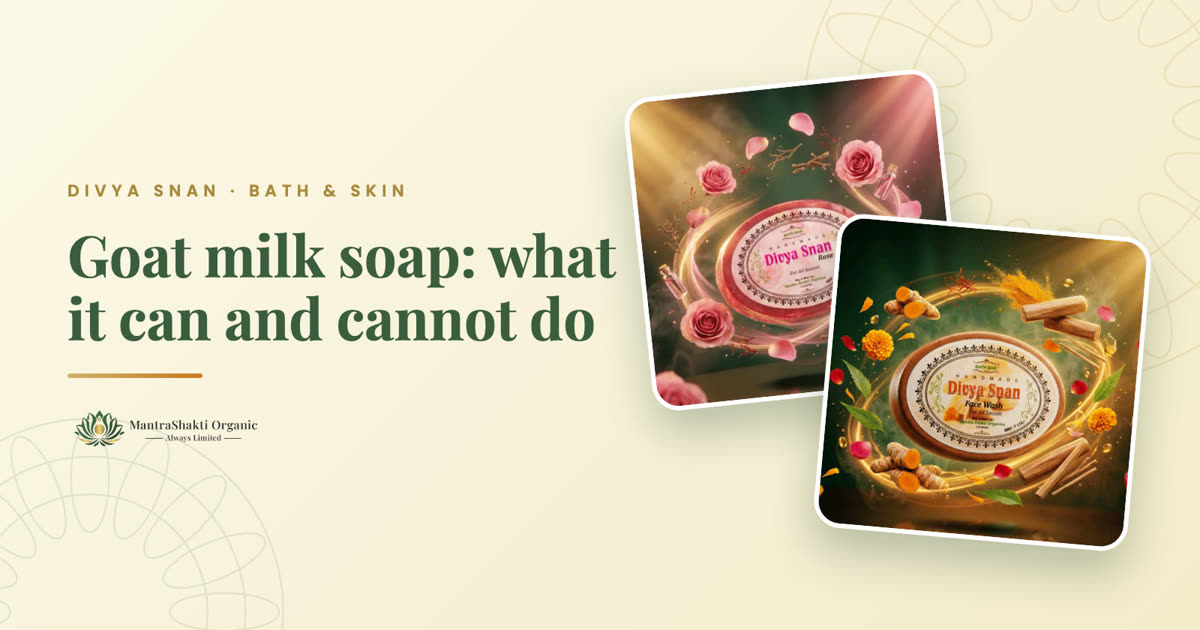
Our Divya Snan bars are handmade melt-and-pour bars. We start from a goat-milk soap base, melt it gently over a water bath, stir in butters and oils (shea, cocoa butter, olive, castor and coconut) and the bar's own botanicals, and pour it into moulds where it sets for several hours.
What does goat milk actually add to a bar of soap?
Goat milk adds fats and milk sugars to the recipe. That is a description of the ingredient, not a promise about your skin. In the bar, those fats make the lather creamier and the bar feel smoother in the hand.
Wikipedia's goat milk article gives a few plain numbers: about 3.8 g of fat per 100 g of goat milk, against 3.6 g in cow's milk, with small fat globules that stay mixed instead of floating to the top. It also notes that goat milk contains lactose at a level similar to cow's milk. In a soap, only a small amount of milk is used, so the numbers for the drink do not carry over to the bar. We mention them so that you know what the ingredient is, not to suggest a result.
Some pages online talk about lactic acid giving a mild exfoliating effect. Healthline says more research is needed on this point. We do not make that claim for our bars. If a seller gives you a specific benefit, ask what it is based on.
Is goat milk soap good for dry skin?
Many people find a creamy bar more comfortable on dry-feeling skin than a harsh, foamy one, but no soap changes dry skin by itself. How you bathe matters at least as much as what soap you use. The American Academy of Dermatology suggests short baths of five to ten minutes in warm water, a gentle cleanser used in small amounts, patting dry, and applying moisturiser while the skin is still damp.
That advice also warns against deodorant soaps for dry skin. A goat milk bar can fit into that routine, because it is mild in feel, but it does not replace a moisturiser. In Lucknow's dry winter and in the hard-water belt across Uttar Pradesh, skin can feel tight after a bath whichever soap you use, so think of the bar as one part of the routine. Our guide on soap for hard water goes into how hard water changes the way a bar lathers and rinses.
One honest caution: some people say a particular goat milk bar left their skin feeling drier or itchier. Skin differs, fragrance differs, and so do recipes. If a bar does not suit you, stop using it.
Can you use goat milk soap on your face?
You can use a mild bar on the face if it is made for it and your skin agrees with it. Many body bars are scented, and fragrance can bother sensitive facial skin, so a face-specific bar or an unscented one is a safer choice. Keep soap away from your eyes and rinse well.
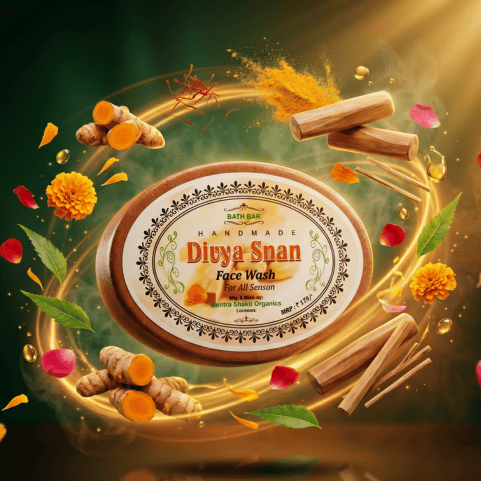
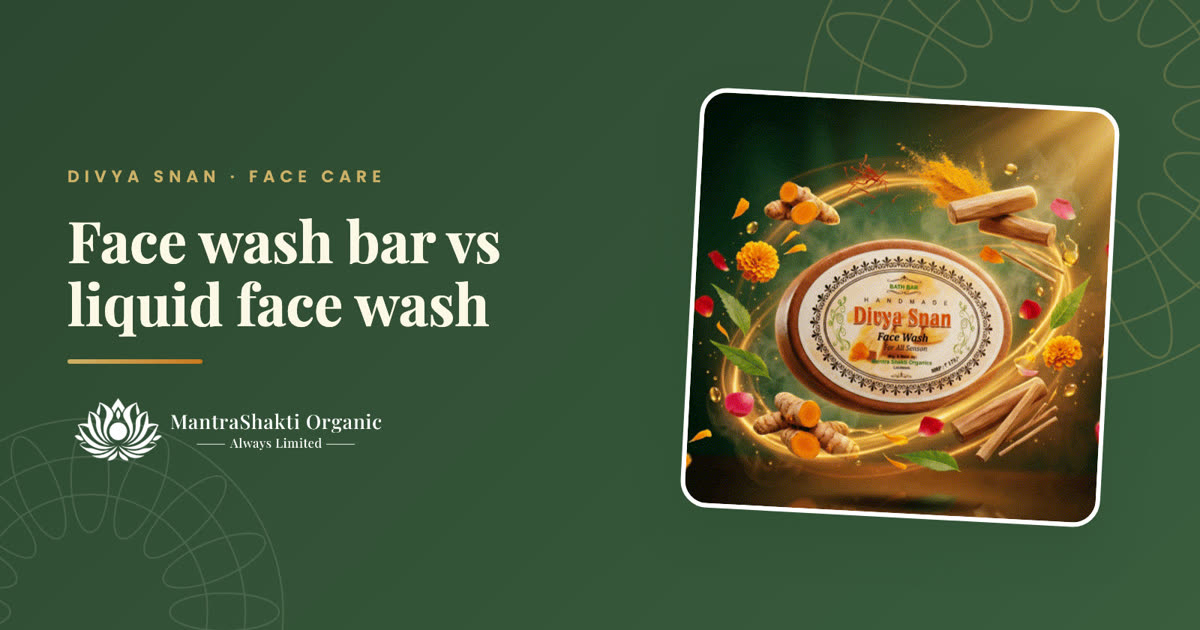
Our Divya Snan Face Wash Bar (₹175) uses the same goat-milk base. It also has ground masoor, moong and urad dal, rice, multani mitti, besan, rose powder, amla powder, haldi, sandalwood powder, aloe vera gel and honey, which is a traditional kitchen-style mix. We list these so you can check for anything you are sensitive to, and we do not give quantities. We make no promise about what it does to skin beyond cleansing. Patch test first.
What should you not expect from goat milk soap?
Do not expect goat milk soap to change your skin's condition. It cleanses. Anything beyond that, such as changing the skin's colour or texture, repairing it or acting as a drug, is outside what a soap can honestly say. In the US, FDA explains the same principle: a product intended only to cleanse is classed as soap, products meant for moisturising or scent are cosmetics, and a product meant to act on a disease is a drug. We follow the same line, which is why our bar pages describe feel and ingredients, not outcomes.
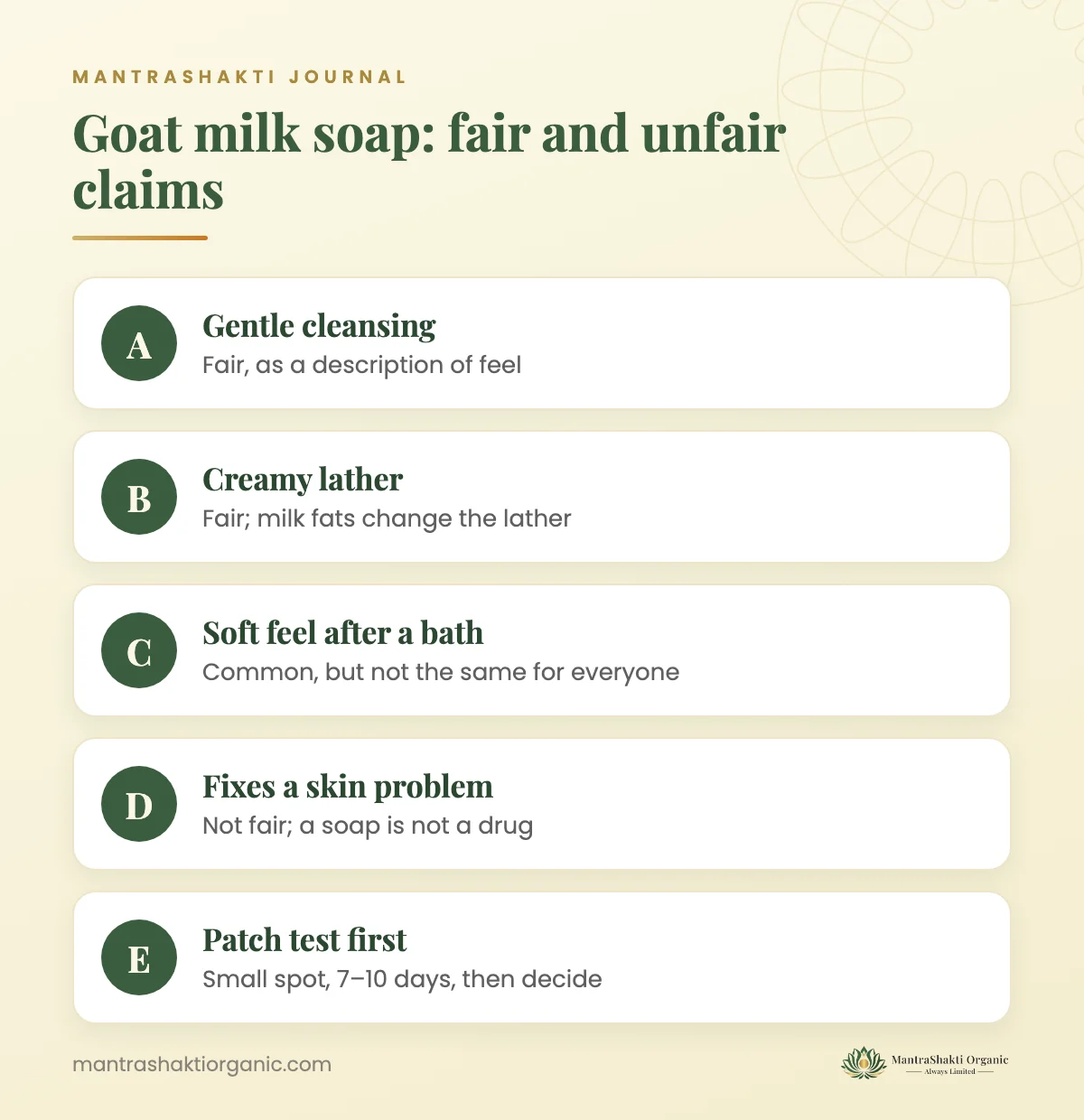
| You may see this claim | What is fair to say |
|---|---|
| "Gentle cleansing" | Fair as a description of feel, but "gentle" depends on your skin and the full recipe |
| "Soft skin after bath" | Fair as a common experience. Not the same for everyone. |
| "Creamy lather" | Fair. Milk fats change lather, and melt-and-pour bars are usually low to moderate lather. |
| "Fixes a skin problem" | Not fair. A soap is not a drug. |
| "Works like an anti-ageing product" | Not fair. No soap can promise that. |
| "Changes skin colour" | Not fair, and not something we say about any bar. |
If you have a skin condition, a known allergy, are pregnant, or take medication, ask a doctor what is suitable for you. For babies and young children, ask a paediatrician before choosing any bar.
How do you read a goat milk soap label?
Read the ingredient list from the top: ingredients are normally listed in order of amount, so a milk ingredient near the bottom means very little milk. Look for the word "goat" or "goat milk" in the list, check what comes with it, and ask the seller about anything unclear.
- Find the milk. Look for "goat milk" or "goat milk base" in the ingredients. A picture of a goat on the wrapper tells you nothing.
- Check the position. Earlier in the list generally means more of it. Many makers do not publish exact amounts, and we do not give percentages either.
- Look for fragrance and colour. If you are sensitive, ask whether the bar has added scent. Some of our bars carry essential oils, and some do not, so check the bar you want.
- Note the weight. Compare price per 100 g, not per bar. Our Divya Snan bars are 100 g at ₹125.
- Ask about the method. Cold-process or melt-and-pour is fine either way, but an honest seller can tell you which.
- Patch test. See the steps below.
Use the finder below to compare our bars and shortlist one by scent, use and budget. It only helps you narrow down our own list.
Interactive · 20 seconds
Find your Divya Snan bar
Three quick taps. We suggest by what you like, not by skin problems.
Try these first
Not sure about a fragrance? Our scent-swap promise covers it: one free swap per bar within 7 days. Patch-test any new soap first.
How do you patch test a new soap?
A patch test checks, on a small area, whether your skin reacts to a product before you use it all over. The American Academy of Dermatology describes a home test: apply a quarter-sized amount to a spot such as the underside of your arm or the bend of your elbow, twice a day, using your normal amount and leaving it on for your normal time. Continue for 7 to 10 days. If you see no redness, itching or swelling, you can start using it.
- Wash the spot with plain water and pat dry.
- Work up a small lather and apply it to the test spot, as you would at bath time.
- Leave it for the usual time, rinse, and pat dry.
- Repeat twice a day for 7 to 10 days.
- If redness, itching or swelling appears, rinse the product off, stop using it, and ask a doctor if it persists.
For a fuller walkthrough, see our patch-test guide for soap, face packs and hair oil.
How do you store and use a soft melt-and-pour bar?
Keep it on a draining dish and let it dry between uses. A softer bar wears faster if it sits in a puddle. Our bars are softer than pressed commercial bars, which is how the method works.
- Use a dish with ridges or holes so water can drain away.
- Keep the bar out of direct streams from the shower.
- Store spare bars in a cool, dry cupboard, in their wrapper.
- In monsoon, see our monsoon storage guide.
- For daily use steps, see how to bathe with a bar soap.
What are common mistakes with goat milk soap?
- Believing a big promise. If a label says it fixes a condition, be careful. A soap cannot promise that.
- Using very hot water. It tends to leave skin feeling tight, whatever the soap.
- Leaving the bar in water. It turns mushy fast.
- Skipping the patch test because it is "milk" and "mild".
- Using a scented body bar on the face when your skin is sensitive.
- Judging after one bath. Give a bar a week or two of normal use, as long as your skin is comfortable.
Where can you buy goat milk soap in India, and how do you choose?
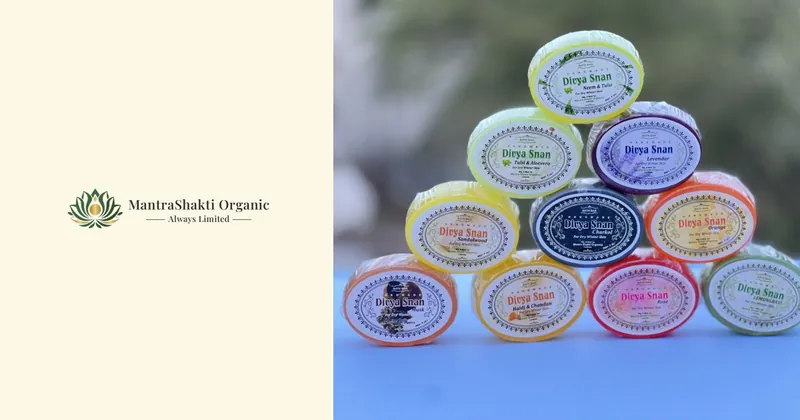
You can buy goat milk soap from small makers, farm brands and large retailers. Choose by the ingredient list, the method, the weight and how honestly the seller talks about it. Our Divya Snan bars start at ₹125 for 100 g. If you want to try several, the Soap Box lets you pick any four for ₹500 with free delivery, and a free Herbal Dant Manjan comes in every box of four. If you dislike a scent, message us within 7 days and we swap it free, one swap per bar. For choosing between scents, read which Divya Snan bar to choose.
Frequently asked questions
What are the benefits of goat milk soap for skin?
The honest benefits are about feel: a creamy, mild lather and skin that feels soft and comfortable after a bath. It is a cosmetic cleansing bar, not a drug, and research on the soap itself is limited.
Is goat milk soap good for dry skin?
Many people find a creamy bar comfortable, but no soap changes dry skin by itself. Short, warm baths, a gentle cleanser and a moisturiser applied on damp skin matter just as much. If a bar leaves you feeling drier, stop using it.
Can I use goat milk soap on my face?
You can if the bar is mild and your skin agrees with it. Body bars are often scented, so a face-specific bar such as our Face Wash Bar, or an unscented one, is safer. Patch test first and keep soap out of your eyes.
What are goat milk soap benefits in Hindi (bakri ke doodh ke sabun ke fayde)?
Bakri ke doodh wale sabun ka asli fayda sirf itna hai ki jhaag malaidaar hota hai aur nahane ke baad twacha naram aur aaramdayak mehsoos ho sakti hai. Yeh dawai nahin hai aur kisi twacha ki samasya ka ilaaj nahin karta. Naya sabun lagane se pehle patch test zaroor karein.
What is a goat milk soap base?
A goat milk soap base is a ready block of soap that already contains goat milk. Makers melt it, add other ingredients, and pour it into moulds. This method is called melt-and-pour, and it is how our Divya Snan bars are made.
Is goat milk soap available in India?
Yes. Small makers, farm brands and larger companies sell it. Check the ingredient list and the method, and compare the price per 100 g before buying.
Is cold-process goat milk soap better than melt-and-pour?
Neither is automatically better. Cold-process bars are usually harder and last longer in the dish, while melt-and-pour bars are softer and wear faster. The ingredients and the maker's care matter more than the method.
Should I patch test goat milk soap?
Yes. Test a small amount on the underside of your arm, twice a day for 7 to 10 days, as the American Academy of Dermatology describes. If you see redness, itching or swelling, stop using it.
Sources and further reading
Shop this guide
Made by hand in small batches in Lucknow.
More from the Journal
18 Sep 2026 · 6 min