
How to Use Amla Powder for Hair: Packs, Rinses and Henna Mixes
How to use amla powder for hair: the short answer
How to use amla powder for hair: stir it with water, curd or a little oil into a thick paste, spread it over your hair in sections, leave it 20 to 40 minutes without letting it dry, then rinse well with lukewarm water and shampoo. A pack once a week or less is a reasonable rhythm.
This guide covers the four mixes people search for (amla with water, curd, coconut oil and henna), quantities by hair length, timings, an amla rinse, storage and the safety checks that matter with henna. We are a family workshop in Lucknow, not a clinic, so it describes how a household hair pack is made and used and goes no further.
Key takeaways
- Amla powder is a pack ingredient, not a dye. On its own it does not colour hair the way henna does.
- Start with about 1 part powder to 1½ parts liquid by volume: roughly 3 to 4 level tablespoons of powder for shoulder-length hair.
- Keep the pack damp and covered for 20 to 40 minutes. A pack that dries hard is the main cause of a gritty rinse.
- For colour you need henna: mix it with a mildly acidic liquid, rest it 8 to 24 hours, then leave it on for several hours. Amla is an optional add-in.
- Patch-test every new paste behind your ear, keep it out of your eyes, and avoid anything sold as “black henna”.
- Mix only what you will use. Curd and oil mixes are for the same day.
What is amla powder, and is the one you cook with the same as the one in a hair pack?
Amla powder is dried, finely ground Indian gooseberry, the sour pale-green fruit sold across north India every winter. For a hair pack you want plain amla powder with nothing else in it, which is what a single-ingredient, food-grade powder is.
The fruit's botanical name is Emblica officinalis (also written Phyllanthus emblica), and it is called aonla or amalaki in some regions. A 2019 review by ICAR researchers lists aonla powder among the fruit's processed products and notes its use in the cosmetic industry for shampoo, hair oil and dyes. A home pack is the household version of that use.
You can judge a powder by eye and nose:
- Texture: fine, dry and free-flowing. Lumps or a hard cake at the bottom usually mean damp has got in.
- Colour: it varies with how the fruit was dried, from tan to olive-brown. A vivid green or dyed look is a reason to ask what else is in the pack.
- Smell: tart and fruity. A musty or stale smell means old or damp-stored powder.
- Label: one ingredient. For hair, skip blends whose contents you cannot read.
Amla with water, curd, coconut oil or henna: which mix should you make?
The four classic mixes differ mainly in texture and in how easily they rinse out. None is more correct than the others, so choose by how you want the paste to spread and how much rinsing you are willing to do.
| Mix | Quantities | Texture and feel | Leave on | Worth knowing |
|---|---|---|---|---|
| Amla + water | 3 level tbsp amla, 4 to 5 tbsp lukewarm water | Thin to medium paste; the plainest version and the easiest to rinse | 20 to 30 minutes | If it leaves your hair feeling rough, move to curd or add a spoon of oil next time |
| Amla + curd (dahi) | 3 tbsp amla, 3 to 4 tbsp thick plain curd, a teaspoon of water only if too stiff | Creamy, spreads evenly, faint sour smell | 20 to 30 minutes | Make it fresh and use it the same day. Skip it if dairy ever irritates your skin |
| Amla + coconut oil (nariyal tel) | 3 tbsp amla, 3 to 4 tbsp water, 1 tbsp warm coconut oil or your usual hair oil | Smooth and slippery, noticeably less gritty | 30 to 40 minutes | Oil means a proper shampoo to rinse. Warm the oil gently, never hot |
| Amla + henna (mehndi) | 1 part amla to about 4 parts henna, by weight | Thick, dark green-brown paste, gritty until rested | 2 to 4 hours, up to about 6 | Needs an overnight rest, a mild acid and a strand test first |
Add one new ingredient at a time. If something stings or itches you then know what caused it, which you cannot say about a mix with five add-ins.
How much amla powder do you need for your hair length?
For shoulder-length hair of ordinary thickness, use 3 to 4 level tablespoons of amla powder and 5 to 6 tablespoons of liquid, then scale up or down. The working ratio is about 1 part powder to 1½ parts liquid by volume.
| Hair length | Amla powder (level tbsp) | Liquid (tbsp) | Paste you will have |
|---|---|---|---|
| Short (chin length or shorter) | 2 | 3 | About 5 tbsp |
| Shoulder length | 3 to 4 | 5 to 6 | About 8 to 10 tbsp |
| Mid-back | 5 to 6 | 8 to 9 | About 13 to 15 tbsp |
| Waist length, or very thick hair | 8 to 10 | 12 to 15 | About 20 to 25 tbsp |
These are starting points, not rules. Powders differ in how thirsty they are, so add the last tablespoon of liquid slowly. The paste is right when it is as thick as hung curd: it should cling to a spoon held sideways for a moment before sliding off, and it should neither run down your wrist nor crumble. Very thick or dense hair needs about one row more than its length suggests; fine, thin hair about one row less.
How do you make and apply an amla hair pack (amla hair mask kaise banaye), step by step?
An amla hair pack, or mask, takes about ten minutes to prepare and 20 to 40 minutes to sit. This is the method for the water, curd and oil versions; the henna version has its own steps further down.
- Get ready. Detangle your hair, pick the mix and quantity from the tables above, and put on an old T-shirt. Amla stains pale fabric.
- Sift the powder through a tea strainer into a glass, ceramic or stainless-steel bowl. Never use an iron kadhai or tawa (see the mistakes section below).
- Add the liquid a spoon at a time, stirring to a smooth paste. If you are using curd or oil, stir that in last.
- Rest the paste for 10 minutes. Amla powder is thirsty and thickens as it sits, so loosen it with a teaspoon of water if it has become stiff.
- Part your hair into four sections and spread the paste with your fingertips or a wide brush, a little at a time, from roots to ends. Press it along the lengths instead of rubbing, which tangles. If your scalp is sensitive, try the first pack on the lengths only.
- Cover your hair with a shower cap or an old cotton scarf. Covering keeps the pack damp and keeps the paste off your shoulders.
- Set a timer for 20 to 40 minutes (shorter for water and curd, longer for the oil mix) and take it off before the paste dries.
- Rinse and shampoo, following the next sections.
Season changes the timing. In the hot weeks before the monsoon an uncovered pack dries quickly, so cover it and judge by touch rather than the clock. In a Lucknow winter the paste stays wet longer, but the water is cold: do the pack in a warm room and rinse with lukewarm water.
What is an amla rinse, and how is it different from a pack?
An amla rinse is a thin, strained amla water poured over hair as a last step, whereas a pack is a thick paste left on before the wash. A rinse is the lighter option if you dislike the mess of a paste.
- Stir 1 level tablespoon of amla powder into 1 cup (about 240 ml) of just-boiled water for short to shoulder-length hair, or 2 to 3 tablespoons into 2 cups for longer hair.
- Cover and steep for 15 to 20 minutes, stirring now and then.
- Strain through a fine cloth or double-layered muslin. A tea strainer lets silt through. Let the liquid cool to lukewarm.
- After shampooing, pour it slowly over your hair, work it through with your fingers, leave it 2 to 3 minutes and finish with a quick pour of plain water.
Make it fresh each time and throw away what is left. The liquid can leave a brownish tinge on white towels and very pale hair, so use an old towel.
How long should amla stay on your hair, and how often can you use it?
Leave a plain, curd or oil-based amla pack on for 20 to 40 minutes and take it off before it dries; a henna mix is a different job and stays on for hours. Once a week is a reasonable ceiling, and every second week is plenty if your hair tends to feel dry.
No research gives a figure showing that a longer time or a more frequent pack is better, so the limits are practical ones. A pack that dries pulls at your hair and is far harder to rinse, so once the paste stops being wet, stop. If your hair feels rough or tight afterwards, shorten the time, add curd or oil next time, or leave a longer gap.
How do you rinse an amla pack out without it feeling gritty?
Rinse before you shampoo: wet your hair fully, work your fingers through each section under lukewarm water until no specks come away, then shampoo once and rinse again. Grit almost always means the pack dried on the hair or was rinsed in a hurry.
- Plain water first. Most of the powder leaves in a long rinse, and shampoo lathered over a lot of paste only makes a gritty foam.
- Use your fingers like a comb, then a wide-tooth comb under the running water.
- Bend forward so the water carries specks off the ends instead of back onto your scalp, and check behind the ears and along the hairline, where powder hides.
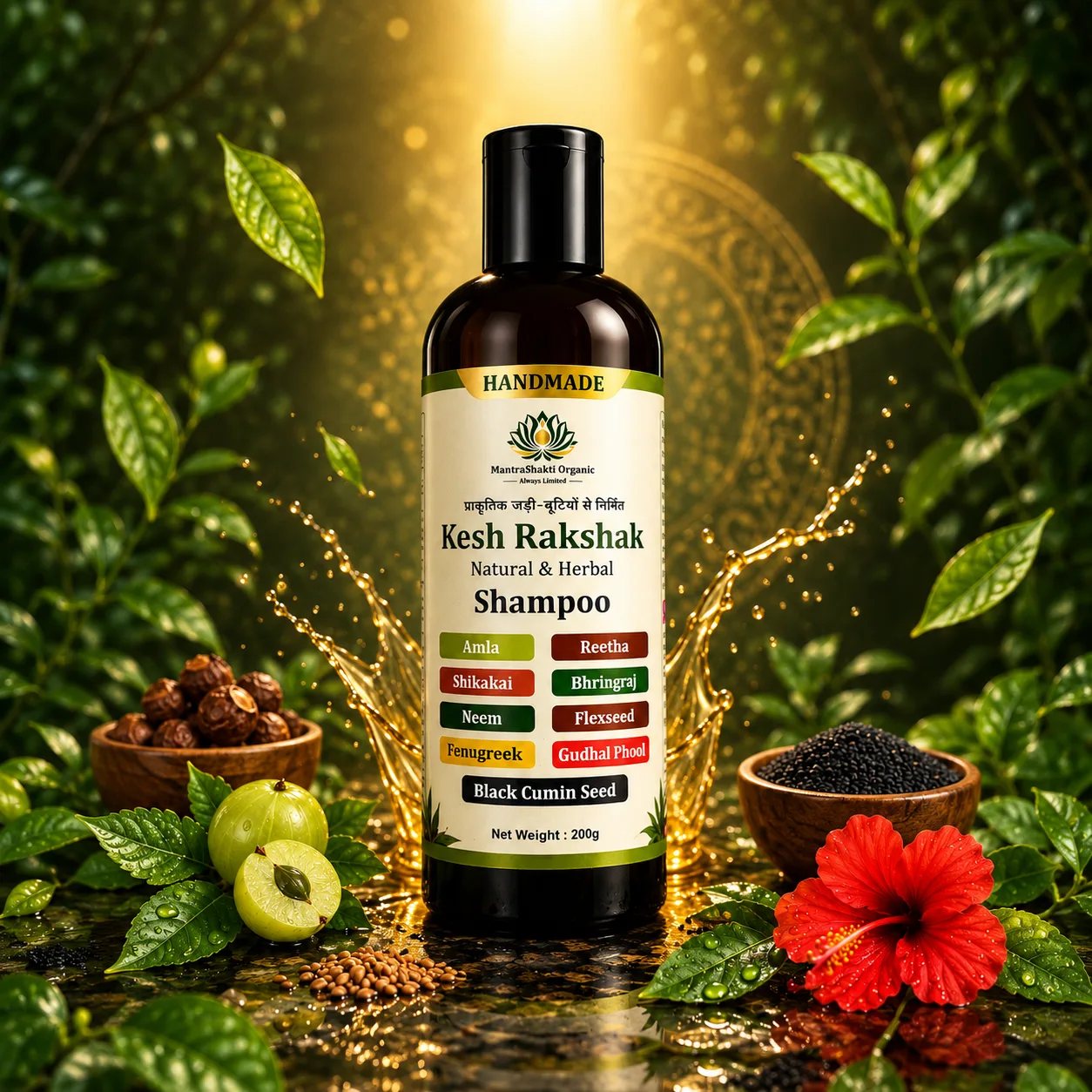
- If the pack had oil in it, a proper shampoo is part of the rinse. A mild herbal shampoo such as our Kesh Rakshak Herbal Shampoo is one option.
- In hard-water areas rinse for longer than feels necessary; our hard-water hair-washing routine explains why.
Does amla powder colour hair?
Not in the way henna does. Amla powder is not a dye, so a plain pack will not change your hair colour in any dependable way, though it can leave a faint brownish tinge on very pale or bleached hair. Do a strand test if you are unsure.
Henna is the real dye. It is the ground leaf of Lawsonia inermis, and when the leaf is mixed into a moist, mildly acidic paste, compounds in it slowly turn into a form that binds to keratin, the material hair and skin are made of, and leaves a stain (Homi Bhabha Centre for Science Education, TIFR). On its own henna gives a red-orange stain that can deepen towards auburn (Journal of Cosmetic Science).
Henna users do add amla to the pot. Amla is a sour fruit, so it can supply some of the mild acid, and some people report a browner, less orange result. We could not find a controlled test of that, so consider it an experiment on a hidden strand and not a promise. Indigo, used with henna for darker tones, is a separate dye with its own method; follow its pack and do not add amla to it unless the pack says to.
How do you mix amla powder with henna to colour hair?
Mix the henna and amla powders dry, add warm water and a mildly acidic liquid to make a paste like thick yoghurt, and let it rest 8 to 24 hours. Then apply it to clean hair, cover it, leave it on for several hours and rinse with plain water.
- Weigh the powders. Use the henna pack's own guidance for how much your hair needs, and add amla at about a quarter of the henna's weight (1 part amla to 4 parts henna) as a cautious starting point. Henna strength varies by crop; a Journal of Cosmetic Science paper puts the dye content of henna leaf at roughly 0.3 to 3 per cent.
- Add the acid. Stir in warm water and a squeeze of lemon juice. The HBCSE note says the dye form is stable in acid and suggests that is why lemon juice has long been added; the journal paper calls a mildly acidic paste, around pH 5.5, ideal.
- Cover and rest. Press cling film onto the surface and leave the bowl at room temperature. According to the same paper the dye-releasing form builds up after about 8 hours, peaks between 12 and 24 hours and then declines, and a paste left about a week at room temperature gives only a weak orange. So mix it the night before, not last week.
- Test a strand. Dab some on a hidden strand at the nape, leave it for your planned time, rinse and judge the colour a day or two later, because it keeps developing.
- Apply to clean, dry hair in sections, wearing gloves. Henna stains skin and nails too, so smear a little oil along your hairline and ears first.
- Cover and keep warm, and leave it for 2 to 4 hours. Longer contact lets more dye in, about 6 hours is generally enough for maximum uptake, and warmth speeds it up (Journal of Cosmetic Science).
- Rinse with plain water only, until it runs clear. Wait a day or two before shampooing, while the colour settles.
Henna is long-lasting. It grows out instead of washing out, so if your hair has been bleached, chemically straightened or coloured, ask your stylist before using it.
Patch test, eyes and “black henna”: what to check first
Test every new paste on your skin before it goes near your scalp, keep all of them out of your eyes, and never use anything sold as “black henna”. These three habits are the basics.
- Patch test. Dab a little of the finished paste behind your ear or on the inner bend of your elbow, let it dry and leave it uncovered. DermNet NZ advises 48 to 72 hours for a hair-dye test. Itching, redness, swelling or blisters mean stop, rinse it off and see a doctor if it does not settle. A clear test is reassuring but does not promise you will never react.
- Eyes. The paste is gritty and irritating. If any gets in, rinse with plenty of clean running water.
- “Black henna”. The US FDA says henna is approved only as a hair dye and not for direct use on skin, and that the ingredient used to blacken henna is often a coal-tar dye containing PPD (para-phenylenediamine), which can cause dangerous skin reactions in some people. Read the ingredient list: plain henna is one ingredient, henna leaf powder. A pack that promises jet black in minutes, or lists any “phenylenediamine”, is a different product with its own instructions.
If you have a skin condition, an allergy, are pregnant or take medication, ask a doctor before using any new hair or scalp product, henna and herbal packs included.
How do you store an amla hair pack, and the powder itself?
Do not store the mixed pack: make what you need and throw away leftover curd or oil mixes the same day. A plain amla-and-water paste can wait an hour or two, covered, or up to a day in the fridge, but fresh is better and anything that smells off goes in the bin.
The dry powder is simple: keep it in a clean, airtight jar in a cool, dry cupboard and always use a dry spoon. Damp is the enemy, and the monsoon is when powders clump, so decant a 100 g pack into a small jar that is shut properly after every use. Our amla buying and storing guide has more on keeping amla dry.
Common mistakes with amla hair packs
- Letting the pack dry on your hair. It tightens and rinses out in gritty flakes. Cover it and stop at the first sign of dryness.
- Mixing in an iron vessel. Amla contains tannins (ICAR review), and tannins meeting iron form a dark compound, the reaction behind old iron-gall ink (SAA Dictionary). Expect a much darker paste that can stain the vessel, your hands and towels. Use glass, ceramic or steel.
- Skipping the patch test, especially with an unlabelled henna pack.
- Using henna straight after mixing. The dye needs hours to release; a quick mix gives a patchy, pale result that gets blamed on the henna.
- Saving a curd pack for tomorrow. It sours, and it is not worth the risk on your scalp.
- Making the paste too stiff. More powder only means a harder rinse. Adjust the liquid, not the powder.
- Rushing the rinse. Specks left at the hairline and behind the ears are the usual cause of an itchy, dull-feeling finish.
About our amla powder
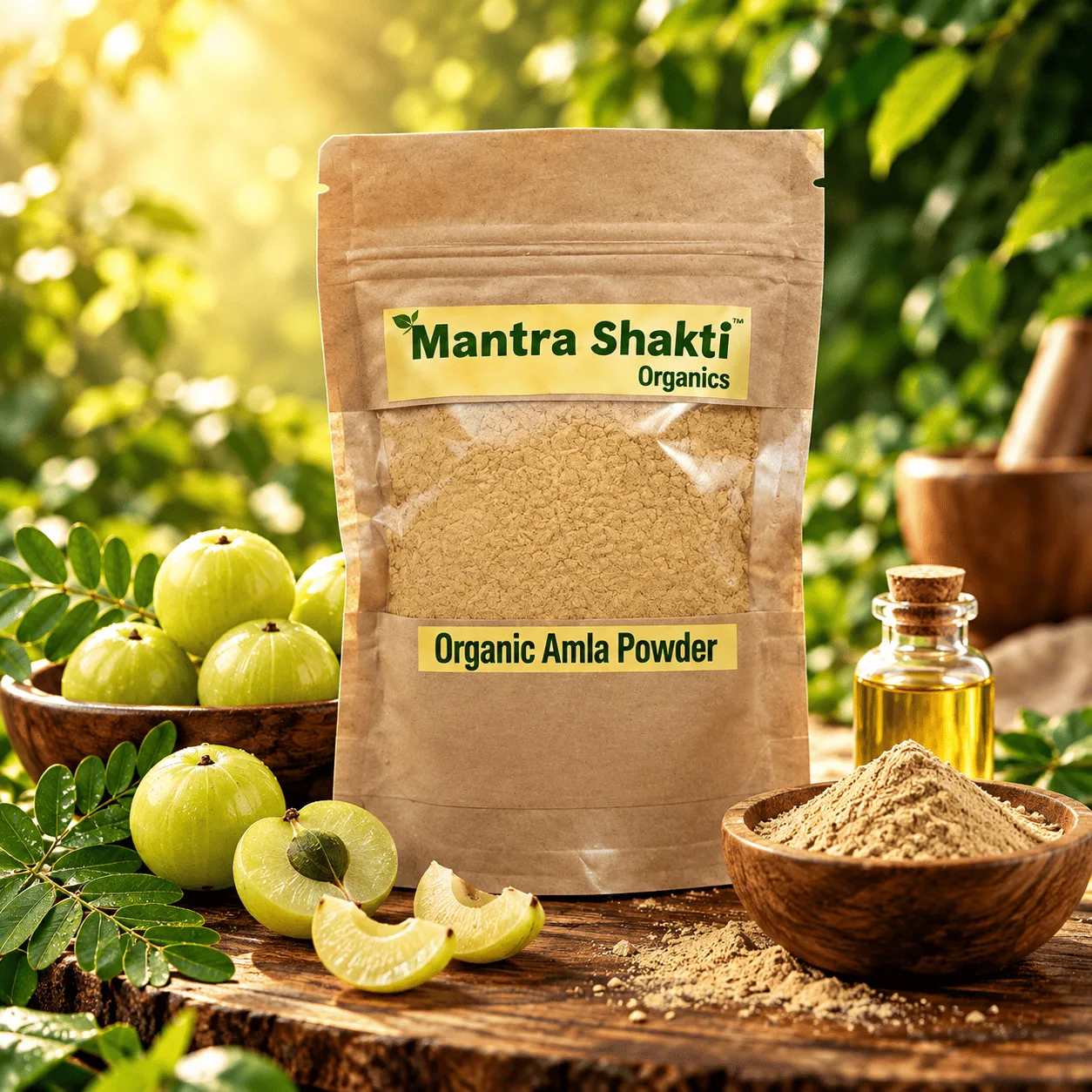
MantraShakti Organic Amla Powder (Indian Gooseberry), 100 g, ₹280, is a single-ingredient powder packed in small lots at our workshop in Chinhat, Lucknow. It is sold as a food ingredient under our FSSAI licence. Using it in a hair pack is a household tradition we describe here, not a use we claim for the product. If hair care is what brought you here, the rest of our range is in Hair Care.
Frequently asked questions
How do you apply amla powder to hair (amla powder baalon mein kaise lagayein)?
For shoulder-length hair, stir 3 to 4 level tablespoons of amla powder into 5 to 6 tablespoons of lukewarm water or thick curd until it is a paste like hung curd. Spread it over clean hair in sections, cover with a shower cap, leave it 20 to 40 minutes without letting it dry, then rinse well and shampoo.
What should you mix amla powder with: water, curd or coconut oil?
All three work; they differ in texture. Water gives the thinnest paste and rinses out most easily. Curd (dahi) is creamier and spreads evenly, but use it the same day. A spoon of coconut oil makes it smoother and less gritty, but needs a proper shampoo to rinse. Add one new ingredient at a time.
How long should an amla hair pack stay on, and how often can I use it?
Twenty to forty minutes, taken off before the pack dries hard. Once a week is a reasonable ceiling, and every second week is plenty if your hair tends to feel dry. No research figure shows that a longer time or a more frequent pack is better.
How do you add amla powder to henna, and how much?
Mix the dry powders first, then add warm water and a mildly acidic liquid such as a little lemon juice, and rest the paste 8 to 24 hours. A cautious starting ratio is 1 part amla to 4 parts henna by weight. Test a hidden strand and judge the colour after a day or two.
Does amla powder colour hair on its own?
Not the way henna does. Amla powder is not a dye, so a plain pack will not change hair colour dependably, though it can leave a faint brownish tinge on very pale or bleached hair. Some henna users add a little amla for a different tone, but we found no controlled test of that.
Can you use the same amla powder you cook with on your hair?
Yes, if it is plain dried amla powder with nothing added: fine, dry and free-flowing, with a tart, fruity smell and no musty note. Ours is a single-ingredient food product, and using it in a hair pack is a household tradition, not a use we claim for it.
How do you wash an amla pack out without it feeling gritty?
Rinse before you shampoo. Work your fingers through each section under lukewarm water until no specks come away, checking behind the ears and along the hairline, then shampoo once and rinse again. Grit usually means the pack dried on the hair, so keep it covered and damp.
Can amla powder be mixed with shikakai or hibiscus powder?
Yes. Amla, shikakai and reetha are a familiar trio in traditional herbal hair washes, and hibiscus (gudhal) powder is another common partner. Mix the powders dry, add liquid as for a normal pack, use the same total quantity, add one new powder at a time and patch-test first.
Sources and further reading
- U.S. FDA: Temporary Tattoos, Henna/Mehndi, and "Black Henna": Fact Sheet — henna approved only as a hair dye; PPD in "black henna"
- DermNet NZ: Allergy to paraphenylenediamine — how to patch-test a hair dye and what a reaction looks like
- Homi Bhabha Centre for Science Education, TIFR: Lawsone — how henna's dye forms under mild acid and binds keratin
- Journal of Cosmetic Science 68(1): Addressing epidemic of para-phenylenediamine sensitization by going forward into the past — henna contact time, mild acidity and resting time
- Indian Journal of Agricultural Sciences (2019): Aonla (Emblica officinalis) in India, a review — aonla's processed products, including powder, and its use in hair products
- Society of American Archivists Dictionary: Iron gall ink — how tannins and iron salts form a dark compound
Written by the MantraShakti Organic workshop team, Chinhat, Lucknow. We make by hand and we are not medical professionals; this guide is general household information, not medical advice.
Shop this guide
Made by hand in small batches in Lucknow.
 44% OFF
More from the Journal
20 Oct 2026 · 18 min