What Is Multani Mitti? Fuller's Earth vs Bentonite, Kaolin, Besan
What is multani mitti?
Multani mitti is the Hindi name for fuller's earth, a fine natural clay that soaks up oil and grease. The name means "clay of Multan". Fuller's earth is defined by what it does, not by one mineral, so its make-up varies by deposit: usually palygorskite (attapulgite) or a calcium-rich smectite clay, a type of bentonite.
Key takeaways
- English name: fuller's earth. A "fuller" was a textile worker who cleaned and thickened wool cloth, which is what the clay was first used for, according to the US Geological Survey (USGS).
- Defined by function: the USGS defines fuller's earth as any clay able to decolourise oil or other liquids without chemical processing. In practice it is usually palygorskite or a calcium-rich smectite.
- No single recipe: a 1961 analysis of the Khairpur clay known as multani mitti identified palygorskite, while an older analysis of Jodhpur clay shows a different make-up. Colour, feel and behaviour differ by deposit.
- Versus the others: bentonite is a smectite clay and its sodium type swells strongly in water; kaolin is a white, non-swelling clay; besan is chickpea flour, a food and not a clay.
- Where it comes from: the Indian Bureau of Mines records about 74% of India's fuller's earth resources in Rajasthan. The name comes from Multan, now in Pakistan.
- Face packs are a small use. Of the industrial use the Bureau could record in 2014–15, about 91% went to vanaspati makers. Cosmetic multani mitti is for external use only and is never to be eaten.
What is multani mitti called in English (english mein kya kahate hain)?
In English, multani mitti is called fuller's earth. "Multani mitti" means clay of Multan, the city in present-day Pakistan that gave the clay its name. "Fuller's earth" comes from fullers, the textile workers who worked the clay into wool cloth so that it would absorb grease and oil. Both names describe the same job: a clay that lifts oil and dirt.
That job explains why one clay turns up in so many places. A short paper in the Journal of the Pakistan Association of Dermatologists notes that fuller's earth was used to clean wool in Europe, is used today to decolourise oils, in drilling mud and as an absorbent, and has been used for centuries across South Asia as a cleanser for skin and hair. It adds that the first written record of its use in Asian homes came only under colonial rule, long after households had been using it.
What is multani mitti made of?
Multani mitti is made of clay minerals, which are hydrous aluminium silicates (compounds of aluminium, silicon, oxygen and water), plus small amounts of other minerals such as quartz. Two clay families account for most fuller's earth: palygorskite (attapulgite), whose crystals grow as thin laths, and calcium smectite (calcium montmorillonite), which has a layered, sheet-like structure.
No single formula applies, because the make-up depends on the deposit. The table shows two published analyses of clay from two places. They are old and they are single samples, so read them as a picture of variation, not as a specification for any pack you can buy.
| Component | Khairpur clay, "better known as multani mitti" (1961 study) | Jodhpur (Kapurdi) clay (reported in 1946, cited in a 2019 paper) |
|---|---|---|
| Silica (SiO2) | 51.50 | 47 |
| Alumina (Al2O3) | 19.06 | 23.3 |
| Iron oxide (Fe2O3) | 7.31 | 6.95 |
| Lime (CaO) | 0.39 | 2.9 |
| Magnesia (MgO) | 2.51 | traces |
| Other oxides and loss on heating (mostly water) | Titanium oxide 1.19, potassium oxide 2.60, sodium oxide 0.99, loss on ignition 8.90 | Not reported in the source |
| Main clay mineral identified | Palygorskite (attapulgite), with quartz, kaolin and iron oxide (limonite) as fine-grained impurities | Not stated in the source |
Look at the lime: 0.39 per cent in one sample and 2.9 per cent in the other. Even the 1961 researchers could not give exact proportions for the minerals, though they estimated free quartz at about 2.75 per cent in their sample. The dermatology paper notes that composition may vary with the area the clay is mined from, and that is the honest answer to "what is it made of": a natural clay with natural impurities, and a make-up that changes from deposit to deposit.
How is multani mitti made (kaise banti hai)?
It is not made from other ingredients. It is a naturally occurring clay that is dug out of deposits and then typically dried and ground into powder, and how finely it is milled and sieved decides how smooth the powder feels. "Activated" fuller's earth is a different, industrial product, made by processing the clay with acid to improve how well it decolourises oils, so a powder sold as "activated" is not plain multani mitti.
Where does multani mitti come from (kahan se aati hai)?
The name points to Multan, but in India the clay is dug mainly in Rajasthan and a handful of other states. The Indian Bureau of Mines put India's recorded fuller's earth resources at about 256.7 million tonnes as of 1 April 2010, with about 74 per cent of the total in Rajasthan and the rest in Arunachal Pradesh, Assam, Karnataka, Madhya Pradesh and Telangana. Fuller's earth is a "minor mineral" under India's Mines and Minerals Act, and production in 2013–14 was reported from Andhra Pradesh (before it was split), Madhya Pradesh, Rajasthan and Karnataka.
Older references fill in the picture. The 1961 paper from the Pakistan Council of Scientific and Industrial Research describes a vast clay deposit at Khairpur, in Pakistan, and notes that it is better known as multani mitti. The earliest Indian reference cited by the dermatology paper is to the Kapurdi clay near Jodhpur. A pack of powder does not carry a mine's name, so where a particular powder was dug is a fair question to put to any seller. It is also one reason two packs of "multani mitti" can look, smell and feel different.
Is multani mitti the same as bentonite clay?
Related, but not identical. Bentonite is a clay made mostly of smectite minerals, usually montmorillonite. Its sodium type swells strongly in water, while its calcium type swells little and is often what is sold as fuller's earth. Fuller's earth can also be palygorskite, which is not a smectite at all, as in the Khairpur clay analysed in 1961. So some multani mitti is a calcium bentonite, and some is not a bentonite.
The Indian Bureau of Mines puts the practical difference in one line: bentonite is a swelling-type clay and fuller's earth is a non-swelling type, a difference it links to sodium in one and calcium in the other. It also notes that calcium bentonite can be converted to the sodium type by ion exchange or acid activation. That is a useful simplification, and it is only that, because the make-up varies as shown above.
Multani mitti vs bentonite, kaolin, besan and sandalwood powder: how do they compare?
They are different kinds of material. Three are clays with different mineral make-ups, and two are plant products that are not clays at all. This table sets out the differences.
| Material | What it is | Main mineral or source | In water | Where it is used |
|---|---|---|---|---|
| Multani mitti (fuller's earth) | A natural clay defined by its ability to absorb oil and grease and decolourise liquids | Palygorskite (attapulgite) or calcium smectite, plus minor impurities; varies by deposit | Breaks up in water without swelling into a gel | Industry: absorbing oil, grease and pet waste, decolourising oils. Households: cleansing skin and hair, plastering mud walls |
| Bentonite | A clay rock made mostly of smectite minerals | Montmorillonite, sodium or calcium type | Sodium type swells strongly; calcium type swells little | Drilling mud, binding foundry sand, pet litter; also a filler in cosmetics and soaps |
| Kaolin (china clay) | A white clay | Kaolinite, Al2Si2O5(OH)4 | Does not swell | Paper coating, ceramics, paint and rubber filler; also used in some cosmetics and soaps |
| Besan | Flour from dehusked chickpeas (Bengal gram) | Plant material, not a mineral | Makes a batter; can go stale | Cooking, and traditional ubtan-style pastes |
| Sandalwood (chandan) powder | Ground heartwood of the sandalwood tree | Plant material with its own scent | Makes a paste; does not behave like a clay | Traditional pastes and fragrance |
Multani mitti vs kaolin. Kaolin is made of one mineral, kaolinite, and it does not swell in water. It is usually whiter and is used mainly in paper and ceramics. Multani mitti is a fuller's earth, and its minerals are different, so a recipe or a time written for one is not automatically right for the other.
Multani mitti vs besan. Besan is a food, ground chickpea flour, and it has the grain, smell and shelf life of a flour. Multani mitti is a mineral clay, very fine and smooth. Traditional ubtan-style pastes in many households use both, for different textures, but they are not swaps for each other.
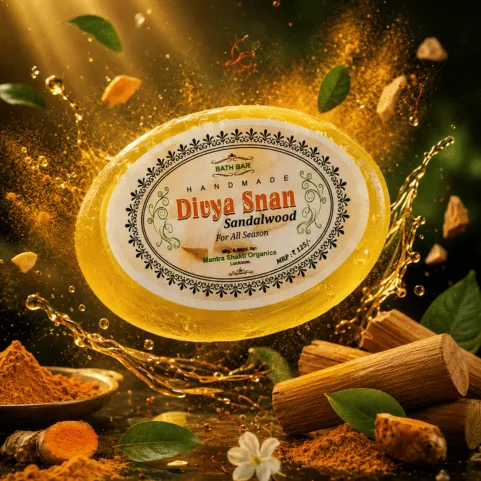
Multani mitti vs sandalwood powder. Sandalwood powder is plant material valued for its scent, while multani mitti is mineral clay with no scent of its own. If it is the scent of chandan you like, our Divya Snan Sandalwood Bath Bar is the place to look, not a clay.
What is multani mitti used for?
Most fuller's earth never reaches a face. The USGS reports that the major use of fuller's earth is as absorbent granules for oil, grease and pet waste, and as a carrier for pesticides and fertilisers; the granules are made by heating the clay at 400–1,000 °C and crushing it. In India, the Bureau of Mines records the vanaspati (hydrogenated cooking fat) industry as the largest consumer of fuller's earth, where it is used to decolourise oils, and it notes that a sizeable quantity is also used outside industry for plastering mud walls and washing hair, a use that is not counted in its figures.
On the face, multani mitti is a traditional cleansing clay. Its cosmetic function is physical: as a paste dries it absorbs surface oil and lifts dirt. The dermatology paper cited here is blunt that there is no scientific evidence of therapeutic effects, and we make none. The directions for our own pack are on the Multani Mitti Face Cleanser product page.
Is there a "food-grade" and a "cosmetic" multani mitti?
Multani mitti sold for face packs is a cosmetic ingredient, for external use only. Fuller's earth does have a link to food, but an industrial one: it is used to decolourise and filter cooking oils and fats, and that is a processing step in a factory, not a reason to eat a clay powder.
Words such as "food grade", "cosmetic grade" and "industrial grade" can mean different things from one seller to another, and none of them turns a clay into a food. Read the pack for what the product is sold as and how it is meant to be used. Do not eat multani mitti. If you or someone in your family feels a strong urge to eat clay or soil, mention it to a doctor.
Does multani mitti expire (expire hoti hai kya)?
A clay mineral does not rot the way food does, but a powder can take in damp, clump and pick up mould or dirt. What matters is how it is packed and stored, so follow the date marked on the pack. Our own pack carries a batch number and a use-before date.
- Keep it dry. Close the pack tightly after use, or move the powder to a clean, dry container with a lid, and keep it off a steamy bathroom shelf.
- Scoop with a dry, clean spoon. Wet fingers and damp spoons bring moisture and microbes into the powder.
- Throw it away if it smells musty, shows dark or fuzzy spots, or has set into hard, damp lumps.
How can you spot a poor-quality multani mitti powder?
A good powder is fine, smooth, evenly coloured and free of grit and strong smells. You can check most of that at home in five minutes with the steps below. They use the same particle-size physics that soil scientists rely on, so they tell you about sand and grit, not about every possible fault.
- Read the pack first. Look for what the product is, a batch number, a date, and who packed it. A loose, unlabelled powder tells you nothing about what is in it. Be wary of anything sold as "activated": in the clay trade that means processed with acid for industrial use.
- Look at it in daylight. Natural colour varies with the deposit: the 1961 Khairpur specimen was yellow, and fuller's earth is reported grey when quarried. So colour alone proves nothing, but dark specks, stones, plant bits, or a bright, unnatural tint are reasons to ask questions.
- Smell it dry. Good powder smells of little, or faintly of earth. Perfume, a chemical smell or a musty smell are all reasons not to use it.
- Rub a pinch between your fingers. It should feel smooth and silky. Colorado State University Extension notes that sand feels gritty and clay feels sticky, so a gritty feel means large particles.
- Do the glass test. Stir a level teaspoon into a clear glass of water, then leave it alone for a minute or two. The same extension guide notes that sand settles in about a minute, while clay stays suspended for a day or more. A visible layer of coarse grit on the bottom within a minute means sand. A thin film of fine sediment is normal in a natural mineral. If the powder swells into a thick gel instead of dispersing, it behaves like a sodium bentonite, which is a different clay.
- Check the paste. Mixed with water, it should spread evenly with no lumps or grit. If it feels gritty on your skin, rinse it off.
What mistakes do people make when buying multani mitti?
- Buying loose, unlabelled powder. With no batch, date or packer, you cannot ask a question of anyone.
- Judging by colour. A uniformly pale powder is not automatically better, and a yellow or grey one is not automatically worse; natural colour follows the deposit.
- Using fuller's earth sold for pets or workshops. Absorbent granules are made by heating the clay and crushing it, for a different job. They are not a face-pack powder.
- Assuming "food grade" means edible. It does not, and multani mitti is never to be eaten.
- Swapping clays in a recipe. A sodium bentonite swells into a thick gel and needs far less liquid than multani mitti, so a recipe for one can ruin the other.
- Storing it in a damp bathroom. Damp is what spoils a clay powder.
How do we pack our multani mitti?
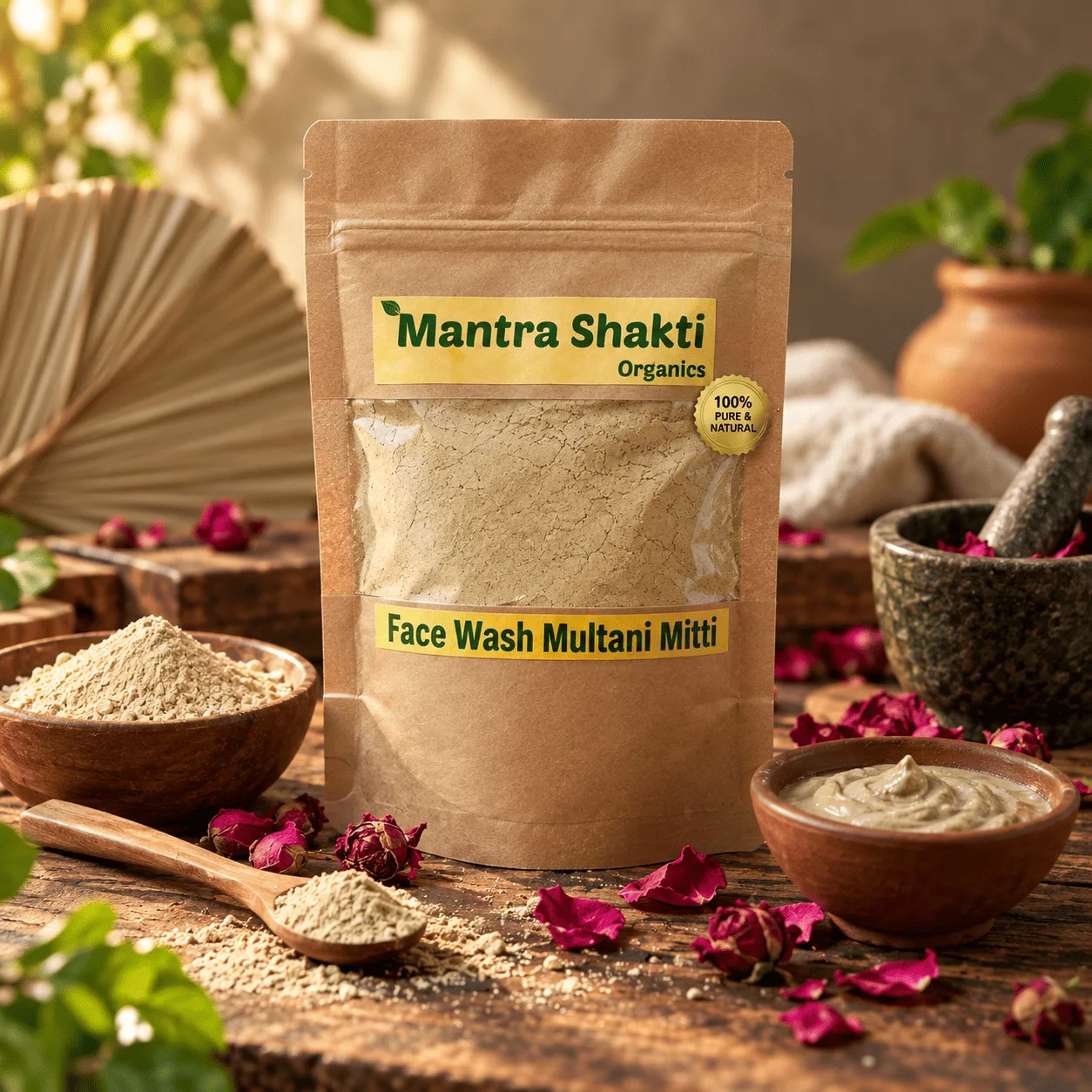
Our Multani Mitti Face Cleanser (100 g, ₹199) is a single-ingredient multani mitti (fuller's earth) powder for external use. Like everything we sell, it comes from the family workshop in Chinhat, Lucknow, in small batches, and each pack is marked with a batch number and a use-before date, which is the first thing to look for on any clay powder. If you would rather have a bar for the face, our guide to choosing a Divya Snan bar explains the range. Patch-test any new product before it goes on your face, and if you have a skin condition, an allergy, are pregnant or take medication, ask a doctor first.
Frequently asked questions
What is multani mitti called in English?
Multani mitti is called fuller's earth in English. The Hindi name means clay of Multan, and the English name comes from fullers, the textile workers who used the clay to clean and thicken wool. The US Geological Survey defines fuller's earth as any clay that can decolourise oil or other liquids without chemical processing.
What is multani mitti made of?
It is made of clay minerals, which are hydrous aluminium silicates, usually palygorskite (attapulgite) or calcium smectite (calcium montmorillonite), plus small amounts of natural impurities such as quartz. The exact make-up depends on the deposit. A 1961 analysis of the Khairpur clay found palygorskite with quartz, kaolin and iron oxide impurities.
Where does multani mitti come from (kahan se aati hai)?
The name comes from Multan, now in Pakistan, but the clay is dug from deposits in many places. In India the Bureau of Mines records about 74% of fuller's earth resources in Rajasthan, with the rest in Arunachal Pradesh, Assam, Karnataka, Madhya Pradesh and Telangana. Where a particular packet was dug depends on the seller's supplier.
Is multani mitti the same as bentonite clay?
Related, but not identical. Bentonite is a clay made mostly of smectite minerals; the sodium type swells strongly in water and the calcium type swells little. Fuller's earth is often a calcium bentonite, but it can also be palygorskite, which is not a bentonite. Multani mitti typically swells little in water, unlike sodium bentonite.
Multani mitti vs kaolin clay: what is the difference?
Kaolin is a white clay made of the mineral kaolinite, which does not swell in water and is used mostly in paper and ceramics. Multani mitti is a fuller's earth, usually palygorskite or calcium smectite, defined by how well it absorbs oil and grease. They are different minerals, so a recipe written for one is not a recipe for the other.
Multani mitti vs besan: which is used for what?
Multani mitti is a mineral clay, while besan is chickpea flour, a food made from dehusked Bengal gram. Both appear in traditional ubtan-style pastes, but they are different materials: the clay is very fine and smooth, and besan is a flour that can go stale or attract insects if stored badly. They are not swaps for each other.
Does multani mitti expire (multani mitti expire hoti hai kya)?
A clay mineral does not rot like food, but the powder can take in damp, clump and pick up mould or dirt. Follow the date on the pack, keep it dry in a closed container, scoop with a dry spoon, and throw it away if it smells musty or shows dark or fuzzy spots.
Can multani mitti be eaten?
No. Multani mitti sold for the face is a cosmetic for external use only. Fuller's earth is used in industry to decolourise cooking oils, but that is a factory step and does not make a face-pack powder a food. If anyone feels a strong urge to eat clay or soil, mention it to a doctor.
Sources and further reading
We opened and read each of these pages. The two analysis tables report numbers exactly as the papers give them.
- US Geological Survey: Bentonite and Fuller's Earth Resources of the United States (Professional Paper 1522, Hosterman and Patterson, 1992) – definitions of bentonite and fuller's earth, smectite and palygorskite, swelling versus non-swelling, uses, activated clay
- Indian Bureau of Mines: Indian Minerals Yearbook 2015, Part III, Fuller's Earth – Indian resources and the Rajasthan share, production by state, uses and consumption, and the note on household use
- Khan AH: A Study of Multani Mitti, Pakistan Journal of Scientific and Industrial Research, 1961 – chemical and X-ray analysis of the Khairpur clay known as multani mitti
- Kumar P: Multani Mitti: Is it more than a placebo? Journal of the Pakistan Association of Dermatologists, 2019 – etymology, the Jodhpur (Kapurdi) analysis, uses, and the lack of scientific evidence for therapeutic effects
- Colorado State University Extension: Estimating Soil Texture: Sandy, Loamy, or Clayey – how sand and clay feel, and how fast each settles in a jar of water
- Wikipedia: Kaolinite – formula, non-swelling behaviour and common uses of kaolin
Written by the MantraShakti Organic workshop team, Chinhat, Lucknow. We are a family workshop, not geologists, so the mineralogy here comes from the sources above. This is general information, not medical advice.
Shop this guide
Made by hand in small batches in Lucknow.
More from the Journal
10 Nov 2026 · 12 min
Soap pH Level Explained: Why Soap Is Alkaline and What pH 5.5 Means
Read more →
12 Nov 2026 · 15 min
Bath Routine Steps: How to Bathe With Bar Soap (Nahane Ka Sahi Tarika)
Read more →