
Soap pH Level Explained: Why Soap Is Alkaline and What pH 5.5 Means
What is the pH of bath soap?
Most bath soap is alkaline. Soap pH is typically 8.5 to 11, and in a 2014 study of 64 bathing soaps bought in India, 53 read between about 9 and 10 in solution. That follows from how soap is made, with a strong alkali; bars sold at pH 5.5 are generally built on synthetic detergents instead.
Skin is quoted at roughly pH 4 to 6, depending on the source, so the usual figures for bar soap sit well above it. That gap is a measured fact about products dissolved in water. None of the sources cited here measured an effect on skin, and this article does not claim one. It explains what the numbers mean, why soap is alkaline, how soap differs from syndet bars, what the BIS standards say, and how to test a bar at home.
Key takeaways
- pH runs from 0 to 14, with 7 neutral. The scale is logarithmic: each whole unit is a tenfold change in hydrogen-ion concentration.
- Soap is typically pH 8.5 to 11.0 (2022 review). In a 2014 Indian study of 64 soaps, 53 read 9.01 to 10, and only 2 were in the skin pH range quoted as 5.4 to 5.9.
- Soap is alkaline because it is made by reacting fat with a strong alkali. Bars at pH 5.5 are generally syndet bars, quoted at 5.5 to 7.0.
- The BIS toilet soap and bathing bar standards set no pH value. They cap free alkali at 0.05% (caustic) and 1.0% (carbonated).
- A pH number describes the product in water, not an outcome on skin. No source cited here says which pH is good for skin.
- We have not published a pH reading for any Divya Snan bar. Strips give an approximate home reading.
What is pH, and what do the numbers mean?
pH is a number from 0 to 14 that says how acidic or alkaline (basic) a watery solution is: 7 is neutral, lower numbers are acidic and higher numbers are alkaline. The scale is logarithmic. The US Environmental Protection Agency's CADDIS page on pH explains that a one-unit change is a tenfold change in hydrogen-ion concentration. So pH 9.5 and pH 5.5, four units apart, differ 10,000-fold in hydrogen-ion concentration. The scale squeezes large differences into small numbers; it is a measure of chemistry, not of harm.
| What | pH quoted | Source |
|---|---|---|
| Distilled water, as measured in the 2014 Indian study | 6.24 to 6.88 | Tarun et al., 2014 |
| Drinking water within the Indian standard | 6.5 to 8.5 | BIS IS 10500:2012 |
| Normal skin | 5.4 to 5.9 (Indian study); 4.0 to 6.0 (2022 review) | Tarun et al., 2014; Mijaljica et al., 2022 |
| Syndet cleansers | 5.5 to 7.0; a newer class at 5.0 to 5.5 | Mijaljica et al., 2022 |
| Soap | Typically 8.5 to 11.0; 53 of 64 Indian bars read 9.01 to 10 | Mijaljica et al., 2022; Tarun et al., 2014 |
Two cautions on reading the table. The sources disagree a little on skin, which is why a range is given, and the soap figures describe the product dissolved in water. The 2014 study dissolved 150 mg of soap in 15 ml of distilled water, a 1% solution, left it undisturbed for 24 hours and read it on a calibrated pH meter. The study did not measure anything on skin.
Why is soap alkaline?
Soap is alkaline because of how it is made. Saponification reacts fats or oils with a strong alkali, sodium hydroxide or potassium hydroxide, and produces soap, which is the salt of a fatty acid, plus glycerine. The 2022 review in Molecules says this process always results in a highly alkaline product.
In chemistry terms, the fatty acid is a weak acid and its partner in the salt comes from a strong alkali, so the salt makes water alkaline when it dissolves. That is why a bar with no free alkali left still reads alkaline in water. It also explains why a bar that reads pH 5.5 is generally a different kind of cleanser, not a soap with one ingredient adjusted.
Soap, syndet and bathing bar: what is the difference?
A soap is made by saponification and reads alkaline; a syndet is a cleanser built on synthetic surfactants and reads near neutral or slightly acidic; and the BIS bathing bar sits between them, combining soap with synthetic surfactants. The names describe the chemistry, and none of them is a quality grade.
| Kind | What it is | pH reported | What BIS says |
|---|---|---|---|
| Soap (toilet soap) | Salt of fatty acids, made by saponification | Typically 8.5 to 11.0 | IS 2888 sets three grades by TFM; no pH value; free caustic alkali 0.05% maximum and free carbonated alkali 1.0% maximum |
| Syndet | Cleanser built on synthetic surfactants, with no soap as its base | 5.5 to 7.0; newer class 5.0 to 5.5 | Not named in IS 2888 or IS 13498 |
| Bathing bar | Soap of fatty acids plus synthetic surface-active agents | Not specified by the standard; depends on the recipe | IS 13498 sets no pH value; the same free alkali limits apply |
Our guide to choosing a Divya Snan bar covers scent and format, which is how we suggest choosing between bars.
What does "pH 5.5" on a cleanser mean, and is a pH 5.5 bar a soap?
"pH 5.5" says that the product, dissolved in water, reads about 5.5, close to the figures quoted for skin. Chemically, a bar at that reading is not mainly soap, because soap is always highly alkaline; the 2022 review quotes syndets at 5.5 to 7.0.
The label is a statement about chemistry and about how the maker measured it. It does not promise any effect on skin, and the figure changes with the dilution, the water and the instrument, which is why a fair comparison needs the same method for every bar. If a pack gives a pH, look for how it was measured.
Soap ph level kitna hona chahiye? Which pH is good for skin?
No source cited here sets a correct pH for soap, and none says which pH is good for skin. True soap reads alkaline because of its chemistry, and syndets read near neutral or slightly acidic. Which you prefer comes down to scent, feel, price, the water where you live and how your own skin responds.
What the 2014 Indian study did say is that the soaps and shampoos commonly used sit outside the pH range of normal skin and hair, and its authors hoped manufacturers would consider pH. That is an observation about products in solution. The study did not test any effect on skin, and it does not show that one pH is better or worse for anyone. If you have sensitive skin or a skin condition, ask a dermatologist, not a pH chart.
Hinglish mein: "soap ka pH kitna hona chahiye" ka koi ek sahi jawab nahin hai. Asli sabun ka pH chemistry ki wajah se 8.5 se 11 ke beech aata hai, aur 5.5 wale bar aam taur par syndet hote hain. Kisi bhi sabun ke liye "pH list" par bharosa karne se pehle dekhein ki pH kaise naapa gaya.
What do the BIS soap standards say about pH?
Neither IS 2888 (toilet soap) nor IS 13498 (bathing bar) lists a pH value among its requirements. Both limit free alkali instead: free caustic alkali, which is leftover alkali expressed as sodium hydroxide, at 0.05% by mass at most, and free carbonated alkali at 1.0% at most.
The standards control leftover alkali, not the pH of the lather, so they do not stop a bar from reading around pH 9 or 10 in water, as most of the bars in the 2014 study did. They set other limits too, such as minimum TFM and minimum lather. Neither standard gives soap a pH pass mark, so a "pH list" for soaps does not rest on an official BIS grade in these two documents.
How can you check a soap's pH at home?
Dissolve a small amount of the bar in distilled water and dip a pH strip in the clear liquid. The result is approximate, because strips are read by eye in steps of about half a unit to one unit, but it is enough to show whether a bar reads alkaline or near neutral.
- Get suitable strips. Buy pH indicator strips that cover at least pH 4 to 11, or full-range universal paper, check the expiry date, and keep the colour chart from the pack.
- Use distilled water. Tap water that meets the Indian drinking-water standard IS 10500 can be anywhere from 6.5 to 8.5, enough to move a reading. Even distilled water measured 6.24 to 6.88 in the 2014 study, so dip a strip in your water first as a blank.
- Make a weak solution. The study used a 1% solution. At home, shave a thin piece of about 1 g into 100 ml of water. If you have no scale, use the same small amount of shavings and the same volume of water for every bar you compare.
- Stir gently and wait. Stir without making lather and let the jar stand. The study left its solutions for 24 hours; a longer wait at home, with an occasional stir, is likely to give a steadier reading than a quick swirl. Test the clear liquid, not the foam.
- Dip, wait and read. Dip a fresh strip for the time printed on the pack, take it out and compare it with the colour chart in daylight straight away.
- Repeat and record. Test a second strip and note the amount of soap, the volume of water and the date, so you can compare bars fairly. Small differences between strips are normal.
Strips are for the solution, not for your skin, and a home reading will not match a laboratory meter to the decimal. The 2014 study used a pH meter calibrated with a pH 7 standard solution, so expect your strip readings to be less precise than its figures.
Common mistakes when reading soap pH
- Reading pH as a quality or mildness score. It describes the chemistry of the product in water.
- Comparing readings made by different methods. A "pH 5.5" on a pack and a strip reading from your kitchen may use different dilutions.
- Testing with tap water or with the foam. Use distilled water and the clear liquid.
- Reading the strip late. Colours drift after the time on the pack.
- Taking one reading as the pH of "the soap". Bars differ by recipe and batch.
- Trusting a pH list without a method. We do not publish brand lists, because a figure depends on the batch, the dilution and the instrument.
How we make our bars, and what we publish about pH
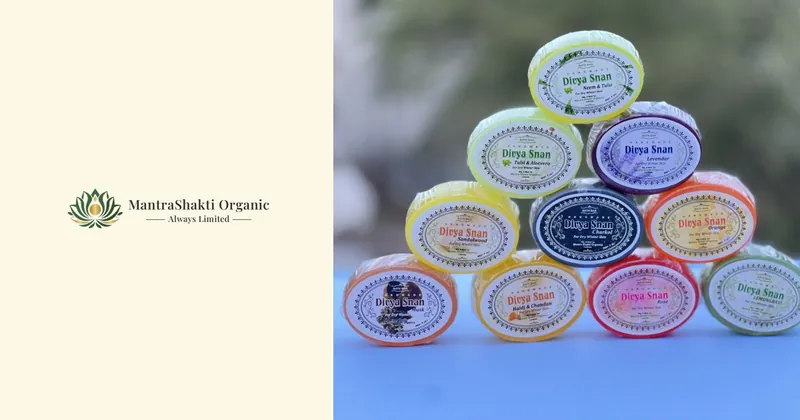
We make the Divya Snan bars by hand in small batches at our family workshop in Chinhat, Lucknow. We have not published a pH reading for any bar, and we do not state one here. If you test a bar with strips, take your number as approximate and note your method; questions about a particular bar can go to care@mantrashaktiorganic.com. The bar made for the face is the Face Wash Bar, and the whole range is in the Divya Snan collection.
Frequently asked questions
What is the pH of bath soap?
True soap is alkaline: a 2022 review in Molecules puts soap typically at pH 8.5 to 11.0. In a 2014 Indian study of 64 bathing soaps, 53 read between about 9 and 10 in solution, and only 2 were in the skin pH range. Individual bars vary by recipe and by how they are measured.
Why is soap alkaline?
Soap is made by saponification, reacting fats or oils with a strong alkali such as sodium hydroxide or potassium hydroxide. The result is soap, the salt of a fatty acid, plus glycerine. The 2022 review says the process always results in a highly alkaline product.
What should a soap's pH be (soap ph level kitna hona chahiye)?
No source cited here sets a correct pH for soap, and the BIS soap standards list no pH value. True soap reads alkaline because of its chemistry, while syndet bars are quoted at 5.5 to 7.0. Choose by scent, feel, price, your water and how your skin responds.
What does "pH 5.5" on a cleanser mean?
It says the product, dissolved in water, reads about 5.5, close to the figures quoted for skin. It is a statement about chemistry and about how the maker measured it, not a promise of any effect on skin. A bar at that pH is generally built on synthetic surfactants rather than soap.
Is a pH 5.5 bar actually a soap?
Chemically, not mainly. Soap made by saponification is always highly alkaline, and syndets, which are synthetic detergent cleansers, are quoted at pH 5.5 to 7.0. Under BIS standards, a bar that combines soap with synthetic surfactants is called a bathing bar.
Which soap pH is good for skin?
No source cited here says which pH is good for skin. The 2014 Indian study measured product solutions, not skin, and noted that most common soaps sit outside the pH range quoted for normal skin. If you have sensitive skin or a skin condition, ask a dermatologist.
How can you check a soap's pH at home?
Dissolve about 1 g of soap in 100 ml of distilled water, stir without making lather, let it stand, then dip a pH strip for the time on the pack and read it against the colour chart in daylight. Test your water first as a blank. Take the result as approximate.
Do MantraShakti bars have a published pH?
We have not published a pH reading for any Divya Snan bar. If you test one with strips, take your number as approximate and note the method. You can write to care@mantrashaktiorganic.com with questions about a particular bar.
Sources and further reading
- Tarun J, Susan J, Suria J, Susan VJ, Criton S. Evaluation of pH of Bathing Soaps and Shampoos for Skin and Hair Care. Indian Journal of Dermatology, 2014;59(5):442-444
- Mijaljica D, Spada F, Harrison IP. Skin Cleansing without or with Compromise: Soaps and Syndets. Molecules, 2022;27(6):2010
- US Environmental Protection Agency, CADDIS: pH (the pH scale is logarithmic)
- Bureau of Indian Standards: IS 2888:2004 Toilet Soap, Specification (open copy)
- Bureau of Indian Standards: IS 13498:2017 Bathing Bar, Specification (open copy, Internet Archive)
- Bureau of Indian Standards: IS 10500:2012 Drinking Water, Specification (open copy)
Written by the MantraShakti Organic workshop team, Chinhat, Lucknow. This guide is general information about soap chemistry, not medical advice. If you have a skin condition or your skin reacts to a product, ask a doctor. pH figures are quoted from the sources listed above, as read on 17 October 2026. Explore the Divya Snan range.
Shop this guide
Made by hand in small batches in Lucknow.
More from the Journal
12 Nov 2026 · 15 min
Bath Routine Steps: How to Bathe With Bar Soap (Nahane Ka Sahi Tarika)
Read more →