
Gond Katira: How to Use, Soak and Check If It Is Genuine
How do you use gond katira?
How to use gond katira in one breath: rinse 1 teaspoon of crystals, soak them in 1 cup of plain water for 6 to 8 hours or overnight until they swell into a soft, translucent jelly, then drain and stir 1 to 2 tablespoons into a glass of sharbat, falooda or chilled milk. Keep the rest covered in the fridge.
Key takeaways
- Start with 1 teaspoon of crystals per cup (about 240 ml) of plain water and soak 6 to 8 hours. Measure the jelly once, then scale up or down.
- Use 1 to 2 tablespoons of soaked jelly per glass. Maayeka’s recipe uses about 2 tablespoons; that is a recipe quantity, not a daily amount.
- Soaked gond katira is almost tasteless and colourless, so the drink around it supplies the flavour.
- Keep soaked jelly in a covered container in the fridge and use it within 3 days. Keep dry crystals in an airtight, dry jar.
- Always soak before eating. Do not swallow the dry crystals.
- There is no official kitchen test that proves gond katira is genuine. Combine a look, a sniff, the overnight water test and a proper label.
About this guide. Most pages on this topic talk about what gond katira is supposed to do for the body. This one sticks to the kitchen: quantities, timings, storage, how it behaves in a glass, and what you can and cannot check when you buy it. We leave health claims out on purpose.
How much gond katira per cup of water, and how long should you soak it?
A level teaspoon of crystals in a cup of plain water, left for 6 to 8 hours, is a sound starting point. Recipes agree on overnight; the quantities differ, and the gum simply takes up the water it needs.
That is how this gum is built. In JECFA’s food specification for tragacanth, a mere 1 g of the gum in 50 ml of water swells into a smooth, stiff, slightly cloudy mucilage. A little gum holds a lot of water, which is why a small spoonful of crystals turns into a surprisingly large bowl of jelly. Maayeka’s sharbat recipe soaks a tablespoon of dry gond katira in a glass of water, covered, overnight, and reads the result by sight: the pieces turn translucent and jelly-like, resembling crushed ice.
| What you see next morning | What it means | Next time |
|---|---|---|
| Soft, translucent jelly with a little loose water | The ratio is right | Keep it |
| One solid block, no free water | Too many crystals for the water | Use fewer crystals or more water |
| Jelly pieces swimming in a lot of clear water | Plenty of water left over | Use a few more crystals, or just drain it |
| Pieces with a hard, opaque centre | Not soaked long enough | Give it a few more hours |
The simplest way to learn your own pack is to measure once. Soak a level teaspoon in a cup of water overnight, drain it through a sieve, and measure the jelly in a cup. Note the number. From then on you know how much jelly one teaspoon gives you, and every drink after that is arithmetic. The swelling varies with the gum, the grade and the water, so one measurement on your own kitchen beats any fixed figure from a website.
How do you soak gond katira, step by step?
Pick, rinse, cover with plain water, wait, drain. The only thing that takes time is the waiting.
- Measure and pick. Put 1 level teaspoon of crystals on a plate and remove any bark, dark specks or grit. Raw gum can carry stray bark, which JECFA’s specification says has to be removed before the gum goes into food.
- Rinse. Hold the crystals in a small sieve under running water for a few seconds. Maayeka washes them before soaking.
- Cover with plain water. Use a clean glass or steel bowl, wide enough for the gum to swell, and about 1 cup of water you would be happy to drink. Cover the bowl.
- Wait 6 to 8 hours. Start in the evening. In a hot kitchen, put the covered bowl in the fridge instead of leaving it on the counter, because the usual food-safety advice is to refrigerate prepared food within two hours.
- Check the pieces. They should be soft and translucent right through. If you can feel a hard centre, give them a few more hours.
- Drain and fluff. Pour everything through a sieve, rinse the jelly lightly and fork it loose. It is ready to use.
What does soaked gond katira taste like?
Almost nothing. Once soaked it is colourless, odourless and nearly tasteless, so it takes on the flavour of whatever you stir it into.
That is its charm in a drink. What you get is texture: soft, slippery, slightly chewy pieces that slide up a straw and look like crushed ice in the glass. Rose syrup, lemon, roasted cumin and black salt, thandai or cold milk all come through clearly. One useful detail from FAO’s review of plant gums: an advantage of tragacanth over many other gums is its stability under acid conditions, so lemon in the glass fits well.
How do you make gond katira sharbat?
Put 2 tablespoons of soaked jelly in a tall glass, add chilled lemon-sugar water or rose syrup, top with ice and stir gently. That is the whole recipe.
Here is a one-glass version built from the quantities recipe writers use. Taste and adjust the sweetness; it is your glass.
- Jelly first. Spoon 2 tablespoons of soaked, drained gond katira into a tall glass.
- Add sabja if you like. Maayeka adds 1 tablespoon of soaked sabja seeds (10 to 15 minutes in water) to the same glass. The two jellies look good together and feel different on the tongue.
- Add the flavour. Use about 1.5 tablespoons of rose syrup.
- Mix the water. In a jug, stir about 1.5 tablespoons of lemon juice and 2 tablespoons of sugar into a glass of chilled water until the sugar dissolves. Sugar dissolves slowly in very cold water, so stir it into a little room-temperature water first.
- Combine. Pour the lemon water over the jelly, add ice, stir once and garnish with mint.
For a milk version, skip the lemon water and pour chilled milk over the jelly and syrup; Maayeka describes this as a gond katira milkshake.
Where else can you use soaked gond katira?
Anywhere you would add a soft, neutral jelly to something cold. Here is how the common dishes work.
| Dish | How to add it | Note |
|---|---|---|
| Lemon or rose sharbat | 1 to 2 tablespoons of jelly in the glass, liquid poured over | Stir gently so the pieces stay whole |
| Chilled rose or badam milk | 1 to 2 tablespoons stirred into cold milk | Serve straight away |
| Falooda | Layered with sabja, vermicelli, syrup, milk and ice cream | Use jelly that is fully soaked and drained |
| Sweet lassi | Stirred in just before serving | Add after blending, not before |
| Thandai | Spooned into the glass before the chilled thandai is poured over | Adds texture to a thick, creamy drink |
| Kheer or phirni | Fold into the cooled dessert | We found no reliable source on cooking the jelly, so add it cold |
Can you soak gond katira in milk?
Soak it in water and add the jelly to milk afterwards. That is what recipes do, and it keeps a bowl of milk from sitting out for hours.
If you still want to soak it in milk, do it in the fridge, never on the counter. Milk is a perishable food, and the standard food-safety advice is to refrigerate prepared food within two hours and keep it below 4°C (40°F). An overnight soak at kitchen temperature in a Lucknow May is far outside that.
Can you mix gond katira with sabja or chia seeds in one drink?
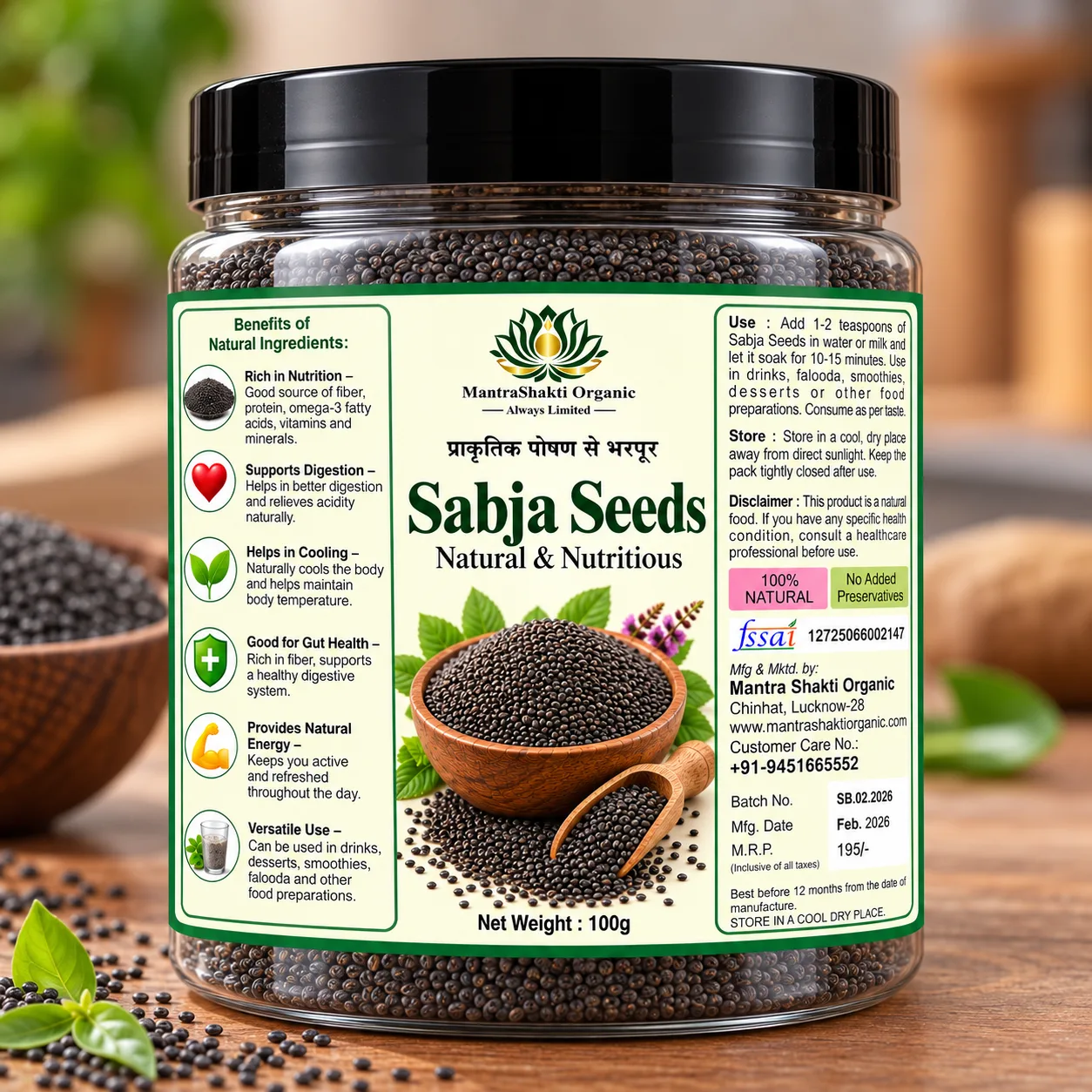
Yes. Maayeka’s sharbat uses 2 tablespoons of soaked gond katira and 1 tablespoon of soaked sabja in the same glass. Chia seeds are used the same way, soaked first. Keep the total to a few spoonfuls, because three kinds of jelly in one glass leaves little room for the drink itself.
How do you store gond katira, dry and soaked?
Keep dry crystals airtight and dry; keep soaked jelly covered in the fridge and use it within 3 days.
| Form | How | How long |
|---|---|---|
| Dry crystals | Airtight jar in a cool, dry cupboard; always use a dry spoon | Follow the packing date on the pack |
| Soaked jelly | Covered container in the fridge, at or below 4°C (40°F) | Use within 3 days |
| Jelly in a finished drink | Fridge, covered | Same day; milk drinks especially |
Recipe writers say soaked gond katira keeps 3 to 4 days in the fridge. The University of Wisconsin Extension gives 3 to 4 days for refrigerated leftovers and says prepared food should go into the fridge within two hours. We stay at the cautious end and say 3 days, because the jelly may look the same on day 5 as on day 1, so the calendar is a better guide than your eyes. If it smells sour or feels slimy, throw it away.
How can you tell if gond katira is real or fake?
No kitchen test proves it. The honest approach is to combine a few cautious checks: how it looks, how it smells, what it does overnight in water, and what the label says.
FSSAI publishes a set of household adulteration tests called DART (Detect Adulteration with Rapid Test). When we checked in October 2026 it covered milk, oils, sugar, grains, spices, vegetables and beverages, but it had no entry for gond katira. The international purity specification for tragacanth is a laboratory document: it sets limits for moisture, ash and acid-insoluble matter and tests for the presence of acacia and other soluble gums, agar, dextrin and karaya gum. A spoon and a glass of water cannot reproduce any of that, so anyone who tells you a kitchen trick “proves” purity is overselling.
We also could not find a published list of what gond katira is mixed with in India, so we will not guess at one. These checks are cautions, not verdicts:
| Check | What a swelling gum should look like | Pause and ask questions if |
|---|---|---|
| Colour and shape | Tragacanth: off-white to pale yellow, flat or twisted, horny pieces. Karaya type: pale yellow to pinkish brown, irregular, translucent pieces | The pieces are chalky or have a powdery coating, glitter like sugar or salt, are mostly dark, or are deep brown and shiny (that looks like babool gond, a different gum) |
| Bark and grit | A few bark specks, picked out before use | Lots of bark, stones or dust |
| Smell, dry and soaked | Tragacanth is described as odourless. The powder of a karaya-type gum smells of vinegar | The smell is musty, sour, soapy, perfumed or chemical |
| Overnight water test | Soft, translucent jelly that holds its shape, with mostly clear water | The pieces dissolve into a thick, sticky liquid; a layer of sand, grit or sediment settles at the bottom; or the pieces stay hard and glassy |
| Label and seller | Ingredient name, plant name, FSSAI licence number, packing date, contact details | It is loose, unlabelled, or the seller cannot say what plant it is |
The look and smell rows rest on the published descriptions: JECFA’s tragacanth description (white to pale yellow, horny, odourless) and its karaya description (pale yellow to pinkish brown, with a distinctive acetic acid smell in powder form). FAO’s review adds that in both tragacanth and karaya the higher grades are paler and cleaner and the lower grades are darker with foreign matter, so colour is a clue about grade, not a verdict on honesty.
If you think you have bought adulterated food, stop using it, keep the pack and the bill, and report it. The Health Ministry’s reply to the Lok Sabha in July 2026 says consumer complaints reach FSSAI through the Food Safety Connect web portal, the mobile app, the FSSAI helpline and state helplines, and are attended to by the respective state food safety authorities.
Common mistakes
- Too little water. The crystals take up what they need; with too little water you get one solid block.
- A tight jar. The gum needs room to swell. Use a wide bowl.
- Skipping the rinse and the pick. Dust and bark come with raw gum.
- Counter-top soaking in peak summer. Move the bowl to the fridge when the kitchen is hot.
- Keeping soaked jelly for a week. Three days is the limit we recommend.
- Dipping a wet spoon into the dry jar. A damp crystal swells and sticks the rest together.
- Eating the crystals dry. Always soak first.
How we pack gond katira
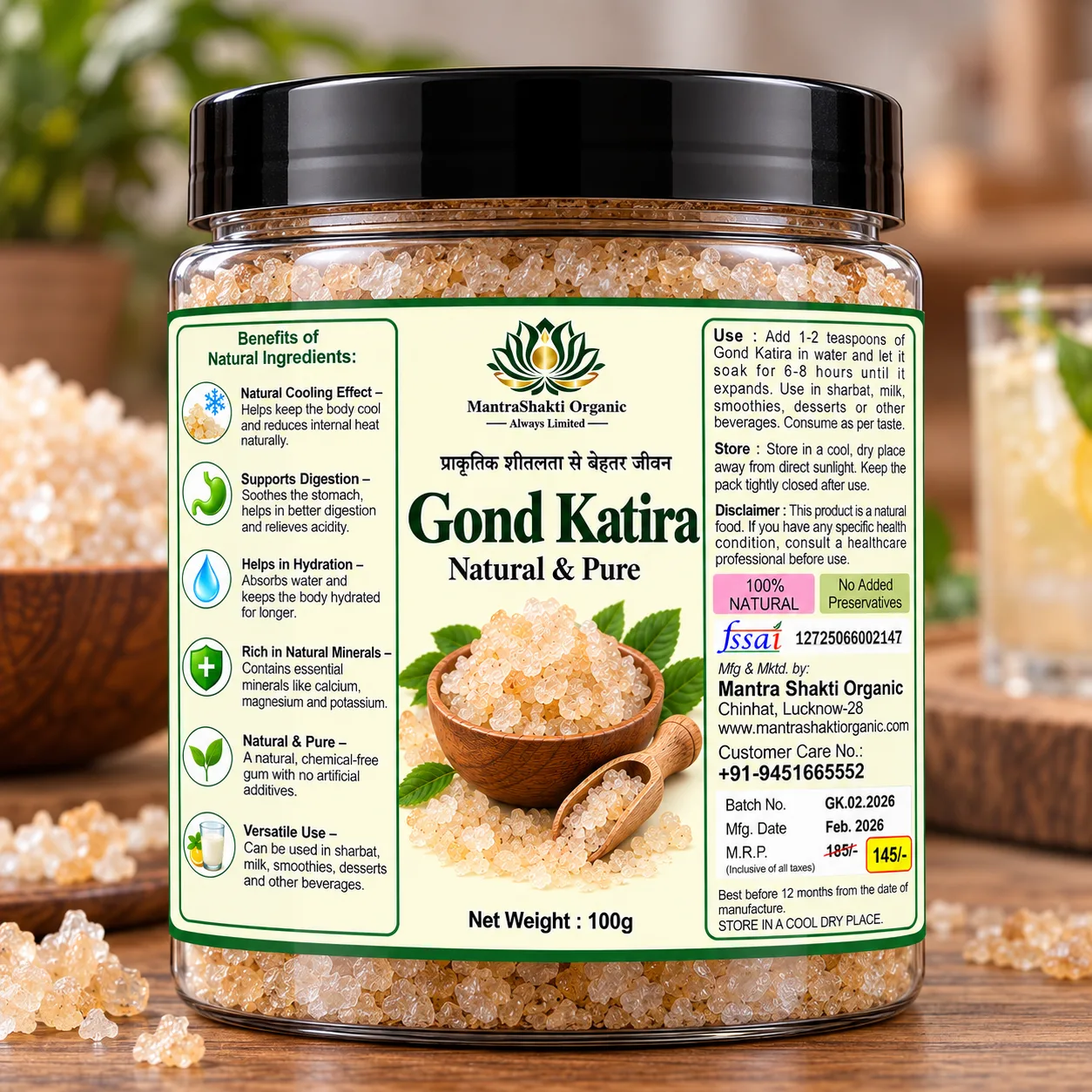
Our gond katira is a single-ingredient pack at ₹145 for 100 g, packed in small lots in Lucknow under FSSAI licence 12725066002147. It is the soaking gum, so it is for the kind of drinks in this guide and not for frying in ghee for laddoos. If you want to see who packs it, read who makes MantraShakti Organic, and browse the rest of the shelf in our pantry range.
Frequently asked questions
How do you use gond katira, and how long should you soak it (gond katira kaise use kare, kitna time bhigona chahiye)?
Soak it for 6 to 8 hours, which in practice means overnight, in plain water in a covered bowl. It is ready when every piece is soft and translucent with no hard centre. Then drain it and stir 1 to 2 tablespoons into sharbat, falooda or chilled milk. In Hinglish: raat bhar saade paani mein bhigoyein, subah chhaan kar 1 se 2 chamach sharbat ya thande doodh mein milayein. In a hot kitchen, soak it in the fridge instead of on the counter.
How much water does gond katira need, and how much does it swell?
Start with 1 level teaspoon of crystals in 1 cup (about 240 ml) of plain water. The gum takes up the water it needs and you drain the rest. How far it swells depends on the gum, the grade and the water, so soak a teaspoon once, measure the jelly, and use that number from then on.
How do you make gond katira sharbat?
Put 2 tablespoons of soaked, drained gond katira in a glass, add about 1.5 tablespoons of rose syrup, then pour over chilled water mixed with about 1.5 tablespoons of lemon juice and 2 tablespoons of sugar. Add ice and mint. For a milk version, use chilled milk instead of the lemon water.
Can you soak gond katira in milk?
It is better to soak it in water and add the jelly to milk afterwards. If you do soak it in milk, do it in the fridge, because milk should not sit at kitchen temperature for hours. Refrigerate prepared food within two hours and keep it at or below 4°C (40°F).
How do you know if gond katira is real or fake?
There is no official home test; FSSAI's list of rapid tests has no entry for gond katira. Use cautious checks: pale, horny pieces with little bark, no powdery coating or odd smell, and an overnight soak that gives soft translucent jelly rather than a sticky liquid or sediment. Buy a labelled pack that names the plant, and report suspected adulteration through FSSAI's Food Safety Connect.
How long does soaked gond katira keep in the fridge?
Use it within 3 days, kept covered at or below 4°C (40°F). Recipe writers say 3 to 4 days, and university guidance for refrigerated leftovers is also 3 to 4 days; we stay at the cautious end. Throw it away if it smells sour or feels slimy.
What does gond katira taste like?
Almost nothing. Soaked gond katira is nearly tasteless, colourless and odourless, so it takes on the flavour of the drink. What it adds is a soft, slippery jelly texture.
Can you mix gond katira with sabja or chia seeds in one drink?
Yes. A common sharbat uses 2 tablespoons of soaked gond katira and 1 tablespoon of soaked sabja in one glass. Chia seeds, soaked first, can be used the same way. Keep the total to a few spoonfuls so the glass still has room for the drink.
Sources and further reading
- FAO/WHO JECFA specification: Tragacanth gum (INS 413) — swelling in water, appearance, odour, purity tests
- FAO/WHO JECFA specification: Karaya gum (INS 416) — appearance and acetic acid odour of a karaya-type gum
- FAO Non-Wood Forest Products 6: Gums, resins and latexes of plant origin (Coppen, 1995) — grades by colour and foreign matter; stability in acid
- Maayeka: Gond katira sharbat (Anjana Chaturvedi) — soaking, sharbat quantities, storage, sabja pairing
- University of Wisconsin Extension: How to store leftovers — refrigerate within two hours; 3 to 4 days at or below 40°F
- FSSAI Eat Right India: DART, Detect Adulteration with Rapid Test — FSSAI’s list of household adulteration tests
- Lok Sabha Unstarred Question 1092, Ministry of Health and Family Welfare, 24 July 2026 — how food complaints reach FSSAI and state authorities
Written by the MantraShakti Organic workshop team, Chinhat, Lucknow. We pack our foods in small lots; we are not doctors or dietitians, and this guide is general kitchen information, not medical advice. If you have a medical condition, an allergy, are pregnant or take medication, ask a doctor before changing what you eat.
Shop this guide
Made by hand in small batches in Lucknow.
More from the Journal