
How to Check Jaggery Purity at Home: A Buyer's Checklist
How to check jaggery purity at home: what actually works
How to check jaggery purity at home: read the label, look at the powder, and run FSSAI's DART water test by stirring 10 g into a glass of water to see whether chalk settles. None of this proves purity. Washing soda, added colour and added sugar need a laboratory, so use home checks to screen, not to certify.
FSSAI's standards do not define "pure" jaggery. What can be tested is whether a pack meets FSSAI's standard for cane jaggery, which sets limits for moisture, sugars, ash and insoluble matter and bars added colour. This guide separates the checks you can do in a kitchen from the ones you cannot, and it is written with jaggery powder in mind. The limits come from the FSSAI and NIFTEM documents listed at the end.
Key takeaways
- FSSAI's household DART guide, as published on Eat Right India, names jaggery in one test: dissolve 10 g in a glass of water and see whether chalk powder settles at the bottom. It screens for one adulterant only.
- FSSAI's standard for cane jaggery allows at most 2 per cent water-insoluble matter, so a thin film of fine sediment is normal and a thick chalky layer is not.
- Colour is a weak clue. NIFTEM says light golden jaggery is preferred for eating, but traders pay more for white jaggery made with bleaching clarifiers, whose brightening is temporary.
- Cane jaggery may not contain added colour under FSSAI's standard, and the label must carry the maker's address, FSSAI licence number, net quantity, batch number and the date of manufacture or packaging.
- FSSAI's acid-based tests belong in a laboratory. Hydrochloric acid is corrosive, and we do not suggest repeating those tests in a home kitchen.
What does "pure jaggery" mean, and what does FSSAI require?
FSSAI's standards do not define a grade called "pure jaggery". The testable standard is FSSAI's definition of cane jaggery or cane gur: the product obtained by boiling or processing juice pressed out of sugarcane, free from substances unsafe to health, and within set limits. The Ministry of Food Processing Industries' NIFTEM adds that jaggery comes in three market forms, solid, liquid and granular (powder), and that about 80 per cent of the jaggery made in India is solid.
| Parameter | FSSAI limit | What it tells you | Home check? |
|---|---|---|---|
| Moisture | Not more than 7.0 per cent | How dry, and so how stable, the jaggery is | Only a clue: damp, sticky or lumpy powder suggests more moisture |
| Sucrose | At least 70.0 per cent | How much of the jaggery is cane sugar | No, laboratory only |
| Total sugars | At least 90.0 per cent | The overall sugar content | No, laboratory only |
| Reducing sugars | Not more than 20.0 per cent (and, from 1 September 2023, at least 5.5 per cent) | The glucose and fructose share of the sugars | No, laboratory only |
| Sulphate ash | Not more than 4.0 per cent | The overall ash (mineral residue) after burning | No, laboratory only |
| Ash insoluble in dilute hydrochloric acid | Not more than 0.5 per cent | Sand and soil-type contamination | No, laboratory only |
| Extraneous and water-insoluble matter | Not more than 2.0 per cent | Dirt and grit that will not dissolve | Partly: the water test shows it |
| Added colour | Not permitted | Whether the colour was put there | Label and laboratory |
Two further points from the same standard are useful to a buyer. Sodium bicarbonate, if used to clarify the juice, must be food grade, and only additives permitted under the regulations may be used. So a pack that meets the standard may still have been made with a permitted clarifier such as food-grade sodium bicarbonate.
What is jaggery commonly adulterated with?
FSSAI's own material names chalk powder, and its laboratory manual also covers washing soda (sodium carbonate) in sugar-type foods. Coverage of the FSSAI-approved home test reported in August 2026 adds baking soda (sodium bicarbonate). Added colour is a separate issue, because the cane jaggery standard does not allow it at all. These are food-law and quality matters, and we are not saying any of them is present in a particular brand.
- Chalk powder is insoluble in water, which is why the DART test can show it.
- Washing soda and baking soda dissolve in water, so a water test will not reveal them; FSSAI's methods use acid to detect them in the laboratory.
- Added colour is checked through the label and in a laboratory, not by the colour of the powder alone.
- Added sugar cannot be seen by eye. Jaggery powder often has a crystalline texture, so sparkle is not evidence of sugar either way.
How do you do FSSAI's water test on jaggery powder?
Dissolve 10 g of the jaggery powder in a transparent glass of water and look at the bottom. FSSAI's DART guide says that if sugar, pithi sugar or jaggery is mixed with chalk, the adulterant settles down at the bottom. A kitchen scale is the most reliable way to get 10 g; as a rough guide, two to three level teaspoons of fine powder is about that much.
- Use a clear glass. A transparent glass of plain water lets you see the bottom from the side.
- Add the sample. Stir 10 g of jaggery powder into the water for about a minute, until it has dissolved.
- Let it settle. DART does not give a waiting time; we leave the glass undisturbed for two to three minutes so anything heavy can reach the bottom.
- Read the bottom. A thin dusting of fine grains is normal. A clear layer of white or pale powder, thicker than a light film, is what the test is looking for.
- Keep the pack. If the layer looks wrong, stop using the pack, keep it with its batch code and contact the seller before you throw it away.
How much sediment is too much? FSSAI's standard allows up to 2 per cent extraneous and water-insoluble matter, which in 10 g is about 0.2 g, a faint film. Some fine matter from the cane and the process is expected, which is why the standard allows 2 per cent. A pass on this test tells you only that nothing heavy and insoluble is hiding in that spoonful; it says nothing about dissolved adulterants, added sugar or colour.
Does a lighter or golden colour mean better jaggery?
No. NIFTEM's reading manual says light golden jaggery is generally preferred for eating, but also that traders in the mandis pay higher prices for white jaggery prepared with chemical clarifiers such as hydros (sodium hydrosulphite). Colour tells you about how the juice was handled, not how pure the jaggery is.
The manual's clarifier table gives the reasons. It says hydros brightens colour temporarily but hastens colour darkening and spoilage within a month, and that sodium bicarbonate added in the cooling pan also brightens colour temporarily and hastens spoilage. It lists sajji, an alkaline mix of sodium carbonate, sodium sulphate and sodium chloride, as brightening colour temporarily and reducing the taste, with poor storability. The manual also says the colour and composition of jaggery vary with sugarcane variety, climate, farming practice and method of manufacture, so a darker or paler pack is not wrong in itself.
| What you see | What it may mean | What to do |
|---|---|---|
| Even light golden to brown | A normal range for jaggery; cane, season and boiling all change the shade | Move on to the label and the water test |
| Very pale or near white | Possibly a bleaching clarifier, which NIFTEM says brightens colour only temporarily | Read the label for additives; ask the seller how the juice was clarified |
| Bright, uniform yellow or orange that looks artificial | Could be added colour, which the standard does not allow in cane jaggery | Check the label; if in doubt, do not rely on the pack |
| Dark and sticky | Often moisture or age; jaggery darkens in storage | Smell it, and check the date and the seal |
| Patchy, with dark and pale clumps | Uneven mixing or partial moisture damage | Judge by smell and the water test, not colour |
What can you tell from the texture, smell and taste of jaggery powder?
Texture and smell mostly tell you about moisture and age, not adulteration. NIFTEM says traders judge jaggery by sight, by pressing it between the fingers and by taste, and that moisture absorbed from humid air weakens its structure and can end in liquefaction, with microbial spoilage setting in beyond a certain moisture level.
- Texture. A free-flowing powder with soft lumps that crush easily is what you want. Hard, damp or syrupy clumps point to moisture. A fine crystalline sparkle is normal, because NIFTEM describes crystallisation as part of jaggery's texture.
- Smell. It should smell sweet and caramel-like. A sour, fermented or musty smell suggests spoilage and is a reason to stop using the pack.
- Taste. Dissolve a pinch in warm water. A burnt, bitter note can come from charring in the pan; NIFTEM notes that IISR's thick-bottomed pans were designed to avoid charring. A flat, salty or soapy taste can come from alkaline clarifiers such as sajji, which NIFTEM says reduces the taste.
- Grit. A gritty feel between the teeth or a thick residue in the glass suggests insoluble matter beyond the 2 per cent limit.
None of these is proof. They are screening clues that tell you whether to look further.
What should a jaggery pack label show?
Under FSSAI's labelling regulations, a pre-packaged food label must show the name of the food, the maker's or brand owner's name and complete address, the FSSAI logo and licence number, the net quantity, a batch, lot or code number, and date marking. The date of manufacture or packaging must be declared, along with an expiry or use-by date where the regulations require one; a further quality date is optional.
| On the label | Why it matters to you |
|---|---|
| Name of the food, such as cane jaggery or jaggery powder | It must reflect the true nature of the food and not mislead |
| Maker or brand owner's name and complete address | Someone accountable that you can write to |
| FSSAI logo and licence number | The licence under which the food business operates |
| Net quantity | What you are paying for, declared under the Legal Metrology rules |
| Batch, lot or code number | Lets the maker trace your pack to a production run |
| Date of manufacture or packaging, and expiry or use-by where required | Tells you how old the pack is |
| Ingredients and any additives, with class and INS number | A list of ingredients is not required for single-ingredient foods, but any additive has to be declared |
If you buy online, FSSAI's regulations say the mandatory label details must reach you before the sale, with the batch number and the date marking as the exceptions. Marketing words on the front of the pack are no substitute for the particulars the regulations require, so read those instead.
Why do FSSAI's lab tests use acid, and should you repeat them at home?
FSSAI's lab method for chalk and washing soda adds dilute hydrochloric acid to a small sample and watches for fizzing, then confirms with lime water. The same manual warns that concentrated hydrochloric acid is corrosive and can cause burns, and tells analysts to wear goggles, gloves and a lab coat. We do not suggest repeating it at home.
Business Today reported on 14 August 2026 that FSSAI's jaggery test uses about a quarter teaspoon of crushed jaggery and roughly 3 ml of hydrochloric acid, with fizzing pointing to baking soda, and that a home test cannot establish that jaggery is completely pure. Please do not improvise with bathroom or toilet-cleaner acids: they are not the same reagent, and they burn. If you suspect a pack, stop using it, keep it with the batch code, and report it to the seller and to your state food safety authority so that a laboratory can test it.
Your five-minute checklist before you trust a pack of jaggery powder
Work down this list in order and stop at the first thing that looks wrong. It takes about five minutes, most of which is waiting for the glass to settle.
- Read the label for the maker's address, FSSAI licence number, net quantity, batch number and date of manufacture or packaging.
- Check the seal and the pouch: it should be intact, dry inside and free of hard, damp lumps.
- Look at the colour and texture: an even shade, free-flowing powder and no artificial-looking brightness.
- Smell and taste a pinch dissolved in warm water: sweet and caramel-like, with no sour, musty, soapy or burnt note.
- Run the DART water test with 10 g and look for a layer at the bottom of the glass.
- If anything is off, keep the pack and batch code, stop using it and contact the seller.
Common mistakes when checking jaggery
- Taking colour as proof. A pale pack is not purer, and a dark pack is not either.
- Reading a clean glass as a certificate. The water test finds insoluble adulterants only.
- Using acid at home. It is a lab procedure with a burn risk.
- Judging by the front of the pack. Marketing words are not defined terms; the particulars on the label are.
- Ignoring storage. A good jaggery powder left open in monsoon humidity will clump and darken, and that is a handling problem, not adulteration.
How we pack our jaggery powder
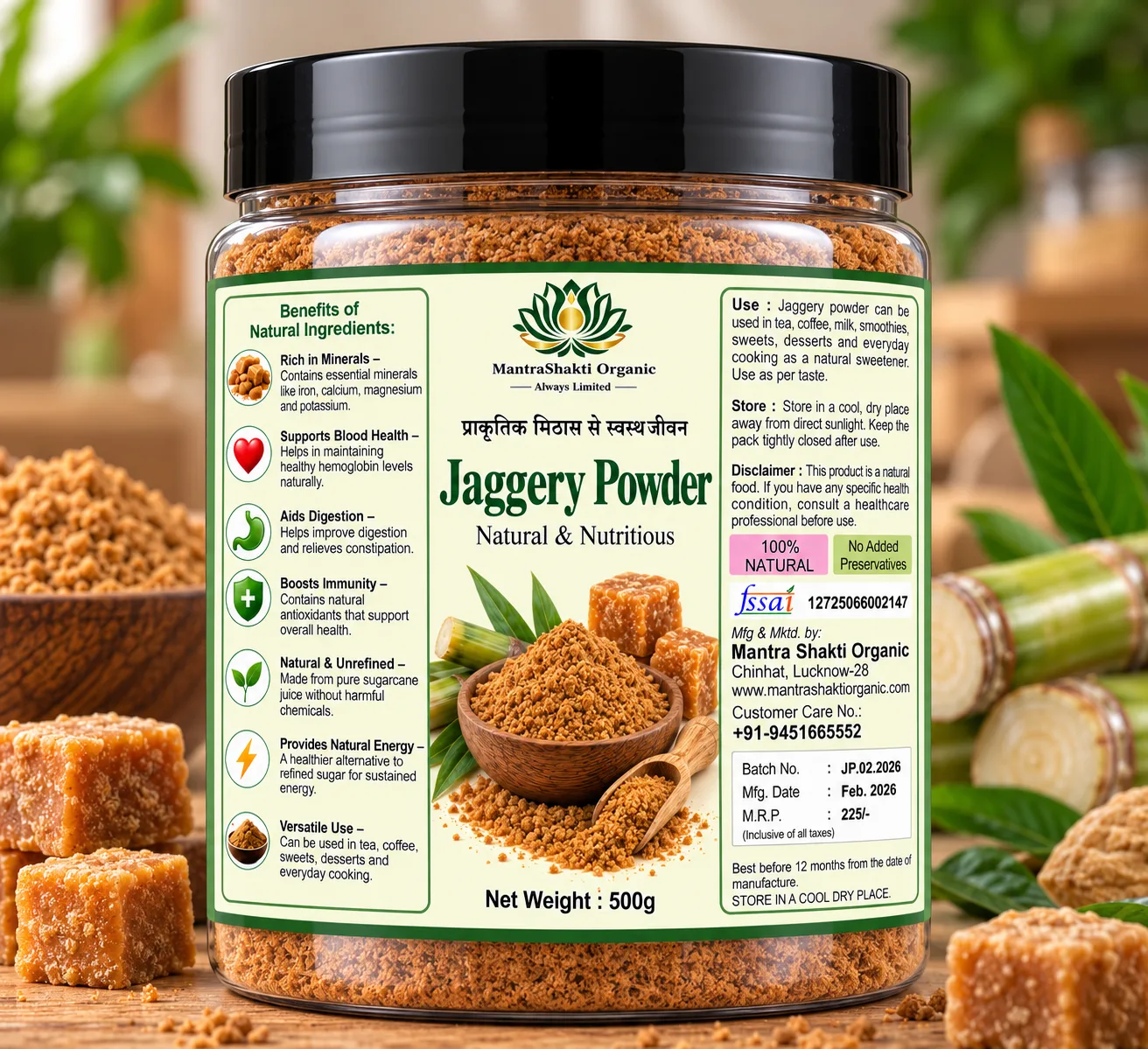
We do not call our jaggery "pure", because FSSAI's standards do not define the word. What we can tell you is that our Jaggery Powder is a single-ingredient pack, packed in small lots at our workshop in Chinhat, Lucknow, at ₹225 for 500 g, with a batch code on every pack. Our FSSAI licence number is 12725066002147, so you can compare it with the number on the pack you receive. If anything about a pack puzzles you, write to [email protected] with the batch code, and browse the rest of the pantry range or read who makes MantraShakti Organic.
Frequently asked questions
How can you tell if jaggery is pure at home?
You cannot prove purity at home, but you can screen. Read the label for the FSSAI licence number, batch number and dates, look at the colour and texture, smell it, and run FSSAI's DART water test, which shows chalk powder settling at the bottom of a glass. Only a laboratory can confirm sugars, ash, added colour or dissolved adulterants.
What is jaggery commonly adulterated with?
FSSAI's household guide names chalk powder, and its laboratory manual covers chalk and washing soda in sugar-type foods. News coverage of FSSAI's August 2026 test mentions baking soda. Added colour is not allowed in cane jaggery at all. These are food-law matters; none of this says any particular brand is affected.
Does a lighter or golden colour mean better jaggery?
No. NIFTEM notes that light golden jaggery is preferred for eating, but that traders pay more for white jaggery made with bleaching clarifiers such as hydros, whose brightening is temporary and which can hasten darkening and spoilage. Colour also varies with cane variety, season and boiling, so use it only as a clue.
What does FSSAI's home test for jaggery involve?
FSSAI's DART guide has a water test: dissolve 10 g of jaggery in a transparent glass of water, and if chalk is present it settles at the bottom. A more recent test reported in August 2026 uses about 3 ml of hydrochloric acid on a quarter teaspoon of crushed jaggery. That needs a corrosive acid, so we recommend leaving it to a laboratory.
How do you check jaggery powder specifically, rather than a block?
Powder hides what a broken block would show, so rely on the water test, the label and your senses. Look for a free-flowing powder with soft lumps, an even colour and a sweet caramel smell. Stir 10 g into a glass of water and check the bottom after a few minutes. A thin film is normal; a thick chalky layer is not.
What should a jaggery pack label show?
The name of the food, the maker's name and complete address, the FSSAI logo and licence number, the net quantity, a batch or lot number, and the date of manufacture or packaging, with an expiry or use-by date where required. Any additives must be declared. FSSAI's cane jaggery standard does not allow added colour.
Why does some jaggery taste salty or bitter?
A bitter, burnt note can come from juice that charred in the pan. A flat, salty or soapy taste can come from alkaline clarifiers such as sajji, which NIFTEM says reduces the taste. Jaggery also varies with cane and method. Dissolve a pinch in warm water and taste it alone; if it tastes off by itself, it will in your tea or sweets.
Is a little sediment at the bottom of the glass normal?
Yes. FSSAI's standard for cane jaggery allows up to 2 per cent extraneous and water-insoluble matter by dry weight, which in a 10 g test is about 0.2 g, a faint film. A thick white or grey layer is a different matter and a reason to stop using the pack and contact the seller.
Sources and further reading
- DART: Detect Adulteration with Rapid Test (FSSAI, Eat Right India) The household water test for chalk powder in sugar, pithi sugar and jaggery.
- Food Product Standards, Chapter 2.8: Sweetening agents including Honey (FSSAI) The standard for cane jaggery: limits, no added colour, and food-grade sodium bicarbonate.
- Manual of Methods for detection of adulterants (FSSAI) The laboratory chalk and washing soda test, with its hydrochloric acid safety warning.
- Food Safety and Standards (Labelling and Display) Regulations, 2020, compendium (FSSAI) What a pre-packaged food label must carry, including licence number, batch number and date marking.
- Reading Manual for Jaggery under the PMFME Scheme (NIFTEM, Ministry of Food Processing Industries) Forms of jaggery, clarifiers and colour, grading by sight and taste, and moisture and spoilage.
- Buying jaggery? This simple FSSAI approved home test can help check its purity easily (Business Today, 14 August 2026) News coverage of the acid-based jaggery test and its limits.
Written by the MantraShakti Organic workshop team, Chinhat, Lucknow. This is general consumer information, not a laboratory method or legal advice; only an accredited laboratory can confirm whether a sample meets a standard.
Shop this guide
Made by hand in small batches in Lucknow.
More from the Journal