
Chia Seeds vs Sabja Seeds: What Differs in an Indian Kitchen
Are chia seeds and sabja seeds the same?
No. Chia seeds vs sabja seeds is a comparison of two different plants: chia is Salvia hispanica, a usually speckled seed that needs roughly 3 tablespoons per cup to set firm as a pudding; sabja is sweet basil, Ocimum basilicum, a black seed that wraps itself in slippery gel within minutes and is the classic seed of falooda and sherbet.
Key takeaways
- Different plants. Chia is Salvia hispanica, from southern Mexico and northern Guatemala. Sabja is sweet basil, Ocimum basilicum. Both are in the mint family.
- Different looks. Chia is about 2 mm long and ranges from black and grey to speckled or white. Sabja is 1 to 2 mm long and black to dark brown.
- Similar soak, different gel. In the one lab comparison we found, the usual wait before judging a gel was about 15 to 20 minutes for both. Sabja set at 6 g of seeds per 100 ml of water; chia needed 15 g.
- So chia is the pudding seed and sabja is the drink seed. A spoonful of soaked sabja goes into a glass of sherbet or falooda; a firm chia pudding needs roughly 3 tablespoons per cup.
- Neither should be eaten dry. Soak or mix both into liquid first.
- On our shelf the two cost about the same per 100 g, so price will not decide it.
Why are chia and sabja seeds so easy to mix up?
The confusion is natural. Both are tiny dark seeds, both are sold to be soaked, both turn glossy in water, and both belong to plants in the mint family. Sabja goes by other names too: Swasthi’s Recipes lists tukmaria, falooda seeds and sweet basil seeds. In Hinglish: sabja aur chia seeds mein kya antar hai (सब्जा और चिया सीड में अंतर)? Alag paudhe, alag gel, alag dishes. This guide is about what actually differs when you cook with them. It makes no nutrition comparison. The question “which is better” usually turns into one, and we would rather answer “better for which dish”.
How can you tell chia and sabja seeds apart?
By colour and by what they look like once wet. Most chia is speckled grey and black (it can also be all black or all white); sabja is plain black and, soaked, looks like a black dot inside a clear bead.
A botanical review in Molecules describes chia seeds as very small, oval, about 2 mm long, 1 to 1.5 mm wide and under 1 mm thick, with colour varying from black and grey to black-spotted and white. The PROSEA plant-resources entry for sweet basil describes the seed (strictly a nutlet) as ovoid, 1 to 2 mm by 1 mm, black to dark brown. The size gap is small, which is why the colour matters more than the shape.
Wet seeds are easier to tell apart. Swasthi’s Recipes describes soaked sabja as having a grey outer gel layer around a crunchy black interior. Chia wraps itself in a similar clear jacket. In a glass, that means sabja beads each carry a plain dark centre, and chia beads show a speckled one.
Chia seeds vs sabja seeds: side-by-side comparison
This table puts together the plant details, lab measurements and Indian recipe habits we could source. The lab figures come from one controlled comparison, so read them as a guide to behaviour rather than a promise for every pack.
| Feature | Chia seeds | Sabja seeds |
|---|---|---|
| Plant | Salvia hispanica, mint family | Ocimum basilicum (sweet basil), mint family |
| Other names | Chia | Tukmaria, falooda seeds, sweet basil seeds |
| Dry look | About 2 mm, oval; black, grey, black-spotted or white | 1 to 2 mm, ovoid; black to dark brown |
| Soaked look | Seed inside a transparent gel capsule | Black seed inside a grey, slippery gel layer |
| Lowest seed amount that set to a gel (lab) | 15 g per 100 ml of water | 6 g per 100 ml of water |
| Usual wait before judging a gel (lab) | About 15 to 20 minutes | About 15 to 20 minutes |
| Soaking in Indian recipes | Pudding jars are left for hours or overnight | 10 to 30 minutes for a glass; up to overnight is fine |
| Eat dry? | No: soak or mix into liquid first | No: raw seeds are hard and need soaking |
| Traditional Indian role | Pudding jars, newer drinks | Falooda, sherbet, nimbu pani, milk drinks |
| Price on our shelf | ₹378 for 200 g (about ₹189 per 100 g) | ₹195 for 100 g |
Which soaks faster, chia or sabja?
Neither is slow, and sources disagree about which is quicker, so we will not name a winner. Plan on about 15 to 20 minutes for either; the real difference is how many seeds you need, not how long you wait.
The one controlled comparison we found is a 2018 study in Scientific Reports. It soaked whole seeds in deionised water at different seed-to-water ratios, usually waited 15 to 20 minutes, and judged a gel by whether it stayed put when the vial was turned upside down. Chia needed 15% (15 g of seeds per 100 ml) to set. Sabja needed only 6%. In a kitchen that shows up like this: a pudding that holds its shape when tipped needs a lot of chia, roughly 3 tablespoons per cup of liquid, while sabja thickens a thin liquid with far fewer seeds. The same paper found that, at equal concentrations, basil’s extracted mucilage formed a stiffer gel than chia’s, which fits with sabja beads feeling a little firmer on the tongue.
Indian recipes are less exact than a lab. Maayeka soaks sabja for 10 to 15 minutes before adding it to a sharbat; Swasthi’s Recipes gives 30 minutes to overnight and 2 teaspoons of seeds to half a cup of lukewarm water, noting that you can use more water because the seeds take up only what they need.
What is the difference in texture and taste?
Sabja gives you separate slippery beads with a firm black centre; chia gives you a softer gel with small seeds suspended in it. Neither has a strong taste once soaked.
Think of sabja as tiny pearls: each seed is its own bead, which suits a straw and looks good floating in rose milk. At pudding strength, chia links up into one continuous gel, which is what you want in a pudding and less so in a clear drink. Because both are mild, the milk, syrup or lemon around them does the flavouring.
Which seed suits which Indian drink or dessert?
Sabja suits cold, thin drinks and falooda; chia suits puddings and jars that need to set. These are habits, not rules, and both work in a lassi or milk drink if you soak them first.
| Dish | Sabja seeds | Chia seeds |
|---|---|---|
| Falooda and kulfi falooda | The traditional seed; it is literally called falooda seed | Not the usual choice |
| Rose sherbet, nimbu pani, shikanji | Traditional; 1 tablespoon soaked per glass is typical | Works if soaked in plain water first |
| Sweet or salted lassi | Soak, drain, stir in at the end | Same |
| Thandai or rose milk | Soak, drain, stir in at the end | Same |
| Overnight pudding or a kheer-style jar | Not the usual seed | The pudding seed: roughly 3 tablespoons per cup and a few hours in the fridge for a firm set |
| Sherbet with gond katira | A common partner: Maayeka uses 1 tablespoon soaked sabja with 2 tablespoons soaked gond katira | Possible, but it adds a third texture |
How can you compare them yourself in a glass?
Run a side-by-side soak and watch the clock. It takes half an hour and shows you the difference better than any description.
- Set up two clear glasses with half a cup of plain water each.
- Add the seeds. Put 2 teaspoons of sabja in one glass and 2 teaspoons of chia in the other. Stir each straight away so the seeds do not float in a clump on the surface.
- Look at 5 minutes. Per PROSEA, the sweet basil seed wall produces a thick slimy coating within some minutes, so the sabja beads should already look wrapped.
- Look at 15 to 20 minutes. This is the usual wait for gel in the lab. Chia beads should show a clear capsule around a speckled seed; sabja beads a grey layer around a black one.
- Stir and spoon some onto a saucer at 30 minutes. Compare how firmly each bead holds together and how much loose water is left.
At this ratio chia is well below its 15% line, so expect separate beads in loose water. Sabja may begin to hold together a little, because its line is much lower. That is the point of the test: in a drink, chia stays as separate beads, and only at pudding strengths does it lock into one gel.
Can sabja seeds be eaten without soaking?
No. Soak them first. Swasthi’s Recipes says to avoid eating unsoaked basil seeds, and notes that raw ones are very hard and difficult to chew until they are prepared.
The same rule applies to chia. Memorial Sloan Kettering Cancer Center advises never eating dry chia seeds on their own, because they swell as they take up liquid and can lodge in the throat, and says they should be prepared or mixed with enough liquid to expand before eating. That is preparation advice, not a reason to avoid either seed: soaked, they are ordinary kitchen seeds.
Can you use chia and sabja together in one drink?
Yes, nothing stops you, but one kind per glass usually looks and feels cleaner. If you want both, soak them separately, drain, and use a spoonful of each so the drink does not turn into a jelly bowl.
Are sabja seeds the same as tulsi seeds?
No. Sabja is sweet basil, Ocimum basilicum. Tulsi is holy basil, Ocimum tenuiflorum (also written Ocimum sanctum), a different species; PROSEA names them as separate species. The seeds look similar and the names get mixed up, so if it matters, ask for the botanical name on the pack.
Why is sabja said to be cheaper than chia?
On our shelf it is not. Our chia seeds are ₹378 for 200 g, which works out at about ₹189 per 100 g, and our sabja seeds are ₹195 for 100 g. Prices elsewhere depend on brand, pack size and season, so compare per 100 g. On the lab figures, sabja needs fewer seeds to thicken a liquid (6 g per 100 ml against 15 g for chia), so a pack of sabja goes further there; for a set pudding, chia is the usual seed.
Common mistakes
- Swapping them spoon for spoon. They gel at different strengths, so a recipe written for one will not behave the same with the other.
- Not stirring in the first minute. Seeds float, clump on the surface and soak unevenly.
- Too little water for sabja. Use more than you think; the seeds take only what they need and you drain the rest.
- Eating either seed dry. Soak them or mix them into liquid first.
- Judging by the packet name. “Falooda seeds” and “tukmaria” mean sabja; “chia” is a different seed.
How we pack chia and sabja seeds
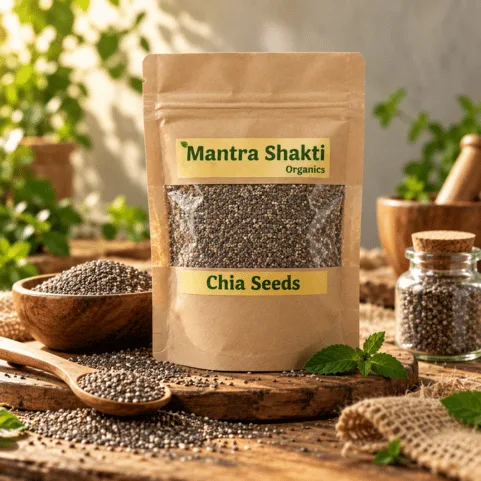
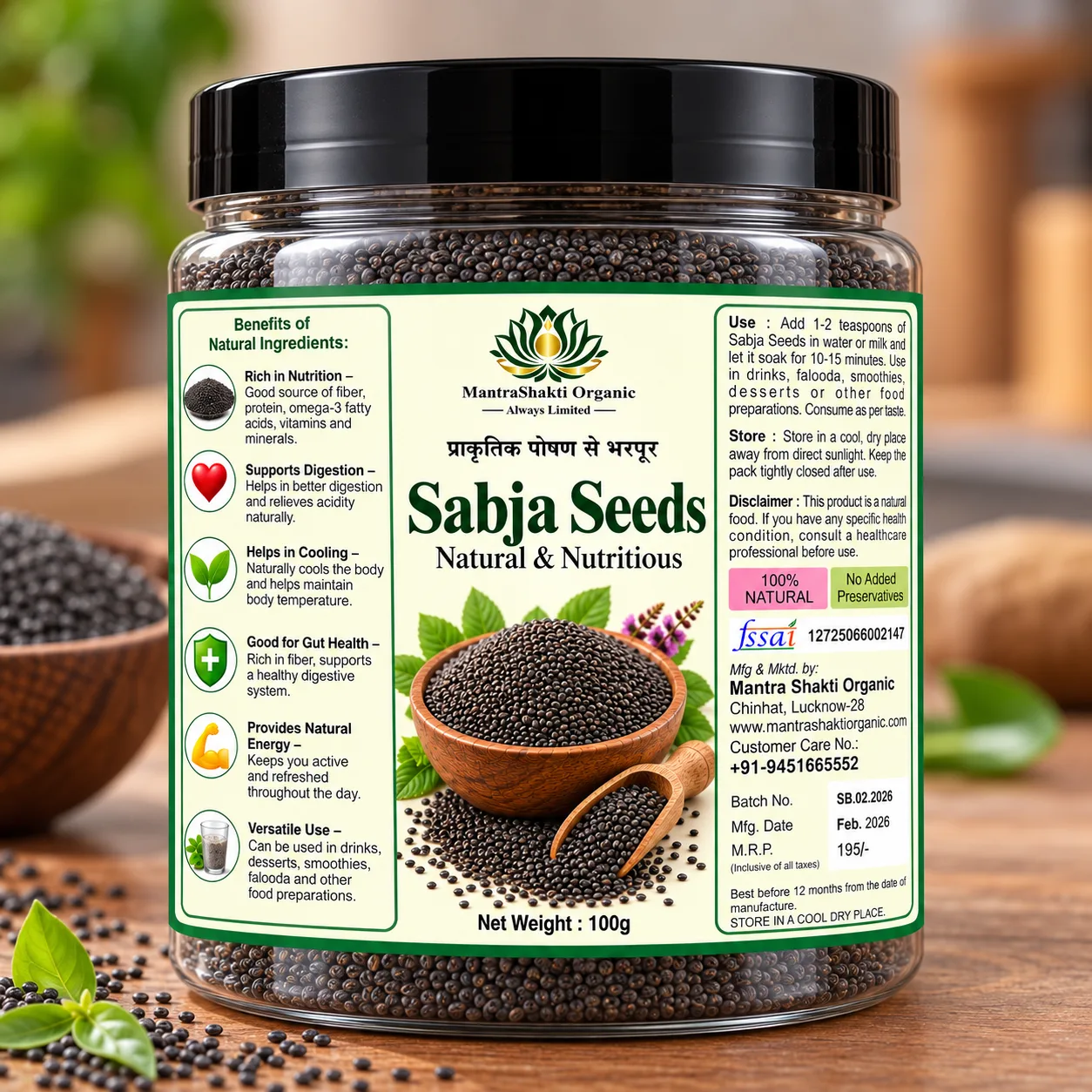
We sell chia seeds (₹378 for 200 g) and sabja seeds (₹195 for 100 g) as single-ingredient packs, packed in small lots in Lucknow under FSSAI licence 12725066002147. You can see them with the rest of our pantry packs in our pantry range, and read about the people who pack them in who makes MantraShakti Organic.
Frequently asked questions
Are chia seeds and sabja seeds the same thing (sabja aur chia seeds mein kya antar hai)?
No. Chia is Salvia hispanica and sabja is sweet basil, Ocimum basilicum. Both are in the mint family, both gel when soaked, but they differ in colour, in how many seeds you need to set a gel, and in the dishes they suit. Sabja is the falooda and sherbet seed; chia is the pudding seed.
How can you tell chia and sabja seeds apart?
By colour and by what they look like wet. Chia is about 2 mm long and ranges from black and grey to speckled or white. Sabja is 1 to 2 mm long and black to dark brown. Soaked, sabja looks like a black centre in a grey bead, while chia sits inside a transparent capsule.
Which soaks faster, chia or sabja?
Sources disagree on which is quicker, so plan on about 15 to 20 minutes for either; the one controlled comparison we found used that wait for both. Indian recipes soak sabja for 10 to 30 minutes. The bigger difference is quantity: sabja gelled at 6 g of seeds per 100 ml of water and chia needed 15 g.
Which seed should you use in falooda and nimbu pani?
Sabja. It is the traditional seed for falooda, rose sherbet, nimbu pani and shikanji, and about a tablespoon of soaked seeds per glass is typical. Chia can go in a nimbu pani if you soak it in plain water first, but it is not the usual falooda seed.
Can sabja seeds be eaten without soaking?
No. Raw sabja seeds are very hard and difficult to chew, and Swasthi's Recipes advises avoiding unsoaked basil seeds. Memorial Sloan Kettering gives the same advice for chia: do not eat dry seeds on their own, because they swell as they take up liquid.
Can you use chia and sabja together in one drink?
Yes, but one kind per glass usually works better. If you want both, soak them separately, drain, and add a spoonful of each so the drink still has room for the liquid.
Are sabja seeds the same as tulsi seeds?
No. Sabja is sweet basil (Ocimum basilicum); tulsi is holy basil (Ocimum tenuiflorum), a different species. The seeds look similar and are sometimes named loosely in shops, so ask for the botanical name if it matters.
Why is sabja cheaper than chia in India?
It is not always. On our shelf chia works out at about ₹189 per 100 g (₹378 for 200 g) and sabja at ₹195 per 100 g, so they are close. Prices elsewhere vary with brand, pack size and season, so compare per 100 g.
Sources and further reading
- Samateh et al., Scientific Reports 8:7315 (2018): Unravelling the secret of seed-based gels in water — minimum gelation ratios and usual wait time
- PROSEA via PlantUse: Ocimum basilicum — basil nutlet size and colour; slimy coating in water
- Molecules 25(1), 11 (2020): Chia seeds (Salvia hispanica L.): an overview — chia seed size, colour and origin
- Swasthi’s Recipes: Sabja seeds drink — names, soaking, soaked appearance, eating raw
- Memorial Sloan Kettering Cancer Center: Chia — caution about eating dry chia seeds
- Maayeka: Gond katira sharbat — soaking sabja for a sherbet
Written by the MantraShakti Organic workshop team, Chinhat, Lucknow. We pack our foods in small lots; we are not doctors or dietitians, and this guide is general kitchen information, not medical advice. If you have a swallowing difficulty, a medical condition, an allergy, are pregnant or take medication, ask a doctor before changing what you eat.
Shop this guide
Made by hand in small batches in Lucknow.
More from the Journal