
Jaggery Powder vs Jaggery Block: Gud, Shakkar and When to Use Each
Jaggery powder vs jaggery: what is the difference?
Jaggery powder vs jaggery block is a question of form, not cane: both are the same sweetener. The block (gud, bheli) is boiled cane juice set in a mould; the powder is granulated or ground jaggery that dissolves in seconds. Swap them weight for weight; the real differences are dissolving speed and how each takes up moisture.
Shakkar, khandsari and brown sugar get mixed up with both. This guide separates the forms, explains at a high level how each is made, compares jaggery with khandsari, bura and brown sugar using FSSAI's definitions, and covers storage in Indian humidity and what to do with jaggery that has gone hard.
Key takeaways
- Jaggery is sold in three forms, solid, liquid and granular (powder). NIFTEM's reading manual says about 80 per cent of the jaggery made in India is solid.
- The forms differ at the end of the boil. Solid jaggery is boiled to a striking point of 115 to 118°C; granular jaggery is taken to about 120°C, rubbed into grains, sieved and dried; liquid jaggery is stopped earlier, at about 103 to 108°C.
- Cane jaggery (FSSAI: at least 70 per cent sucrose, dry weight) is a different product from khandsari (desi: at least 93 per cent) and from brown sugar, which is white sugar with molasses added back.
- Powder starts drier than a block but takes up moisture faster, and a study of jaggery granules found that those without an anti-caking agent were the most hygroscopic. A plain single-ingredient pack has nothing added, so seal it.
- Hardened jaggery rarely needs softening for cooking: break it, grate it or dissolve it. University of Illinois Extension softens hard brown sugar with a slice of bread in about a day, and the same idea can ease jaggery lumps.
What are the forms of jaggery, and how is each made?
There are three market forms: solid (block, cube or bheli), liquid and granular (powder). All start the same way: cane is crushed within 24 hours of harvest, because delay causes sucrose to invert, and the juice is filtered, clarified and boiled. The end point of the boil, and what is done next, decides the form.
| Form | Also called | How it is made, at a high level | How it behaves |
|---|---|---|---|
| Solid | Gud, gur, bheli (round lump), blocks and cubes | Clarified juice is boiled to a striking point of 115 to 118°C, then poured into moulds and cooled (NIFTEM) | Holds its shape; moisture usually sits between 5 and 7 per cent; needs grating or chopping before use |
| Liquid | Liquid jaggery, jaggery syrup | Juice is boiled to a lower end point, about 103 to 108°C, so it stays a semi-liquid syrup (Agricultural Reviews) | Pours and spreads; measured by volume |
| Granular | Jaggery powder, gud powder, shakkar in some markets | Juice is boiled to about 120°C, the thick slurry is rubbed with a wooden scraper to form grains, then cooled, sieved and sun-dried to under 2 per cent moisture (Agricultural Reviews) | Dissolves fastest; measured by the spoon; takes up moisture quickest |
NIFTEM's model project report for a jaggery powder unit describes a similar route: cool the boiled juice, rub it until it dries, crush it and sun-dry it to reduce moisture before packing. It also lists a grinder for turning sun-dried jaggery cubes into powder. One review adds that grains under 3 mm are judged better for granular jaggery. In every form, the difference is in the finish, not in the cane.
Palm jaggery, made from the sap of date, palmyra or coconut palms, is a separate product with its own FSSAI standard. This guide is about cane jaggery.
Is jaggery powder the same as shakkar, khandsari or brown sugar?
Jaggery powder is jaggery in granular form. Khandsari is a different open-pan sugar, bura is a fine-grain sugar made from any sugar, and brown sugar is white sugar with molasses added back. "Shakkar" has no FSSAI definition and is used loosely, so check what a particular seller means by it.
| Product | What it is | Sucrose (FSSAI standard) |
|---|---|---|
| Cane jaggery, block or powder | Product obtained by boiling or processing juice pressed out of sugarcane | At least 70 per cent, dry weight; reducing sugars up to 20 per cent |
| Khandsari sugar (desi) | Made from cane juice by the open-pan process; may be crystalline or powder | At least 93.0 per cent by weight |
| Khandsari sugar (sulphur) | The same open-pan route, also called sulphur sugar | At least 96.5 per cent by weight |
| Bura sugar | Fine-grain product made out of any kind of sugar | At least 90.0 per cent by weight |
| Plantation white sugar | Crystallised product from sugarcane or sugar beet | At least 98 per cent by weight |
| Brown sugar | White sugar with molasses added back (University of Illinois Extension) | Not an FSSAI category in the text we read |
FSSAI's cane jaggery standard defines the product by its source and composition. In the text we read it has no separate standard for powder, so powdered cane jaggery is judged against the same limits as a block. In everyday Hindi, shakkar can simply mean sugar; in some north Indian markets it means granulated jaggery or a pale unrefined sugar. If a recipe or a pack says shakkar, look at the ingredients and the product name rather than the word.
Which form should you use in chai, laddoo, halwa and dal?
Use powder where speed and repeatable spoon measures matter, a grated block where you want to control the sweetness by eye, and liquid jaggery where you need to pour. The table is a practical guide drawn from how each form dissolves, not a measured result.
| Use | Powder | Block | Why |
|---|---|---|---|
| Chai and milk drinks | Easiest | Grate fine first | Powder dissolves in seconds; add it off the heat so it does not split the milk |
| Laddoo and chikki syrups | Good | Good, chopped or grated | Both melt in the pan water; powder saves chopping, and you can sieve the syrup for grit |
| Halwa, kheer and payasam | Good | Good, dissolved first | Dissolve in hot water, strain, and add near the end; in milk dishes add it off the heat |
| Dal, sambar, rasam and kadhi | A pinch | A small piece | A little rounds off spice, salt and sour; either form works |
| Sharbat and cold drinks | Good | Slow | Powder needs a minute or two of stirring in cold water; a block barely dissolves unless grated |
| Drizzling and pouring | No | No | This is where liquid jaggery fits |
Can you swap jaggery powder for a jaggery block in a recipe?
Yes, weight for weight. Weigh the block after grating or chopping it, or weigh the powder, and use the same amount. Measuring by spoon is unreliable when you swap forms, because a level spoon of powder and a packed spoon of grated block do not weigh the same.
If you are replacing sugar, start with the same weight and taste. Jaggery holds less sucrose than white sugar (FSSAI's cane jaggery standard asks for at least 70 per cent against 98 per cent for plantation white sugar), so it can taste a little less sweet, with a deeper, molasses-like background. Recipes written for sugar may need small changes in liquid, and in baking it is sensible to test a small batch first.
How do you dissolve jaggery without lumps or grit?
- Break it up. Crush any hard lumps, or grate a block, so the pieces are small and even.
- Use hot, not boiling, liquid. Add the jaggery to hot water or warm milk and stir for a minute.
- Strain. FSSAI's standard allows up to 2 per cent water-insoluble matter, so a little fine grit is normal. Pour the syrup through a fine sieve or muslin.
- Add it last in milk dishes. Stir dissolved jaggery into milk after the pan is off the heat, because acid and heat can split milk.
Why does jaggery powder turn into hard lumps, and how do you stop it?
Jaggery is hygroscopic, which means it pulls moisture from the air. Typically, a pack that takes up damp and then dries out sets into hard lumps. NIFTEM's reading manual explains that moisture absorbed from humid air weakens jaggery's structure and hardness and often ends in liquefaction, and that microbial spoilage sets in beyond a certain moisture level.
Powder is the most exposed form. A 2023 study in the Journal of Agricultural Engineering on cane and palm jaggery granules found that granules without an anti-caking agent were the most hygroscopic, and that tricalcium phosphate and maize starch reduced caking and hygroscopicity. A review in Agricultural Reviews says the invert sugars and salts in jaggery are what make it absorb moisture, and that jaggery keeps longest when its moisture does not exceed 6 per cent and it is held at 43 to 61 per cent relative humidity, which is a good deal drier than a monsoon day.
- A plain pack has nothing added. A single-ingredient pack contains no anti-caking agent, so it will clump in humid weather if left open. If a powder stays perfectly free-flowing through the monsoon, check the label for an added anti-caking agent.
- Keep it airtight. After opening, move the powder to a dry steel or glass jar with a tight lid. Do not leave it in the original pouch folded over.
- Use a dry spoon, and keep the jar away from the stove, the sink and the steam of the pressure cooker.
- Buy what you will use. Jaggery is made between October and April but eaten all year, so the monsoon is the hard stretch; a smaller pack that is finished quickly is easier to keep than a big one left half empty.
- Throw away spoiled jaggery. A sour, fermented or musty smell, visible mould or a syrupy, running texture means it has gone off.
How long does jaggery powder keep? A sealed pack keeps until the date printed on it. After opening, the Agricultural Reviews paper says storage life depends mainly on humidity and temperature, so an airtight jar, a dry spoon and a cool shelf matter more than the calendar.
How do you soften hardened jaggery?
You often do not need to. For cooking, break hard jaggery, grate it or dissolve it, because every lump melts in hot water. If you want it softer, try a slice of bread in a closed container, the method University of Illinois Extension gives for hard brown sugar. The bread passes moisture to the sugar over about a day, and it can ease jaggery lumps in the same way.
- Break it up. Put lumps in a sturdy bag or cloth and tap with a rolling pin, or chip a block with a heavy knife.
- Re-powder it. Pulse the pieces in a clean, dry grinder in short bursts and sieve out anything coarse. NIFTEM's project report lists a grinder for powdering sun-dried jaggery cubes.
- Soften it gently if you need to. Seal the jaggery in a container with a slice of bread. University of Illinois Extension says bread on top softens hard brown sugar in about a day. Jaggery takes up moisture readily, so take the bread out after a day and use the jaggery soon.
- Dry it if it is damp rather than hard. Spread sticky powder in a thin layer on a clean tray in a dry, airy spot, or in the sun for a few hours; makers sun-dry jaggery to cut its moisture. Crumble it, then store it sealed.
- Know when to stop. If it smells sour or fermented, shows mould or has liquefied, discard it.
How do you make jaggery powder at home from a block?
Dry the block, chop it, grind it in short pulses and sieve it. Makers do the same at scale: NIFTEM describes sun-drying jaggery cubes and grinding them into powder. Do it on a dry day, because a block that has absorbed moisture will gum up the grinder.
- Choose a hard, dry block and chop it into small pieces. If the block is soft or sticky, dry the pieces in a dry, airy spot first.
- Grind in short pulses in a clean, dry grinder jar. Let it rest between pulses so the jaggery does not warm and stick.
- Sieve. Return coarse pieces to the grinder.
- Store it straight away in an airtight jar, and use it within a reasonable time, because homemade powder has none of the drying or packaging a maker uses.
Common mistakes with jaggery powder and blocks
- Swapping by the spoon. Weigh when changing between powder and block.
- Leaving the jar open in the monsoon. Damp air does its damage quickly once a pack is open.
- Using a wet spoon. Moisture from one wet spoon is enough to start a lump.
- Adding jaggery to boiling milk. Switch off the flame first, or dissolve it and add it off the heat.
- Judging by colour. A paler or darker pack tells you about the cane and the boil, not about the form.
How we pack our jaggery powder
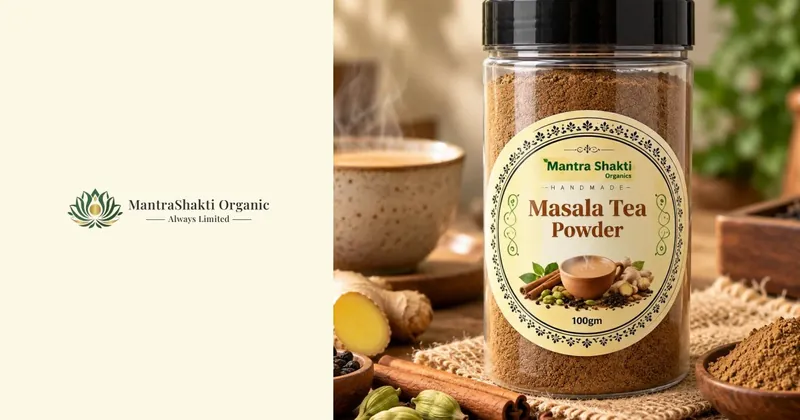
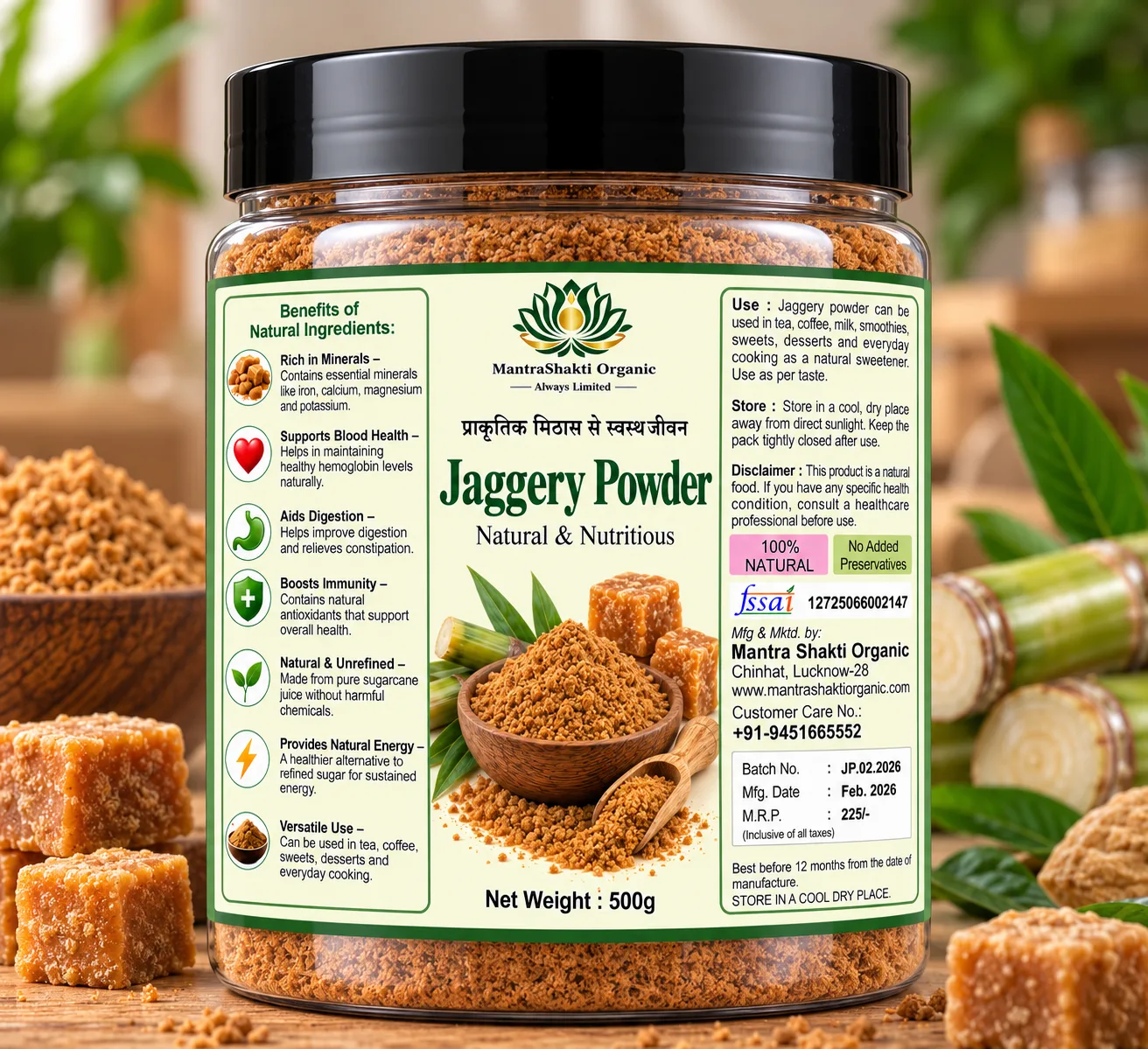
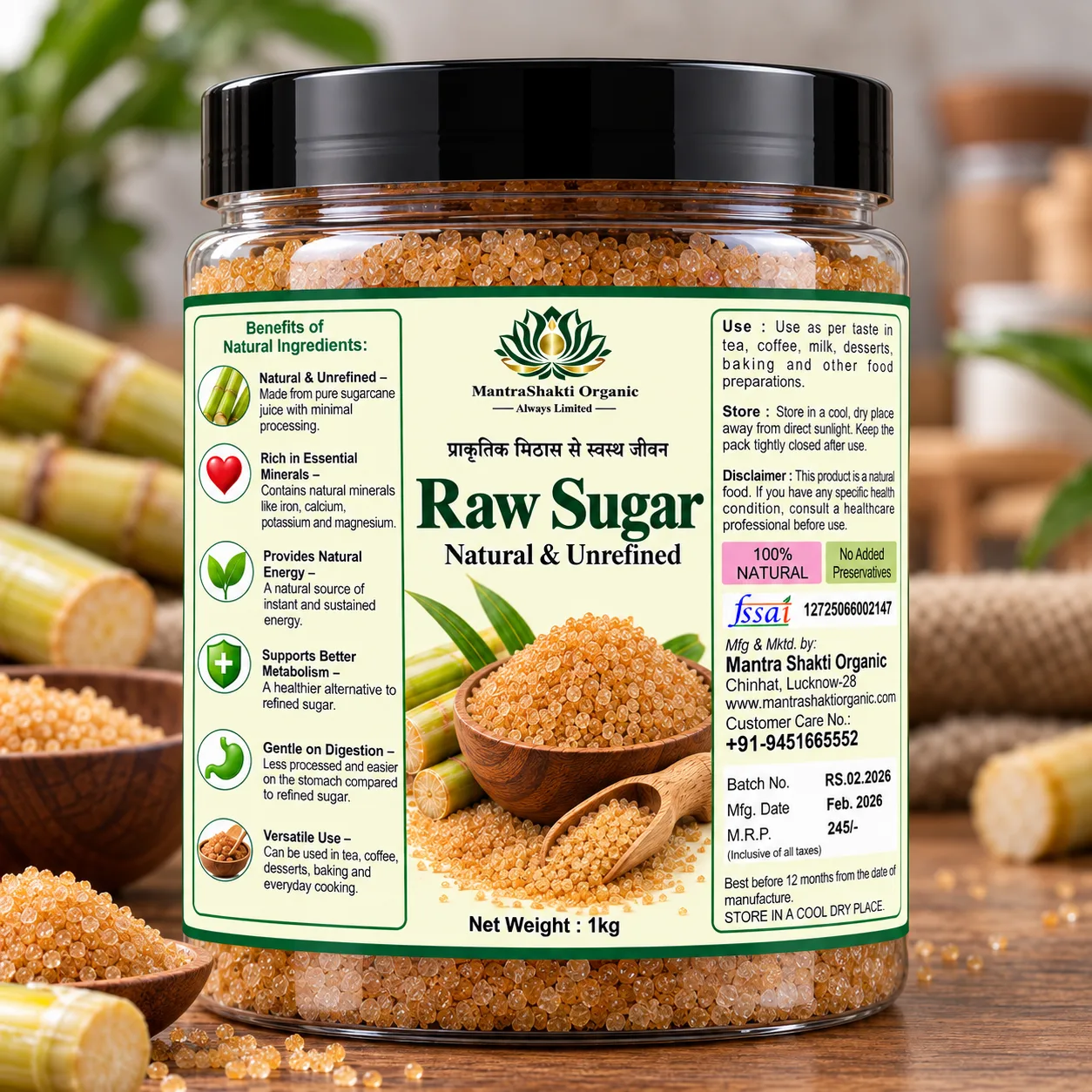
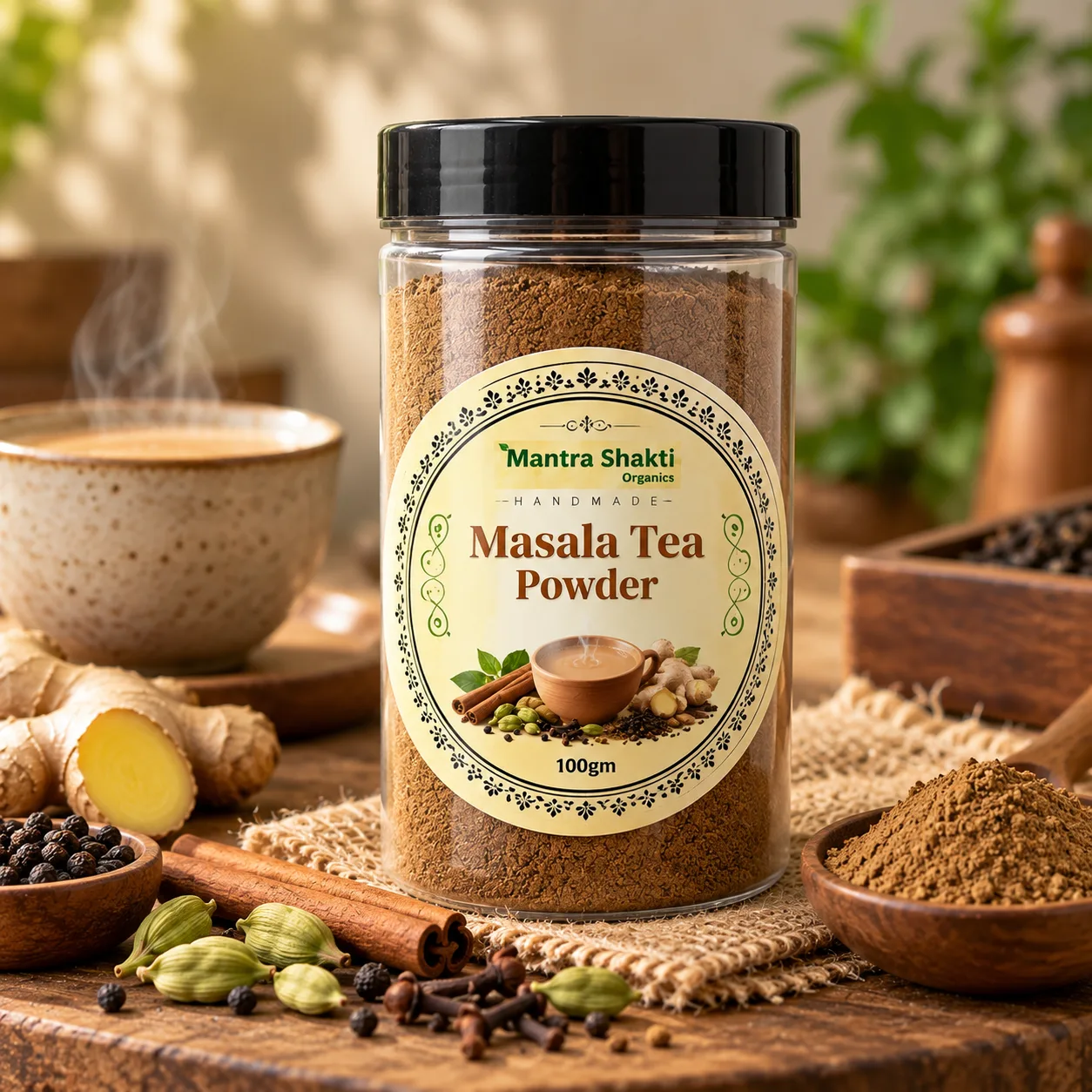
Our Jaggery Powder is a single-ingredient pack, packed in small lots at our workshop in Chinhat, Lucknow, at ₹225 for 500 g. Because nothing is added to keep it free-flowing, it behaves like any plain jaggery powder: keep it sealed and dry. If you would rather use a plain cane sugar, our Raw Sugar is a separate product at ₹245 for 1 kg, and the Masala Tea Powder (₹149 for 100 g) works with either. You can read more about the people behind the packs in who makes MantraShakti Organic.
Frequently asked questions
Is jaggery powder the same as jaggery?
Yes. Jaggery powder is jaggery in granular form, made from the same boiled cane juice as a block. The block is poured into a mould; the powder is rubbed or ground into grains, sieved and dried. Use them weight for weight. The differences are how fast they dissolve and how readily the powder takes up moisture.
Is jaggery powder the same as shakkar or brown sugar?
Not exactly. Shakkar has no FSSAI definition and is used loosely, from plain sugar to granulated jaggery, so check the product name. Brown sugar is white sugar with molasses added back, and khandsari is a different open-pan sugar with a higher sucrose minimum. Jaggery powder is cane jaggery in granular form.
How is jaggery powder made?
Cane juice is filtered, clarified and boiled to about 120 degrees C. The thick slurry is rubbed with a wooden scraper to form grains, then cooled, sieved and sun-dried to under 2 per cent moisture. Another route cools and dries blocks or cubes in the sun and grinds them into powder.
Can you swap jaggery powder for a jaggery block in a recipe?
Yes, by weight. Grate or chop the block and weigh it, or weigh the powder, and use the same amount. Measuring by spoon is unreliable because the two forms pack differently. For halwa, kheer or chai in place of sugar, start with the same weight, dissolve it, add it near the end and taste, since jaggery can taste a little less sweet.
What is the shelf life of jaggery powder?
A sealed pack keeps until the date printed on it. After opening, storage life depends mainly on humidity and temperature: reviews say jaggery keeps longest at under about 6 per cent moisture and 43 to 61 per cent relative humidity. Use an airtight jar and a dry spoon, and discard jaggery that smells sour, shows mould or liquefies.
Why does jaggery powder turn into hard lumps, and how do you stop it?
Jaggery is hygroscopic and pulls moisture from humid air, so powder clumps and then sets hard as it dries. Store it in an airtight steel or glass jar, use a dry spoon and keep it away from steam and the sink. Research on jaggery granules shows they cake unless an anti-caking agent is added.
How do you make jaggery powder at home from a block?
Chop a hard, dry block, grind it in short pulses in a dry grinder jar and sieve out coarse pieces. Do it on a dry day and store the powder straight away in an airtight jar. Makers sun-dry jaggery cubes before grinding them, and a damp block will gum up the grinder.
How do you soften hardened jaggery?
For cooking, simply break, grate or dissolve it. To soften it, seal it in a container with a slice of bread for about a day, as University of Illinois Extension suggests for hard brown sugar, then remove the bread. Discard jaggery that smells sour, has mould or has liquefied.
Sources and further reading
- Food Product Standards, Chapter 2.8: Sweetening agents including Honey (FSSAI) FSSAI's definitions and sucrose limits for cane jaggery, palm jaggery, khandsari, bura and white sugar.
- Reading Manual for Jaggery under the PMFME Scheme (NIFTEM, Ministry of Food Processing Industries) Forms of jaggery, the 115 to 118 degrees C striking point, and how moisture damages jaggery in storage.
- Model Detailed Project Report: Jaggery Powder Unit (NIFTEM, Ministry of Food Processing Industries) The sun-drying and grinding route to jaggery powder.
- The Art and Science of Jaggery Making: A Review (Agricultural Reviews, 2022) Granular and liquid jaggery end points, moisture and humidity limits for storage.
- Effect of Anti-Caking Agents on Handling Characteristics of Cane and Palm Jaggery Granules (Journal of Agricultural Engineering, 2023) Caking and hygroscopicity of jaggery granules, with and without anti-caking agents.
- What Makes Brown Sugar Brown? (University of Illinois Extension) Brown sugar as white sugar with molasses added back, and softening hard sugar with bread.
Written by the MantraShakti Organic workshop team, Chinhat, Lucknow. This is general kitchen information, not medical advice. Jaggery is a sugar; if a doctor has asked you to limit sugar, count it as sugar and follow that advice.
Shop this guide
Made by hand in small batches in Lucknow.
More from the Journal
09 Nov 2026 · 13 min
What Is Char Magaz? The Four Seeds and How Indian Kitchens Use Them
Read more →