Gud Ki Chai Without Curdling: When to Add Jaggery to Milk Tea
Why does gud ki chai curdle, and when should you add the jaggery?
Gud ki chai curdles when milk's casein clumps together, which happens when the mix turns too acidic and too hot at once. The fix is timing: finish the chai, switch off the flame, wait 30 to 60 seconds for the bubbling to settle, then stir in the jaggery powder, ideally dissolved in a little hot water first.
Many cooks add jaggery to hot chai and never see it split, so this is a margin problem, not a rule. Old milk, strong tea, a hard boil and an unlucky lot of jaggery each use up a little of the milk's stability, and the last push tips it over. This guide explains the dairy science in plain words, the order that works, quantities for one, two and four cups, and what to do when a cup has already split.
Key takeaways
- Fresh milk sits near pH 6.6, and its casein clumps out of suspension as the pH falls towards 4.6. Heat lowers the bar: dairy labs use a boil test to catch milk below about pH 5.8.
- Brewed black tea is itself mildly acidic (one dental-journal study measured a tea solution at pH 4.9), so strong, long-boiled tea has already used up some of the milk's margin before the jaggery goes in.
- Jaggery has no fixed acidity: FSSAI's standard for cane jaggery limits moisture, sugars, ash and insoluble matter but sets no pH, so rely on timing, not guesswork.
- Add jaggery after the flame is off and the bubbling has settled, never into boiling chai. Dissolving it in a spoonful of hot water first is gentler still.
- Start with 1 level teaspoon of jaggery powder per 200 ml cup and adjust in half-teaspoons.
- Fresh milk matters more than the shape of the jaggery: powder dissolves faster than a block, but old milk splits with either.
Why does milk curdle when you add jaggery to tea?
Milk curdles when it runs out of stability margin. Its casein particles stay evenly spread only while the milk is close to its natural acidity, and every acidic or hot thing you add narrows the gap between a smooth cup and a split one.
Here is the mechanism. Fresh milk has a pH of about 6.6. At that acidity each casein particle carries a negative charge, so the particles repel one another and stay suspended, according to Virtual Labs course material on casein. Acid cancels that charge. As the pH falls towards about 4.6, casein's isoelectric point, the particles stop repelling, stick together and separate from the watery whey as curds. It is the same chemistry that sets dahi and paneer: acid, whether from bacteria or from lemon juice, sets milk.
Heat narrows the margin further. Indian dairy courses teach a clot-on-boiling test for incoming milk: a small sample is brought to the boil and checked for clots. A Virtual Labs page says the test picks out highly acidic milk (below about pH 5.8) and that milk which clots has poor heat stability. A dairy-technology text published through INFLIBNET adds that milk made acidic by bacterial growth coagulates when heated to boiling, and that the acidity at which this happens varies with the milk's salt balance. Slightly acidic milk can stay liquid at room temperature and still clot once boiled, and that gap is why the test exists.
| Factor | Why it matters | What you can do |
|---|---|---|
| Milk a few hours past fresh | Bacterial growth makes lactic acid, so the milk starts closer to the edge | Use fresh milk and do the spoon test in the method below |
| Strong, long-brewed tea | A black-tea solution measured pH 4.9 in one study, so more decoction means more acid meeting the milk | Brew for a couple of minutes, not until the pan turns black |
| A hard rolling boil | Heat is what turns a marginal mix into curds, and the base of the pan runs hotter than the middle | Use a medium flame and switch off before the jaggery goes in |
| Jaggery added early | Cane juice is naturally acidic and its salts end up in the jaggery, and every lot is made a little differently | Add it last, off the heat, ideally dissolved |
| Lemon or any added acid | A direct acid load on the milk | Keep lemon for milk-free chai |
How much is jaggery really to blame?
Jaggery's part is the hardest to pin down, because "jaggery is acidic" is only half the story. The jaggery-processing deck from NIFTEM, a training institute under the Ministry of Food Processing Industries, describes raw cane juice at about pH 5.6. One clarification method in the same deck raises the juice to about 6.8 with lime solution and then lowers it to about 6.0 with phosphoric acid before boiling. What reaches your pack therefore depends on how the maker worked.
FSSAI's standard for cane jaggery lists limits for moisture, sucrose, total and reducing sugars, sulphate ash, acid-insoluble ash and insoluble matter, but no pH. It allows sulphate ash of up to 4 per cent of the dry weight. Because milk's salt balance affects when it clots on boiling, the salts in a lot may matter as much as its acidity.
We could not find a published study that measures jaggery's effect on milk in a chai pan, so read this as established dairy science applied to a cup, not a proven law. The 30 to 60 seconds in this guide is a kitchen rule of thumb, not a measured threshold.
When should you add jaggery powder to tea?
Add jaggery powder last: after the milk has boiled, the flame is off and the bubbling has settled, or straight into the cup before you strain the chai over it. Do not add it to boiling chai, and avoid putting it in the water with the tea leaves when the chai will also hold milk.
The table ranks the usual timings by how much strain they put on the milk. The ranking is our reading of the science above, not a lab measurement.
| When the jaggery goes in | What happens | Risk of splitting |
|---|---|---|
| Into chai that is boiling | Jaggery meets hot milk at its most reactive, and the milk around each granule is briefly far more concentrated than the rest | Highest |
| In the water at the start, then milk, then a full boil | Tea acid, jaggery and heat all act on the milk for the whole boil | High |
| After switching off and waiting 30 to 60 seconds | The boil is over, and the jaggery dissolves into the whole pan | Low |
| Dissolved in 1 to 2 tablespoons of hot water, stirred in off the heat | The jaggery meets the milk already dissolved and spread out | Lowest for an in-the-pan method |
| In the cup, with the chai strained over it | The jaggery dissolves into a cup-sized volume of chai that has cooled a little on the pour | Low, and nothing to scorch |
| Milk-free chai | No casein to clump | None |
Why does a short wait off the flame help? The boil is over, the pan is no longer heated from below, and the jaggery has the whole panful to spread into instead of meeting a small amount of milk at its hottest. Dissolving it first goes one step further. The principle, which is our reading rather than a measured result, is that the less time any ingredient spends in a hot, concentrated pocket, the safer the milk.
How do you make gud ki chai at home (gud ki chai kaise banaen)?
Make the chai exactly as you normally would, with water, chai patti, spices and milk, then switch off the flame and add the jaggery last. This quantity makes two cups of about 200 ml each; scale it in the same proportions.
- 300 ml water and 200 ml fresh milk (about 1.5 parts water to 1 part milk; use 2 to 1 for a lighter cup)
- 3 level teaspoons (1 tablespoon) of chai patti (CTC tea leaves)
- A small piece of crushed adrak (ginger) and 1 to 2 crushed elaichi pods, or ⅛ to ¼ teaspoon of masala tea powder per cup
- 2 level teaspoons of jaggery powder for medium-sweet cups
- Test the milk. Bring two tablespoons of the milk to a boil in a small steel pan and look at the pan wall and the spoon. Smooth means go ahead. Specks or clots mean this milk is likely to split in the chai whatever you do, so use another packet. This is a kitchen version of the dairy clot-on-boiling test, not an official procedure.
- Make the decoction. Boil the water with the chai patti and the ginger or masala for about two minutes at a steady boil.
- Add the milk. Pour it in, bring the pan back to the boil and let it rise once. Lower the flame for a minute if you like a deeper colour.
- Switch off and wait. Turn off the flame and wait 30 to 60 seconds, until the bubbling stops and the foam settles.
- Prepare the jaggery. Put the jaggery powder in the cups, or stir it into a tablespoon or two of hot water in a small bowl first.
- Strain and stir. Pour the chai through a strainer over the jaggery and stir for ten seconds. Taste, and add more in half-teaspoon steps if you want it sweeter.
- Serve at once. Do not put the pan back on the flame. If you need another round, make a fresh pot.
How much jaggery powder per cup of chai?
Start with 1 level teaspoon of jaggery powder for a 200 ml cup of chai and move in half-teaspoon steps. A level spoon of jaggery powder does not taste exactly like a level spoon of white sugar, so match your usual sugar quantity first, taste, and then adjust.
The reason is composition. FSSAI's standard asks for at least 70 per cent sucrose in cane jaggery (dry weight), against at least 98 per cent for plantation white sugar. The rest of the jaggery is other sugars, ash and insoluble matter, and the powder also carries some moisture. A spoon of jaggery powder therefore holds less sucrose than a spoon of refined sugar, and its sweetness arrives with a deeper, molasses-like background.
| Cups of chai | Lightly sweet | Medium | Sweet |
|---|---|---|---|
| 1 cup | ½ teaspoon | 1 teaspoon | 1½ teaspoons |
| 2 cups | 1 teaspoon | 2 teaspoons | 3 teaspoons (1 tablespoon) |
| 4 cups | 2 teaspoons | 4 teaspoons | 6 teaspoons (2 tablespoons) |
Cups differ, so scale the spoons to the volume you pour: a small kulhad needs less than a tall steel glass. Jaggery is a sugar, and it is sensible to count it as one. If a doctor has asked you to limit sugar, follow that advice for jaggery as well.
Is jaggery powder or a jaggery block better for chai?
Powder is more convenient for chai because it dissolves in seconds and is easy to measure; a block works just as well once it is grated or crushed fine. The form matters far less than the timing and the freshness of the milk.
| Point | Jaggery powder | Jaggery block (bheli) |
|---|---|---|
| Dissolving | Dissolves in seconds in chai that has stopped bubbling | Needs grating or crushing first; a large lump dissolves slowly and tempts you to stir it over the flame |
| Measuring | A level spoon, the same cup after cup | By eye or by grating, so sweetness drifts from cup to cup |
| In humid months | Takes up moisture and can set into lumps, so keep it airtight | Keeps its shape, but the surface can turn sticky |
| Suits | You make chai daily and want repeatable cups | You like to grate fresh, or only make jaggery chai now and then |
Can you make masala chai with jaggery?
Yes. Make masala chai the usual way, with the spices in the water, and move only the jaggery to the end. Spices go in early because they give up their flavour in boiling water; jaggery goes in late because it is the one ingredient that can upset the milk.
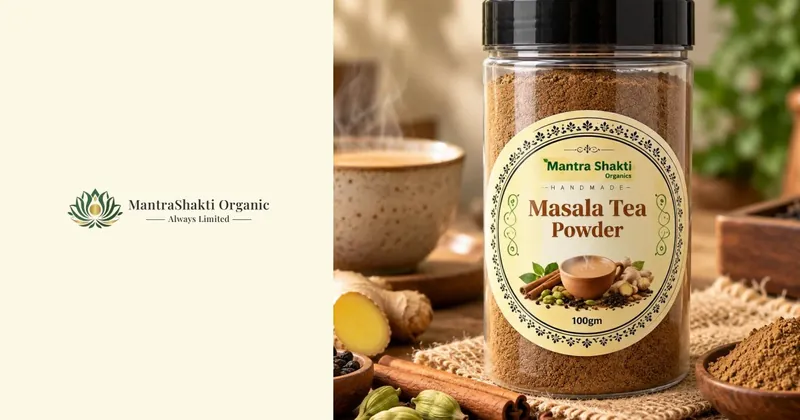
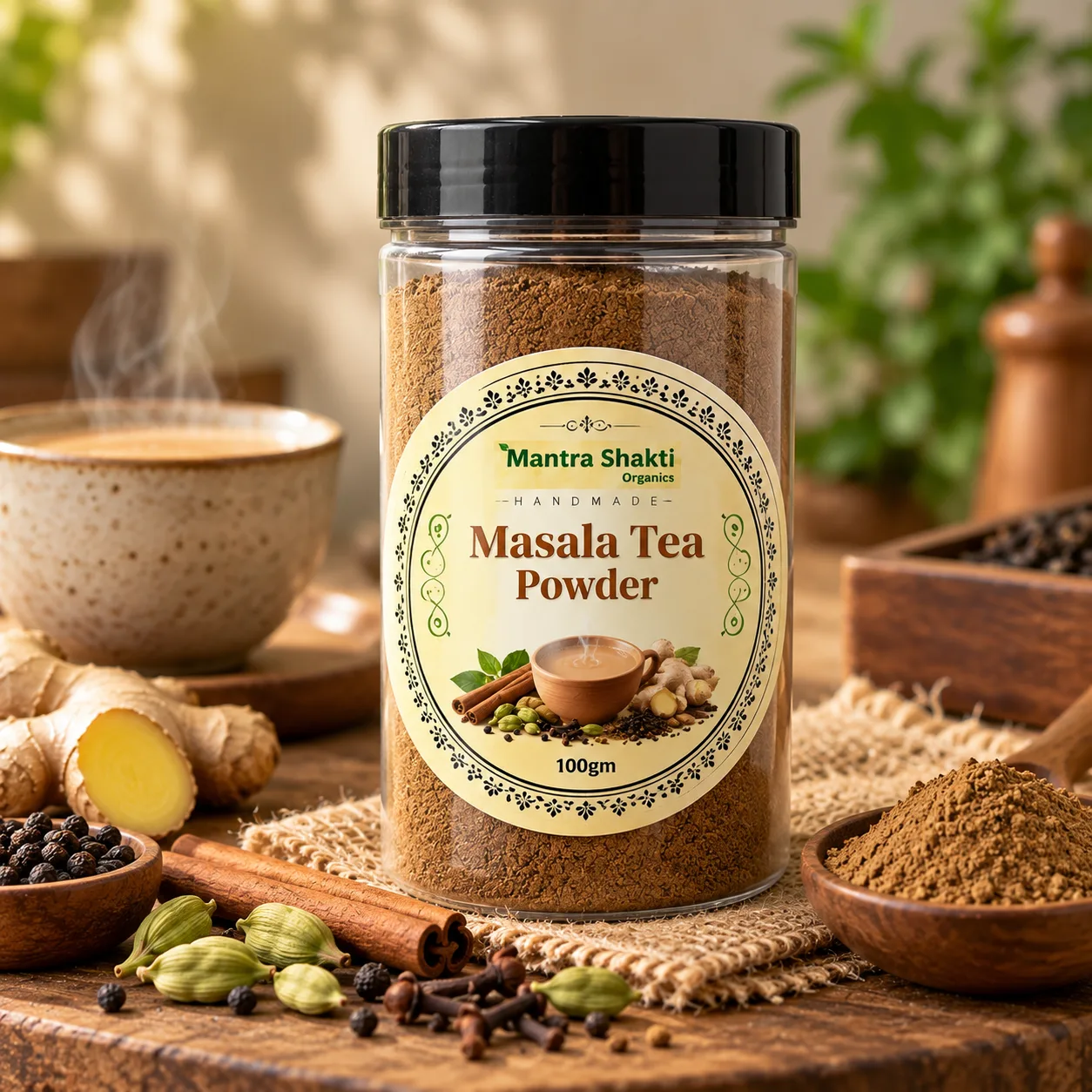
Our Masala Tea Powder is made from cardamom, cinnamon, cloves, ginger and black pepper. Start with ⅛ to ¼ teaspoon per cup, added with the chai patti, and raise it on later cups once you know how pungent you like it. Jaggery's deeper, molasses-like sweetness is a different background from white sugar's clean sweetness, so a recipe that tasted balanced with sugar may need a little more spice or a little less sweetener.
Can you make gud ki chai without milk?
Yes, and then there is nothing to curdle. Boil water with chai patti, crushed ginger and spices for three or four minutes, strain it, and stir the jaggery in at any point, even while it is still hot. Lemon also becomes an option in this version, because curdling is a milk problem: acid and heat split milk, not black tea.
My gud ki chai has already split. What now?
Split chai cannot be turned back into smooth chai, but the look of the curds tells you what went wrong. Fine specks point to timing; large curds in a thin, clear liquid point to the milk. If the milk smelled or tasted sour before you cooked with it, do not drink the chai.
| What you see | Most likely cause | What to do next time |
|---|---|---|
| Fine white specks, chai looks grainy | Milk close to its limit, plus jaggery added while the chai was still bubbling | Switch off first, wait, and dissolve the jaggery in hot water before adding |
| Large curds floating in thin brown liquid | Milk already acidic, or a long boil with strong tea and jaggery together | Run the spoon test on the milk, shorten the boil and add jaggery last |
| First cup fine, reheated second round splits | The mix has already met tea and jaggery, so another round of heat has less margin to work with | Make each round fresh instead of reheating |
| Bitter, harsh taste | Tea leaves boiled for too long, or jaggery scorched on the base of the pan | Keep the boil to a couple of minutes and keep jaggery off the flame |
| Salty, soapy or "off" flavour | The jaggery lot itself, since clarifying and boiling differ from maker to maker | Dissolve a pinch in warm water and taste it alone; if it tastes off by itself, it will in chai |
| Thin film of fine sediment at the bottom of the cup | Usually normal: FSSAI allows up to 2 per cent extraneous and water-insoluble matter by dry weight | Leave the last sip; a thick gritty layer is a quality question for the seller |
| Undissolved bits of jaggery | Lumps too big, or stirred too briefly | Use powder, or grate a block finely, and stir for ten seconds |
Common mistakes with gud ki chai
- Dropping jaggery into boiling chai. It is the most common cause of a split cup, because heat and a concentrated pocket of jaggery reach the milk together.
- Adding jaggery to the water at the start of a milk chai. Tea, jaggery and a full boil then all work on the milk at once.
- Using milk that has sat out. A warm kitchen speeds up souring, and sour milk splits in any chai.
- Boiling the leaves for ages. It makes the chai bitter and puts more acid in front of the milk.
- Reheating a finished cup, or squeezing lemon into milk chai. Both add another push to a mix that is already close to its limit.
How we pack our jaggery powder
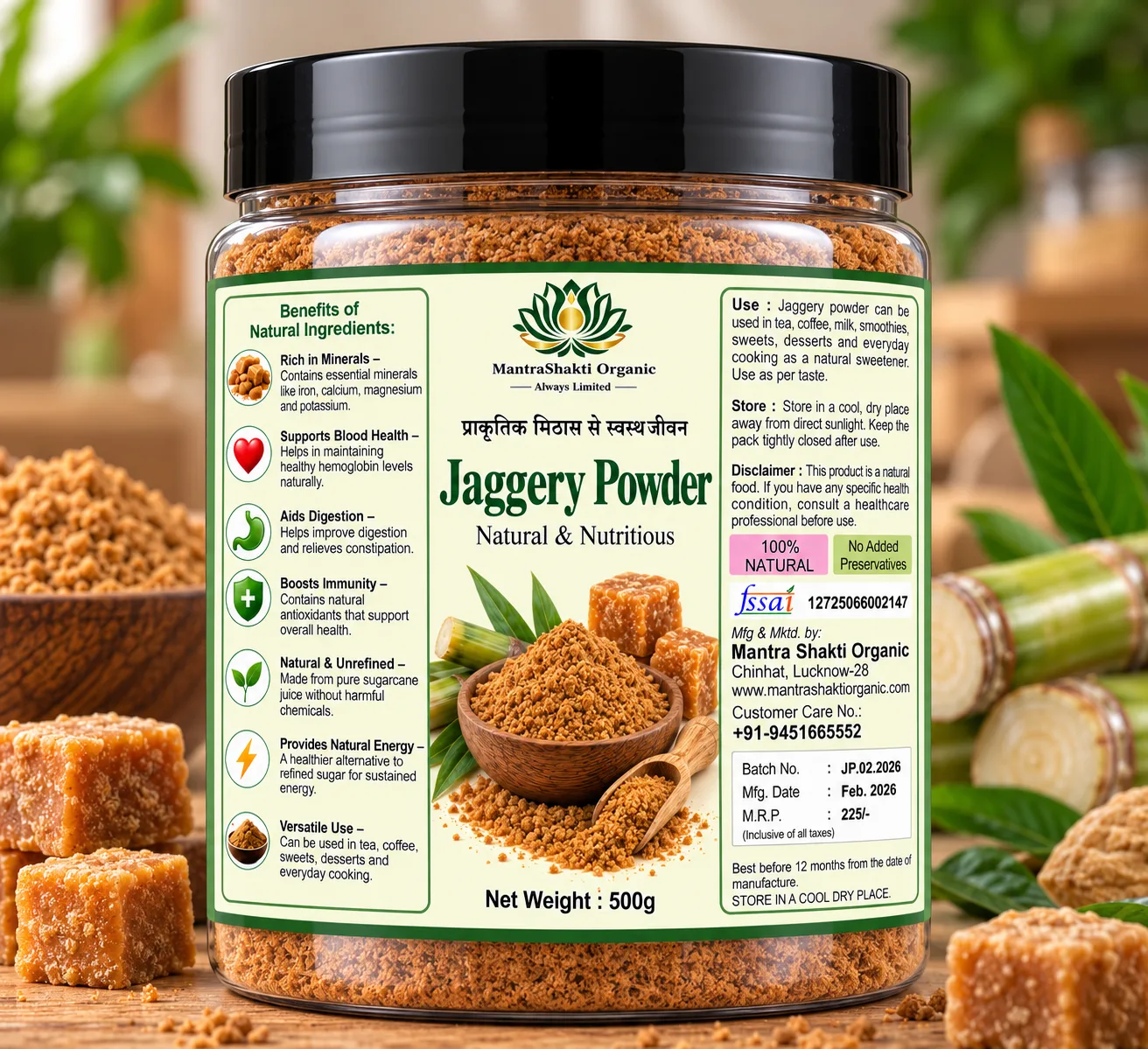
Our Jaggery Powder is a single-ingredient pack, packed in small lots at our workshop in Chinhat, Lucknow, at ₹225 for 500 g. The Masala Tea Powder is ₹149 for 100 g. Keep both packs sealed and away from the steam over the stove. You can read more about the people behind the packs in who makes MantraShakti Organic, and browse the rest of the pantry range.
Frequently asked questions
Why does my gud ki chai curdle?
Because the milk's casein has clumped together. That happens as the milk is pushed towards roughly pH 4.6, and heat, old milk, strong tea and an unlucky lot of jaggery all push in that direction. Most often the jaggery went into chai that was still boiling, or the milk was already slightly sour. Add jaggery after switching off the flame, and test the milk first.
When should I add jaggery powder to tea?
Last. Switch off the flame, wait 30 to 60 seconds until the bubbling settles, then stir the jaggery in, or put it in the cup and strain the chai over it. Dissolving it in a spoonful of hot water first is gentler on the milk. For milk-free tea you can add it at any point.
Can we add jaggery in milk tea?
Yes, as long as it goes in off the heat. The risk is not jaggery itself but the combination of heat, acid and older milk. With fresh milk, a switched-off pan and well-dissolved jaggery, most cups come out smooth.
How much jaggery powder should I use for one cup of chai?
Start with 1 level teaspoon for a 200 ml cup, use half a teaspoon for a lightly sweet cup and a teaspoon and a half for a sweet one. Jaggery powder does not taste exactly like sugar spoon for spoon, so taste after stirring and adjust in half-teaspoons.
Is jaggery powder or a jaggery block better for chai?
Powder is easier because it dissolves in seconds and is simple to measure. A block works too if you grate or crush it finely. Timing and fresh milk matter more than the form. Keep either one airtight, because jaggery picks up moisture in humid months.
Can I make masala chai with jaggery?
Yes. Boil the spices with the water and chai patti as usual and add the jaggery last, off the heat. Jaggery tastes deeper and rounder than white sugar, so you may want slightly more or less spice than in your sugar recipe. Taste, then adjust.
Can I rescue chai that has already curdled?
Not really. Once the casein has clumped, stirring will not make the chai smooth again. If the milk smelled and tasted fresh and the curds are fine, you can strain it and drink it. If the milk was sour, throw it away and start again with a fresh packet.
Why does my gud ki chai taste bitter or salty?
Bitterness usually comes from tea leaves boiled for too long or jaggery scorched on the base of the pan. A salty or soapy note can come from the jaggery lot, since makers clarify and boil cane juice differently. Dissolve a pinch in warm water and taste it alone to find out.
Sources and further reading
- Isoelectric Precipitation of Proteins: Casein from Milk (Virtual Labs, Biochemistry Virtual Lab I) Casein's isoelectric point (about pH 4.6) and the pH of milk (about 6.6).
- Platform Tests of Milk (Virtual Labs, Dairy Technology Lab) The clot-on-boiling test and what a clot says about milk's acidity and heat stability.
- Raw milk quality and Market milk, in Technology of Milk and Milk Products (INFLIBNET) Acidic milk coagulates on boiling, and the acidity at which it clots varies with salt balance.
- Jaggery Processing (NIFTEM, Ministry of Food Processing Industries) Cane juice pH and how it is adjusted during clarification.
- Is black tea better for your teeth than acidic soft drinks? (British Dental Journal, 2001) A black-tea solution measured at pH 4.9.
- Food Product Standards, Chapter 2.8: Sweetening agents including Honey (FSSAI) FSSAI's standard for cane jaggery: sugar, ash and insoluble-matter limits, with no pH limit.
Written by the MantraShakti Organic workshop team, Chinhat, Lucknow. This is general kitchen information, not medical advice.
Shop this guide
Made by hand in small batches in Lucknow.
More from the Journal