
How to Use Multani Mitti on Face: Time, Frequency and Aftercare

How do you use multani mitti on your face?
How to use multani mitti on face: mix a tablespoon of the powder with rose water or plain water into a smooth paste, apply a thin layer to a clean face (not eyes or lips), and rinse after 10–15 minutes, once dry to the touch but before it cracks. Pat dry and moisturise.
Key takeaways
- Time: 10–15 minutes is the usual window. Go by touch, not the clock: rinse when the layer feels dry and slightly tight, not when it has cracked.
- Frequency: start with once a week. Dry or sensitive skin does better with a week or two between packs, and daily use (roj lagana) is not a good idea.
- Before you start: patch-test on your inner forearm, wash your face, and skip the pack if your skin is broken, sunburnt or irritated.
- After you rinse: pat dry and moisturise straight away, as dermatologists advise after any face mask. Add sunscreen if you are heading out in daylight.
- Soap is not needed: plain water removes the clay. A second wash is optional and should be gentle.
- Honest limit: multani mitti is a cleansing, oil-absorbing clay. A short paper in a dermatology journal found no scientific evidence that it works as a therapy, so this guide sticks to how to use it, not what it will do for your skin.
What is multani mitti, and what does it actually do on skin?
Multani mitti is fuller's earth, a fine, naturally occurring clay named after the city of Multan. It has been used across South Asia for generations as a household cleanser for skin and hair. On skin its job is physical: as the paste dries it soaks up surface oil and picks up dirt, which is why a rinsed-off pack leaves skin feeling clean and matte, and sometimes tight.
That is where the evidence stops. A short paper in the Journal of the Pakistan Association of Dermatologists (2019) looked through the literature and noted that the clay's strong adsorbing quality makes it plausible that it lifts oil from the face. It found no scientific evidence of therapeutic effects and concluded that the clay has no role as a therapy in dermatology. The American Academy of Dermatology (AAD) likewise lists clay among the ingredients that absorb oil, and says a face mask cannot replace professional care for a skin condition. Keep that in mind when you read bold promises elsewhere. This guide is only about using multani mitti well and not letting it dry your face out.
What should you do before you put it on?
Patch-test the powder, wash your face, and check that your skin is in a fit state for a drying clay. Five minutes of preparation matters more than the exact recipe.
- Patch-test. Mix a small amount, dab a coin-sized patch on the inside of your elbow or the underside of your forearm, leave it for the time you plan to use it, rinse, and look at the spot after a day. Redness, itching, swelling or burning means this clay, or the liquid you mixed it with, is not for your face. The AAD's more thorough method for any new product is to repeat it on a quarter-sized spot twice a day for seven to ten days, and even a clear result does not rule out a reaction later.
- Cleanse. Wash with your usual gentle face wash and pat dry. Take off sunscreen and make-up first. The AAD advises cleansing up to twice a day and after sweating, and not scrubbing.
- Pick your moment. An evening at home works well, because you can moisturise straight after and stay in. Tie your hair back and keep a soft, clean cotton cloth ready.
- Check your skin. Skip the pack on skin that is broken, sunburnt, itchy or already irritated. If you use prescription skin creams, retinoids or exfoliating acids, ask your dermatologist before adding a clay pack. Those products already dry the skin, a clay pack can add to that, and the AAD warns against doubling up on products with overlapping effects.
How do you mix multani mitti for a face pack?
Start with one tablespoon of powder and add liquid a teaspoon at a time until you have a smooth paste about as thick as hung curd. It should spread without dripping. That usually takes one to two tablespoons of liquid, but fine powder, a warm room and a humid day all change the amount, so go slowly.
- Plain water or rose water (gulab jal). Both work for cleansing. Rose water adds fragrance, which the AAD lists among the common irritants in face masks, so use plain water for your first pack or two and try rose water once you know your skin is comfortable. Other liquids change the texture and how fast the pack dries, so keep the first pack simple.
- A clean, dry bowl and spoon. Glass, ceramic or steel is fine. Stir with the back of the spoon until no lumps remain, because lumps dry unevenly and tug.
- Mix fresh, every time. A wet paste can spoil, so make only what you will use now and throw away what is left. Do not mix a week's worth and store it in the fridge.
- Keep it plain at first. Hold off on lemon juice, essential oils and other add-ins. The AAD lists fragrance and essential oils among the ingredients to avoid in facial masks.
How do you apply and remove multani mitti, step by step?
Apply a thin, even layer, watch it by touch, then loosen it with water before you rinse. Never rub dried clay off with a dry cloth.
- Wash your hands and your face. Pat your face nearly dry. Slightly damp skin lets the paste glide on more easily.
- Mix a fresh paste as above: one tablespoon of powder, liquid added a teaspoon at a time.
- Apply a thin, even layer with clean fingertips or a clean, flat brush: forehead, nose, cheeks, chin and jawline. Aim for a coat you can still see your skin tone through. Keep it off your eyes, eyebrows, lips and the inside of your nostrils.
- Set a timer for 10 minutes and sit back, indoors and away from a fan or direct sun, which dry the layer too fast. Try not to talk, laugh or frown, because a drying layer cracks and tugs wherever your face moves.
- Check by touch. At 10 minutes press a clean fingertip on the edge of the layer. If it feels dry and slightly tight, rinse now. If it is still damp and cool, give it up to five more minutes. If you feel itching, burning or stinging at any point, rinse it off immediately.
- Loosen it first. Wet your fingertips with lukewarm water and massage gently in small circles, or rest a soft, damp cotton cloth on your face for a few seconds before wiping. Do not scrub and do not pick at dry patches.
- Rinse until the water runs clear. Check the hairline, the sides of the nose and the jawline, where clay likes to hide.
- Pat dry with a clean towel. Pat, do not rub.
- Moisturise within a few minutes, while your skin is still slightly damp, and put on sunscreen if it is daytime.
How long should you leave multani mitti on your face (kitni der)?
Ten to fifteen minutes is the usual range, and the cleaner rule is to rinse when the layer is dry to the touch and slightly tight, before it cracks. If you are new to it, start at 10 minutes.
Published advice is not unanimous, so here is how we reached that. A medically reviewed Healthline guide to green clay masks suggests 10 to 15 minutes, or whatever the label says, and rinsing once the mask is dry to the touch and feels tight. The AAD gives no clay-specific time, but it says to follow the label and warns that leaving any mask on longer than intended can cause irritation. Some websites tell you to wait until the clay is bone dry and cracked, or to leave it on for 30–40 minutes. Our reasoning is the other way round: a clay works by drawing moisture out as it dries, so extra minutes mostly add tightness, not extra cleansing. No study has set a leave-on time for plain multani mitti, so we sit at the cautious end.
The clock is only a guide. A thin layer dries faster in dry winter air than in a humid monsoon bathroom, and a thick layer takes longer than a thin one. Use this as a quick check:
| What you see and feel | What it means | What to do |
|---|---|---|
| Darker, glossy, wet-looking and cool to the touch | Still damp; the clay has barely started to dry | Keep waiting and check again in a few minutes |
| Lighter in colour, edges dry, feels slightly tight | Dry to the touch, the point most guides rinse at | Rinse now |
| Cracked, chalky, or pulling when you move your face | Left on too long | Dampen it with water to soften it, rinse well, moisturise generously |
| Itching, burning or stinging at any stage | Possible irritation or allergy | Rinse off at once and stop using it; see a doctor if it does not settle |
How often can you use multani mitti on your face (roj laga sakte hain)?
Once a week is a sensible start for most skin types, and we would not go beyond twice a week even for oily skin. Daily use is not a good idea: clay is a drying, oil-absorbing product, and the AAD notes that face masks used too often can cause irritation, especially on very sensitive skin.
The same Healthline guide advises no more than once a week, and only once every couple of weeks for dry or sensitive skin. No study has tested a schedule for plain multani mitti, so use the table as cautious starting points and let how your skin feels the next morning decide.
| Skin type | Leave-on time | How often to start | Mix with | Straight after |
|---|---|---|---|---|
| Oily or shiny T-zone | 10–15 minutes | Once a week; twice a week only if your skin stays comfortable | Plain water or rose water | An oil-free moisturiser (oily skin still needs one) |
| Combination | 10 minutes | Once a week | Plain water | A light moisturiser, a little more on dry cheeks |
| Normal | 10 minutes | Once a week, or every other week | Plain water or rose water | Your usual moisturiser |
| Dry | 5–10 minutes, thin layer | Once every one to two weeks at most | Plain water | A cream rather than a thin lotion, applied while skin is still damp |
| Sensitive or reactive | 5 minutes, after a week-long patch test | Once a fortnight at most, or skip | Plain water | A fragrance-free moisturiser |
A simple way to build up: do the first pack at 10 minutes, then check your skin the next morning. If it feels comfortable, carry on weekly. If it feels tight, flaky or itchy, lengthen the gap, shorten the time or stop. If you like the clean feeling every day, a gentle face wash does that job daily and the clay stays a weekly extra.
What should you apply after multani mitti (lagane ke baad kya lagaye)?
Apply a moisturiser straight after you pat your face dry. The AAD's advice for any facial mask is to moisturise after washing it off, ideally while skin is still slightly damp. Choose a cream rather than a thin lotion if your skin is dry, and an oil-free moisturiser if it is oily, because oily skin still needs one.
- Sunscreen in the daytime. The AAD recommends a broad-spectrum, water-resistant sunscreen of SPF 30 or higher for sun protection.
- Keep the rest of the routine quiet on pack days. No scrubs or exfoliating acids straight after; the clay has already done its drying step.
- A splash of rose water feels pleasant, but it is a fragrance, not a moisturiser. Skip it if your skin is reactive.
Can you wash your face with soap after multani mitti?
You do not need to. Plain water is enough to rinse the clay off, and a second wash straight after a drying pack is more likely to leave skin tight than cleaner. If you want to cleanse, use a gentle face wash, massage it on with your fingertips, rinse and pat dry, in line with the AAD's advice to use a gentle cleanser and not to scrub.
If you prefer a bar, choose one made for the face. The Divya Snan Face Wash Bar is our handmade bar for the face, and our guide to choosing a Divya Snan bar explains the range. Many soaps and cleansers contain fragrance, which the AAD notes can irritate dry or sensitive skin, so patch-test any new bar before it goes near your face.
Who should be careful with multani mitti?
Anyone with dry, reactive or sensitive skin should go slowly. Anyone with a skin condition or an allergy, anyone who is pregnant, and anyone on regular medication should ask a doctor first. Multani mitti is a household clay, not a therapy for any skin condition.
- Dry, sensitive or reactive skin: patch-test for a week, use plain water, keep it to five minutes, and stop at the first sign of stinging.
- A skin condition or a recent skin procedure: ask a dermatologist before using a clay pack. The AAD advises seeing a board-certified dermatologist if your skin feels worse after using a facial mask.
- Pregnancy: ask your doctor first.
- Children: ask a doctor before using a clay pack on a child's skin.
- Never eat it. Cosmetic multani mitti is for external use only.
What are the most common multani mitti mistakes?
- Waiting until it cracks. Fully cracked clay pulls moisture from the skin and tugs as you move. Rinse when it is dry to the touch.
- Spreading it thick. A thick layer does not clean better. It dries unevenly and cracks at the edges, so keep the coat thin.
- Leaving it on for 30–40 minutes. Some websites suggest it. The AAD's rule is to follow the label and not go past the intended time, and for a plain powder we stay at 10–15 minutes.
- Using it every day from the start. Begin weekly and see how your skin feels the next morning.
- Rubbing it off dry. Dampen it first. Rinsing and patting beat scrubbing, which the AAD says irritates skin.
- Skipping moisturiser. It is the step people forget, and it is the one dermatologists specifically advise after a mask.
- Keeping leftover paste. A wet paste can spoil. Mix fresh each time.
- Adding things on a whim. Lemon juice, essential oils and kitchen add-ins can irritate. Stick to water or rose water until you know how your skin behaves.
How do we pack our multani mitti?
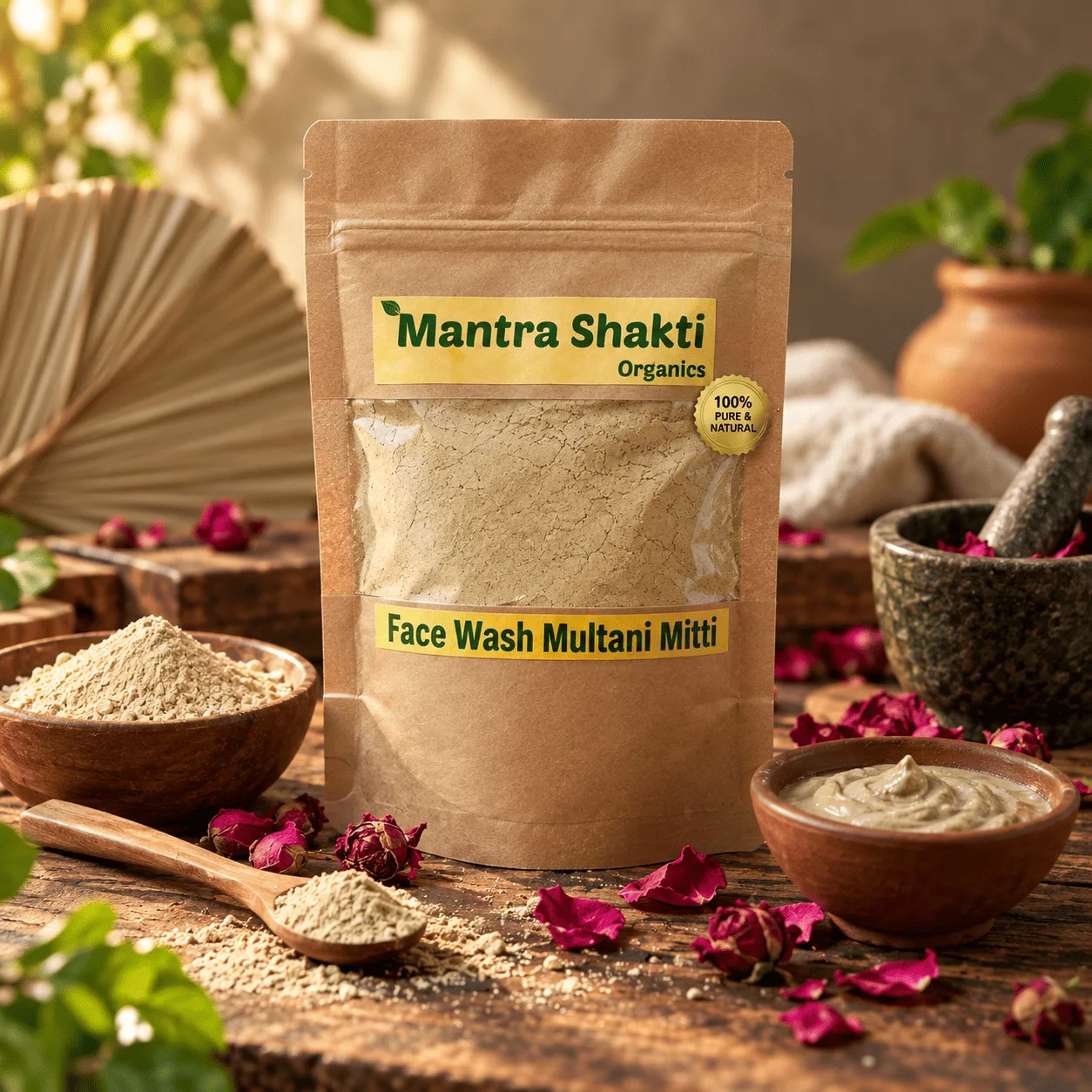
Our Multani Mitti Face Cleanser (100 g, ₹199) is a single-ingredient multani mitti (fuller's earth) powder, so you decide the liquid and the thickness of the mix. Like everything we sell, it comes from the family workshop in Chinhat, Lucknow, in small batches, and each pack is marked with a batch number and a use-before date. If you want a bar for the face instead, see the Divya Snan range.
Frequently asked questions
How long should you keep multani mitti on your face?
Ten to fifteen minutes is the usual range. Rinse when the layer is dry to the touch and feels slightly tight, before it cracks. If you are new to it, or your skin is dry or sensitive, start at five to ten minutes. If it stings, itches or burns at any point, wash it off straight away.
How many times a week can you use multani mitti?
Start with once a week. If your skin stays comfortable for a month, some people with oily skin go to twice a week, but we would not go beyond that. Dry or sensitive skin does better with a week or two between packs. No study has set a schedule for plain multani mitti, so let how your skin feels the next day decide.
Can we use multani mitti daily (multani mitti roj laga sakte hain)?
We do not suggest it. Multani mitti is a drying, oil-absorbing clay, and the American Academy of Dermatology notes that face masks used too often can irritate skin. If you like the clean feeling, use a gentle face wash every day and keep the clay as a weekly extra.
Should you let multani mitti dry completely before washing it off?
Rinse when it is dry to the touch and feels slightly tight, not when it has cracked and turned chalky. Fully drying and cracking pulls on the skin and adds dryness without cleaning any better. If it has cracked, dampen it with water to soften it before you rinse, and moisturise afterwards.
What should you apply after multani mitti (lagane ke baad kya lagaye)?
Pat your face dry and apply your usual moisturiser straight away, while the skin is still slightly damp. A cream suits dry skin, and an oil-free moisturiser suits oily skin, which still needs one. In the daytime add a broad-spectrum sunscreen of SPF 30 or higher. Skip scrubs and exfoliating acids on pack days.
Can you wash your face with soap after multani mitti?
You do not need to, because plain water rinses the clay off. If you want to cleanse, use a gentle face wash made for the face, massage it on with your fingertips and do not scrub. Patch-test any new cleanser first, and avoid harsh or heavily scented soaps straight after a drying pack.
Is multani mitti only for oily skin, or can dry skin use it?
It is most popular with oily and combination skin because the clay absorbs surface oil. Dry skin can try it with extra care: a thin layer for five to ten minutes, no more than once every week or two, a patch test first and a cream straight after. Stop if skin feels tight, itchy or flaky the next day.
Can multani mitti be used during pregnancy?
We cannot give medical advice on this. If you are pregnant, or have a skin condition, an allergy or take medication, ask your doctor before using a clay pack. Multani mitti is for external use only and should never be eaten.
Sources and further reading
The guidance above draws on these pages, which we opened and read. Where published advice disagrees, we say so in the text.
- American Academy of Dermatology: Do facial masks work, and should I add one to my skin care routine? – label directions, patch testing, irritation from overuse, moisturising after a mask, ingredients to avoid
- American Academy of Dermatology: How to test skin care products – the quarter-sized test spot and the seven-to-ten-day method, and why a clear result does not rule out a later reaction
- American Academy of Dermatology: Dermatologists' top tips for relieving dry skin – moisturising while skin is damp, cream versus lotion, patting dry, sunscreen
- American Academy of Dermatology: How to control oily skin – washing no more than twice a day, no scrubbing, why oily skin still needs a moisturiser
- Healthline: 11 Green Clay FAQs: Purported Benefits, Potential Risks, Tips for Use (medically reviewed, 2020) – 10 to 15 minutes, rinsing when dry to the touch, once a week at most, no aggressive towel wiping
- Kumar P. Multani Mitti: Is it more than a placebo? Journal of the Pakistan Association of Dermatologists, 2019 – what multani mitti is, its traditional use, and the lack of scientific evidence for therapeutic effects
Written by the MantraShakti Organic workshop team, Chinhat, Lucknow. This is general information, not medical advice. If you have a skin condition, an allergy, are pregnant or take medication, ask a doctor before using a clay pack.
Shop this guide
Made by hand in small batches in Lucknow.

More from the Journal