
How to Soak Chia Seeds: Ratios, Times and How to Stop Clumps
How do you soak chia seeds?
To soak chia seeds, stir them into plain water and wait 15 to 20 minutes, stirring again within the first few minutes so they do not clump. Use a teaspoon to a tablespoon per glass for a drink, or 2 to 3 tablespoons per cup of milk or curd for a pudding, chilled for a few hours.
Key takeaways
- Soak time: 15 to 20 minutes in water gives a drink full of gel-coated beads; a pudding needs a few hours in the fridge, or overnight, to set.
- Drink: a teaspoon of seeds per glass (about 250 ml) for a lightly beaded nimbu pani, up to a tablespoon for a thick, beady glass. Bloom the seeds in plain water first, then add lemon, salt or syrup.
- Pudding: 2 tablespoons of seeds per cup of milk or curd for a soft, spoonable pudding, 3 tablespoons for a firm one. In the lab, chia needed 15 g of seeds per 100 ml of water to hold its shape when tipped, roughly 3 tablespoons per cup.
- Clumps come from seeds landing in a heap. Scatter them into the liquid while stirring, then stir again a few minutes later.
- Do not eat dry chia on its own. The seeds swell as they take up liquid, so soak them or mix them into enough liquid first.
- Keep soaked chia and chia pudding covered in the fridge and use them within 3 days.
Why does the amount of chia change what you get?
Chia is a simple seed with one quirk: each seed wraps itself in a gel coat as soon as it touches water, and the amount of seed you use decides whether you get loose beads in a glass or one set pudding. Every number in this guide follows from that. We keep it to the kitchen: there is no dose here, only per-glass and per-jar quantities, and no health claims.
What is the right chia-to-liquid ratio for a drink, a gel and a pudding?
It depends on what you want to end up with. Under about 15 g of seeds per 100 ml, a chia mixture still flows: in a glass the seeds stay as separate beads, and in a bowl you get a soft, loose pudding. At 15 g and above it holds its shape even when tipped, which is a firm set.
The 15 g line comes from a 2018 study in Scientific Reports that soaked whole chia seeds in water at different seed-to-water ratios and judged a gel by whether it stayed put when the vial was turned upside down. Chia formed a gel at a seed-to-water ratio of 15% or higher. A tablespoon of chia seeds weighs roughly 12 g (weigh your own spoon once if you want to be exact), so 15 g per 100 ml is about 3 tablespoons in a 240 ml cup. Published pudding recipes sit just below and at that line, which is why a soft pudding and a firm one are only a tablespoon apart.
| Use | Seeds to liquid | Wait | What you get |
|---|---|---|---|
| Light drink: nimbu pani, sherbet, lassi | About 1 teaspoon of dry seeds per glass (250 ml), or 1 to 2 tablespoons of bloomed seeds | 15 to 20 minutes, stirred twice | Separate gel-coated beads floating in the glass |
| Thick, beady drink | Up to 1 tablespoon of dry seeds per glass | 15 to 20 minutes, stirred twice | A thicker glass; a tablespoon of seeds can take up most of a glass of water |
| Batch of gel to add to drinks | 1 tablespoon of seeds to 3 tablespoons of water (1 to 3) | About 10 minutes | A thick, spoonable gel; add 1 to 2 tablespoons per glass |
| Chia pudding | 2 tablespoons per cup of milk or curd for a soft pudding; 3 tablespoons for a firm one | 30 minutes to set lightly; 3 hours to overnight for a full set | A pudding that wobbles instead of flowing; the 3-tablespoon version holds its shape when tipped |
The gel and pudding rows are published kitchen ratios: Food Network Kitchen gives 1 tablespoon of chia to 3 tablespoons of water for a gel that sets in about 10 minutes (its egg-replacement ratio), and 1/4 cup of seeds to 2 cups of flavoured milk or yogurt for a pudding that sits for 30 minutes. Sunny Anderson uses 3 tablespoons to 1 cup of oat milk and chills it for 3 hours. The drink rows are kitchen practice rather than lab numbers. Sharmis Passions blooms the seeds in water for 15 to 20 minutes and uses 2 tablespoons of bloomed seeds for two glasses; because a spoonful of dry seeds blooms into several spoonfuls of gel, that is a small amount of dry seed per glass. Food Network Kitchen says chia can absorb about 10 times its weight in water, and MSK says up to 27 times, which is why a full tablespoon turns a glass thick.
How long do chia seeds need to soak?
At least 15 to 20 minutes in water, which is the wait the lab study used before judging a gel. Longer does no harm, as long as it happens in the fridge.
A glass of lemonade is ready to drink as soon as the beads have a clear coat, so 15 to 20 minutes is enough. A pudding takes longer because it has to set: Food Network Kitchen says to leave a chia pudding for 30 minutes, and most recipes chill it for 3 hours to overnight so it reaches full thickness. Overnight is a convenience, not a requirement. Soaking a drink for a day adds nothing that the first 20 minutes did not; it only starts the clock on how long it stays fresh.
How do you soak chia seeds step by step?
For a drink, bloom the seeds in plain water first and add the flavour afterwards. For a pudding, whisk the seeds into the liquid, stir once more and chill.
For a drink (bloom first):
- Measure the seeds. Put 1 tablespoon of chia in a small bowl or glass.
- Add plain water. Pour in about 1/2 cup (120 ml) of water. Scatter the seeds as you pour, or stir while you add them.
- Stir at once, then again. Stir straight away, and again after 3 to 5 minutes, so no seeds are left glued together.
- Wait 15 to 20 minutes until every seed has a clear coat and the mixture is spoonable.
- Add to the glass. Spoon 1 to 2 tablespoons into each glass of nimbu pani, sherbet or lassi, then stir gently. One tablespoon of seeds blooms into enough for several glasses.
For a pudding (whisk first):
- Whisk the seeds with the sweetener. Sunny Anderson whisks the chia with honey or agave first; in India, jaggery syrup or a little sugar works the same way.
- Add the milk slowly while whisking to break up clumps as they form.
- Chill and stir halfway. Refrigerate for 3 hours, stirring once at about the halfway mark.
- Check the set. It is ready when the seeds have taken up all the milk and the pudding wobbles. If it is too thick, stir in a splash of milk. If it is runny, add another tablespoon of seeds, stir and give it 30 minutes.
Why do chia seeds clump, and how do you fix it?
Clumps form when seeds land in a heap and glue themselves together before the water reaches the middle. Stirring right away and again soon after breaks them up.
The reason is the gel coat. Lab work on chia seeds (Muñoz and colleagues, Journal of Food Engineering, 2012) found that the mucilage sits in the outer layers of the seed coat and, once fully wet, forms fibres that make a transparent capsule around the seed. The Scientific Reports study, which compared chia and basil seeds, watched fibres grow out from the surfaces of wet seeds towards their neighbours within minutes. Fibres that reach neighbouring seeds are what link them together. That is the likely reason a heap of seeds becomes a clump with a dry centre: the outer seeds gel first, seal the heap, and leave the inside dry.
- Scatter, do not dump. Sprinkle seeds into the liquid while you stir.
- Stir twice. Stir straight away, then again within a few minutes, before the gel sets.
- Use a vessel big enough to stir in. A cramped jar gives the seeds nowhere to spread.
- If a pudding stays runny, you probably have too few seeds for the liquid. Add seeds, not time.
- If a drink separates, stir before drinking. Sharmis Passions notes that chia settles at the bottom of a glass left standing.
Why should chia seeds be soaked before eating?
Because they swell as they take up liquid, and swelling is better done in a glass than in your throat. Memorial Sloan Kettering Cancer Center advises never eating dry chia seeds on their own and says they should be prepared or mixed with enough liquid to expand first.
The MSK patient information page explains why: dry chia seeds can absorb up to 27 times their weight in water, so they may expand and lodge in the throat. It cites the case of a 39-year-old man who needed emergency care to clear a blocked oesophagus after eating no more than a tablespoon of dry chia seeds followed by a glass of water. That is a single reported case, not a prediction, but the mechanism is plain: the seeds do their swelling wherever the liquid is. So soak chia first, or stir it into enough liquid and let it sit before you eat. If you have trouble swallowing, ask a doctor before eating chia at all.
Can you soak chia seeds in milk, curd, juice or hot water?
Yes, with small adjustments for each. Plain water is the easiest, and milk and curd work for puddings; the points to watch are acid, salt and time out of the fridge.
| Liquid | Works? | What to watch |
|---|---|---|
| Plain water | Yes | The reference case for drinks and gel batches |
| Milk | Yes | The usual pudding liquid. Keep it in the fridge; do not bloom in milk on the counter for hours |
| Curd (dahi) | Yes | Food Network Kitchen counts yogurt with flavoured milk for pudding. Thin thick curd with a little milk or water so the seeds have enough liquid |
| Lemon water or fruit juice | Yes, but bloom first | In the lab, extracted chia mucilage took up more water at higher pH, so an acidic liquid may reduce how much water it takes up. Soak in plain water, then add the lemon or juice |
| Salted drinks (jaljeera, shikanji with black salt) | Yes, bloom first | Mucilage took up less water as the salt concentration rose. Bloom in plain water and season after |
| Hot or warm water | Yes | Heat does not stop the gel. Mucilage took up the most water near 80°C in the lab. Let it cool to a drinking temperature |
The pH, salt and temperature points come from the Muñoz et al. study of chia mucilage, which tested extracted mucilage, not whole seeds in a glass, so read them as a reason for the bloom-first habit and not as a hard rule. That habit matches what Indian recipe writers do anyway: Sharmis Passions says she always blooms chia seeds in water first.
How do you use soaked chia in nimbu pani, lassi or kheer?
Add it at the end, gently, so the beads stay whole. Soaked chia is nearly flavourless, so the drink around it supplies the taste.
- Nimbu pani or shikanji: bloom the seeds first, then add 1 to 2 tablespoons to the glass after the lemon, sugar and salt are mixed. Sharmis Passions adds lemon juice and syrup, then the bloomed seeds.
- Lassi: stir bloomed seeds into the glass after blending, so the beads stay whole.
- Kheer or phirni-style jar: use the pudding ratio with milk, jaggery or sugar, cardamom and a pinch of saffron, and chill it. We set the seeds cold rather than cooking them in the kheer.
- Rose milk or thandai: stir in 1 to 2 tablespoons of bloomed seeds just before serving.
- Curd bowl: thin the curd, stir in the seeds and leave it in the fridge for 30 minutes or more before eating. Do not sprinkle dry seeds onto thick curd and eat at once.
How do you store soaked chia seeds?
Covered and cold, and for 3 days at most. Soaked chia may look the same on day 5 as on day 1, so go by the calendar rather than your eyes.
The University of Wisconsin Extension advises refrigerating prepared food within two hours, keeping it below 40°F (4°C), and using most leftovers within 3 to 4 days. Some pudding recipes stretch to a week; we stay at 3 days, especially for anything made with milk or curd. Keep the jar covered, stir before using, and throw it away if it smells sour. Dry chia stays in an airtight jar in a cool, dry cupboard, away from damp.
Common mistakes
- Dumping the seeds on top and walking away. That gives you a clump with a dry middle.
- Adding lemon, salt or syrup before the seeds have bloomed. Bloom in plain water first.
- Too few seeds for a pudding. Two tablespoons per cup gives a soft pudding; for a firm set use about 3. More waiting does not fix too few seeds.
- Drinking straight away. The seeds need at least 15 to 20 minutes; a sip too soon is dry-centred seeds.
- Eating a spoonful of dry seeds and chasing it with water. Soak or mix into enough liquid first.
- Keeping a pudding for a week. Stay within 3 days.
How we pack chia seeds
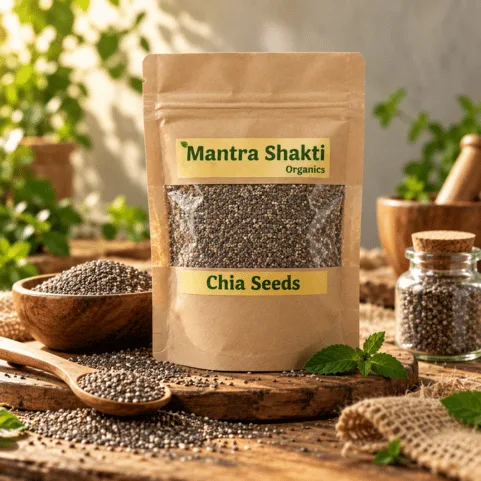
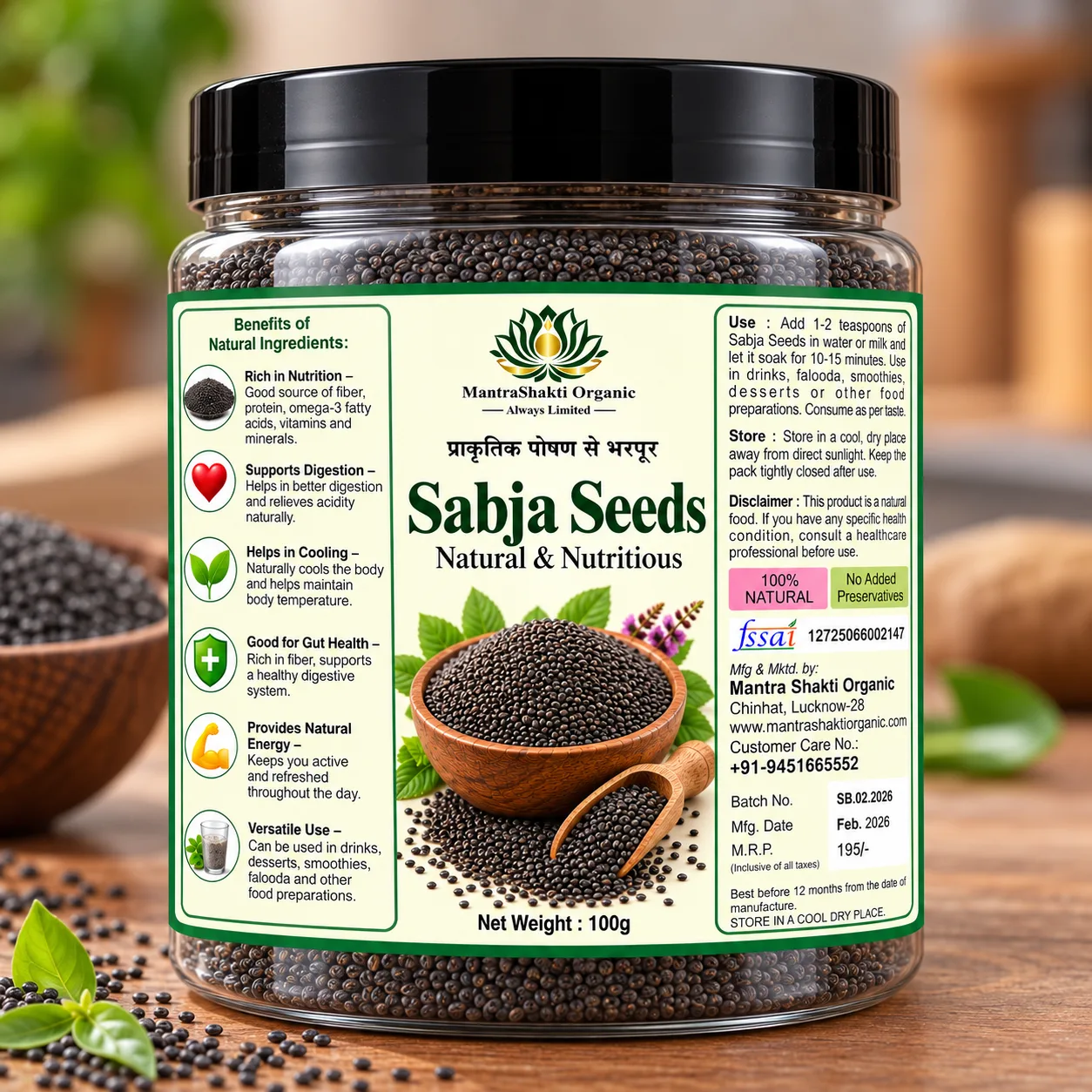
Our chia seeds are a single-ingredient pack at ₹378 for 200 g, packed in small lots in Lucknow under FSSAI licence 12725066002147. If you prefer the traditional falooda-style bead, sabja seeds are the usual choice. You can see both in our pantry range, and read about the people who pack them in who makes MantraShakti Organic.
Frequently asked questions
How long do chia seeds need to soak (chia seeds kitna bhigona chahiye)?
Soak them in plain water for 15 to 20 minutes for a drink, stirring again within the first few minutes. For a pudding, chill for 30 minutes to set lightly or for 3 hours to overnight for a full set. In Hinglish: 15 se 20 minute paani mein bhigoyein aur do baar chalayein; pudding ke liye fridge mein kuch ghante ya raat bhar rakhein.
What is the right chia-to-water ratio for a drink and for a pudding?
For a drink use about a teaspoon of seeds per glass (about 250 ml), or up to a tablespoon for a thick glass; either way the seeds stay as separate beads. For a spoonable gel use 1 tablespoon of seeds to 3 tablespoons of water. For a pudding use 2 tablespoons per cup of milk or curd for a soft pudding and 3 for a firm one; in one lab study chia needed 15 g of seeds per 100 ml, roughly 3 tablespoons per cup, to hold its shape when tipped.
Do chia seeds need to be soaked overnight?
No. Overnight is for puddings, which need hours to set. For a drink, 15 to 20 minutes in plain water is enough, and soaking a drink for a day gains you nothing. Whatever you make, keep soaked chia in the fridge and use it within 3 days.
Can you soak chia seeds in milk or curd instead of water?
Yes. Milk is the usual liquid for pudding, and yogurt or curd works too if you thin it so the seeds have enough liquid. Keep milk- and curd-based chia in the fridge rather than on the counter, because they are perishable.
Can you add chia seeds to hot water or hot lemon water (nimbu pani me chia seeds dal sakte hai)?
Yes. Heat does not stop the gel; in lab work, extracted chia mucilage took up the most water near 80 degrees C. But lemon is acidic and salt reduced uptake in the same study, so bloom the seeds in plain water first, then add the lemon and salt, and let a hot drink cool before you drink it.
Why do chia seeds clump or stay runny, and how do you fix it?
They clump when seeds land in a heap: the outer ones gel first and seal the dry seeds inside. Scatter them into the liquid while stirring and stir again a few minutes later. A pudding stays runny when there are too few seeds for the liquid (2 tablespoons per cup makes a soft pudding, 3 a firmer one), so add a tablespoon of seeds, stir and wait 30 minutes.
How long do soaked chia seeds keep in the fridge?
Use them within 3 days, kept covered at or below 4 degrees C (40 degrees F). University guidance for refrigerated leftovers is 3 to 4 days and some recipes say longer, but soaked chia looks the same however old it is, so we keep to the shorter limit, especially for milk or curd.
How do you use soaked chia in nimbu pani, lassi or kheer?
Bloom the seeds in plain water first. Then stir 1 to 2 tablespoons into the glass of nimbu pani or lassi at the end, after blending, so the beads stay whole. For a kheer-style jar, use 2 to 3 tablespoons of seeds per cup of milk and chill it; do not cook the seeds.
Sources and further reading
- Samateh et al., Scientific Reports 8:7315 (2018): Unravelling the secret of seed-based gels in water — minimum gelation ratio of chia (15 g per 100 ml) and usual wait
- Muñoz et al., Journal of Food Engineering 108 (2012) 216-224: Chia seeds, microstructure, mucilage extraction and hydration — mucilage capsule; effects of pH, salt and temperature
- Memorial Sloan Kettering Cancer Center: Chia — caution about eating dry chia seeds
- Food Network Kitchen: How to eat chia seeds (January 2022) — gel and pudding ratios and times
- Food Network: Sunny Anderson’s chia seed pudding parfaits — whisking method, set test and stirring
- University of Wisconsin Extension: How to store leftovers — refrigeration within two hours; 3 to 4 days
- Sharmis Passions: Chia lemonade — blooming chia in water first; quantity per glass
Written by the MantraShakti Organic workshop team, Chinhat, Lucknow. We pack our foods in small lots; we are not doctors or dietitians, and this guide is general kitchen information, not medical advice. If you have a swallowing difficulty, a medical condition, an allergy, are pregnant or take medication, ask a doctor before changing what you eat.
Shop this guide
Made by hand in small batches in Lucknow.
More from the Journal
24 Oct 2026 · 16 min