
How to Use Masala Tea Powder: Amount Per Cup and When to Add It
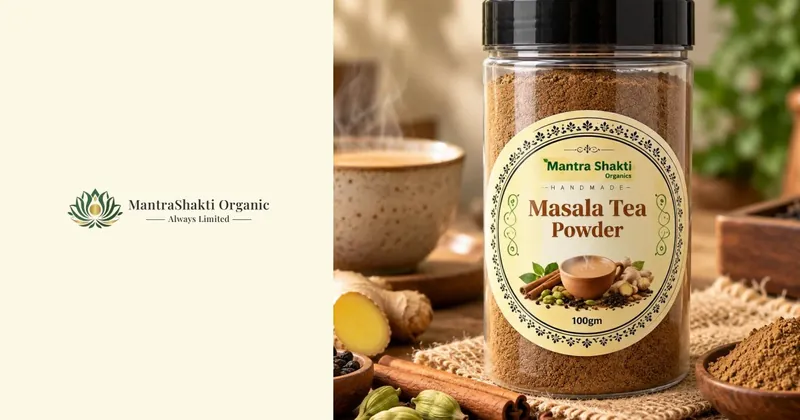
How to use masala tea powder in chai
How to use masala tea powder: add about ¼ teaspoon per cup of chai (about 200 ml) to the water with the chai patti, then boil for three to four minutes before the milk goes in. Use ⅛ teaspoon for a light cup or ½ teaspoon for a strong one, and adjust by taste.
Masala tea powder is a ground spice blend, not an instant tea. Ours is made from cardamom, cinnamon, cloves, ginger and black pepper, so you still bring your own chai patti, milk and sweetener. This guide removes the guesswork, but there is no official standard dose. The amounts below come from the published recipes listed at the end, and they are starting points, not a workshop-tested figure: your tea, your cup size and the freshness of your pack decide the final spoonful.
Key takeaways
- ¼ teaspoon per cup is the usual starting dose. Hebbar's Kitchen uses ½ teaspoon for a two-cup pan, and Swasthi's Recipes uses ½ to ¾ teaspoon for two servings.
- Most recipes put the powder in with the water and tea leaves and boil for 3 to 4 minutes before adding milk. Adding it after the milk gives a milder cup.
- Strength has three dials: how much powder, how long it boils, and how much milk softens it. Change one at a time.
- Over-steeped tea releases tannins that taste bitter and dry, so a very long boil can turn a spiced chai bitter.
- Ground spices fade faster than whole ones. Keep the pack sealed, dry and away from the stove, and replace it once the aroma has faded; Penn State Extension suggests checking ground spices at about six months.
What is masala tea powder?
Masala tea powder, also sold as chai masala or tea masala, is a ground blend of spices that flavours tea. The usual spices are cardamom (elaichi), cinnamon (dalchini), cloves (laung), ginger (adrak or saunth) and black pepper (kali mirch), and home blends often add fennel, nutmeg or star anise. It contains no tea leaves of its own, which is why it is added to chai rather than replacing it.
How much masala tea powder per cup?
Start with ¼ teaspoon per cup of about 200 ml, then move in steps of ⅛ teaspoon. The two Indian recipes below that use a ready spice powder land on that figure, though they write it per pan rather than per cup.
| Recipe | Spice amount | Written for | Per cup (our arithmetic) | When the spices go in |
|---|---|---|---|---|
| Hebbar's Kitchen, chai masala powder | ½ tsp of masala | 2 cups of chai: 2 cups water, 1 cup milk, 4 tsp tea powder | ¼ tsp | With the water and tea, boiled 4 minutes; after the milk for a milder taste |
| Swasthi's Recipes, masala chai | ½ to ¾ tsp of masala powder, or more | 2 servings: 1½ cups water, 1 cup milk | ¼ to ⅜ tsp | With the water and tea, boiled 3 minutes; milk then simmered about 2 minutes |
| Food Network Kitchen, masala chai | Whole spices: 6 cardamom pods and a 1-inch piece of ginger | 3 cups: 2½ cups water, 1¼ cups milk | Not comparable | With the water; tea cooked 1 minute; milk simmered about 8 minutes |
Recipe "cups" are not all the same size. Swasthi's pan starts with 2½ cups of liquid for two servings, so each serving begins at about 1¼ cups, closer to a mug than a small chai cup. We have therefore set our own base at about 200 ml of finished chai, roughly a tea glass. If you pour a big 300 ml mug, count it as 1½ cups; for a small kulhad, use about half.
| Cups of chai | Light | Standard | Strong |
|---|---|---|---|
| 1 cup | ⅛ teaspoon | ¼ teaspoon | ½ teaspoon |
| 2 cups | ¼ teaspoon | ½ teaspoon | 1 teaspoon |
| 4 cups | ½ teaspoon | 1 teaspoon | 2 teaspoons |
Light is for a first try, or a milk-heavy cup where the tea should still lead. Standard is where most people settle. Strong is for a kadak cup with plenty of chai patti. Packs differ in how fresh and how strongly spiced they are, so begin at the low end with a new pack and work up. If the label on your pack suggests an amount, follow it.
When do you add masala tea powder: with the water, the milk or at the end?
Add it with the water and the chai patti, as Hebbar's Kitchen and Swasthi's Recipes do, and boil for three to four minutes before the milk goes in. That gives the fullest spice. For a milder cup, hold it back until the milk is in; for the gentlest result, stir it in off the heat and strain after a minute or two.
| When it goes in | What to expect | Suits |
|---|---|---|
| With the cold water and chai patti, boiled 3 to 4 minutes before the milk | The fullest, most pungent cup. The spices get the longest in the water, but the tea leaves are boiling that long too | Kadak, strongly spiced chai; the method both Indian recipes above use |
| After the milk goes in, for the last minute or two | Softer and rounder; Hebbar's Kitchen notes that some people prefer a mild taste and add it after the milk | Anyone who finds pepper and ginger sharp |
| Off the heat, steeped 1 to 2 minutes, then strained (our variation, not from the recipes above) | Gentlest, because the spices only meet hot liquid briefly | A light cup, or a second round for the same pan |
Two practical notes. First, the powder is fine, so some of it stays in the pan and cup whatever the timing; strain through a fine mesh. Second, we could not find a source that measures how much aroma a four-minute boil removes, so the "boil longer for more flavour" idea is a rule of thumb. If you add fresh ginger as well, boil it in the water first: Swasthi's Recipes warns that adding milk before fresh ginger has boiled can curdle the milk, because of a ginger enzyme called zingibain.
How do you make masala chai with masala tea powder, step by step?
Boil the water with chai patti and the masala for three to four minutes, add milk and sweetener, simmer for a minute or two, then strain. The table gives quantities for one, two and four cups; the water-to-milk ratio of about 1.5 to 1 sits inside the 1:1 to 3:1 range that Swasthi's Recipes gives for different kinds of milk.
| Cups | Water | Milk | Chai patti (CTC) | Masala tea powder | Sugar or jaggery powder |
|---|---|---|---|---|---|
| 1 | 150 ml | 100 ml | 1½ tsp | ¼ tsp | 1 to 2 tsp |
| 2 | 300 ml | 200 ml | 3 tsp (1 tbsp) | ½ tsp | 2 to 4 tsp |
| 4 | 600 ml | 400 ml | 6 tsp (2 tbsp) | 1 tsp | 4 to 8 tsp |
The chai patti figure is a middle value: the recipes above range from about 1¼ teaspoons per serving (Swasthi's Recipes) to 2 teaspoons per cup (Hebbar's Kitchen) and a tablespoon per cup (Food Network Kitchen), so move it to suit your tea.
- Measure first. Level the spoon with a knife and use a dry spoon so the powder does not clump in the pack.
- Boil the decoction. Put the water, chai patti and masala tea powder in a steel pan, bring it to a boil and boil for 3 to 4 minutes, until the liquid turns dark.
- Add milk and sweetener. Pour in the milk. If you are using sugar or raw sugar, add it now. Bring the pan back to a boil.
- Simmer. Lower the flame and simmer for a minute or two, until the chai is the colour you like. Watch the pan, because milk rises quickly.
- Strain and taste. Pour through a fine-mesh strainer. Note the taste and change the masala by ⅛ teaspoon next time, not by a spoonful.
If you sweeten with jaggery powder, switch off the flame and let the bubbling settle before stirring it in, because jaggery added to boiling chai can split the milk. Our Jaggery Powder and Raw Sugar both suit masala chai; sugar goes in with the milk, jaggery goes in last.
Can you make masala tea without milk?
Yes. Boil about 200 ml of water per cup with the chai patti and ⅛ to ¼ teaspoon of masala tea powder for three minutes, then strain. Without milk to round off the bitterness of the tea, the same dose tastes sharper, so start at the lower figure and sweeten to taste. Lemon works in this version, because it is milk, not tea, that lemon splits.
Why does your masala chai taste bitter, sharp, flat or muddy?
Most problems come down to the dose, the boil time or the age of the pack, and each has a simple fix. Food Network's tea guide explains the commonest one: over-steeping releases tannins, which make tea taste bitter and leave a dry feeling in the mouth.
| What you notice | Likely cause | What to do |
|---|---|---|
| Bitter, dry-mouth chai | Tea leaves boiled too long or too much chai patti, releasing tannins | Keep the water-and-tea boil to 3 minutes, cut the chai patti by ¼ teaspoon per cup, and avoid re-boiling several times |
| Sharp, peppery, harsh at the back of the throat | Dose too high for the cup, or a long boil with the powder in from the start | Drop to ⅛ teaspoon per cup, or add the powder after the milk |
| Barely any spice | Dose too low, a large mug counted as one cup, or a pack whose aroma has faded | Count a 300 ml mug as 1½ cups, smell the pack, and add ⅛ teaspoon more |
| Muddy sediment in the cup | Ground spice does not dissolve | Use a fine-mesh strainer and leave the last sip |
| Milk splits | Jaggery added to boiling chai, or milk added before fresh ginger has boiled | Add jaggery off the heat; boil fresh ginger in the water first |
How should you store masala tea powder?
Keep it in a sealed, dry container away from sunlight, heat and steam. Penn State Extension advises storing spices in airtight containers in dry places away from sunlight and heat, notes that whole spices keep their quality longer than ground ones, and suggests evaluating ground spices after six months and replacing any whose aroma has faded.
- Use a dry spoon, and do not measure over the steaming pan; damp air is what turns a loose powder into lumps.
- Keep the pack away from the stove, not on the shelf directly above it.
- Do the smell test. Open the pack and breathe in. A clear spiced aroma means the powder is in good shape; a faint, flat smell means it has faded, and you will need more per cup for less flavour.
- Do not use powder that has gone damp, clumped hard or smells musty.
- Take the printed date as the outer limit. Recipe writers who grind their own chai masala, such as Hebbar's Kitchen, suggest using a home-ground batch within about a month, which hints at how quickly the aroma fades.
Common mistakes with masala tea powder
- Heaping the spoon "to be safe." Spice is easy to add and impossible to take out, so level the spoon and go up in ⅛ teaspoon steps.
- Judging the strength before the milk and sweetener are in. The decoction on its own always tastes sharper than the finished cup.
- Boiling hard for ten minutes. A long boil is how tea turns bitter and dry; keep to the times in the method.
- Keeping the pack by the stove. Heat and steam shorten how long the aroma lasts.
- Dropping jaggery into boiling chai. Switch off first.
How we pack our masala tea powder
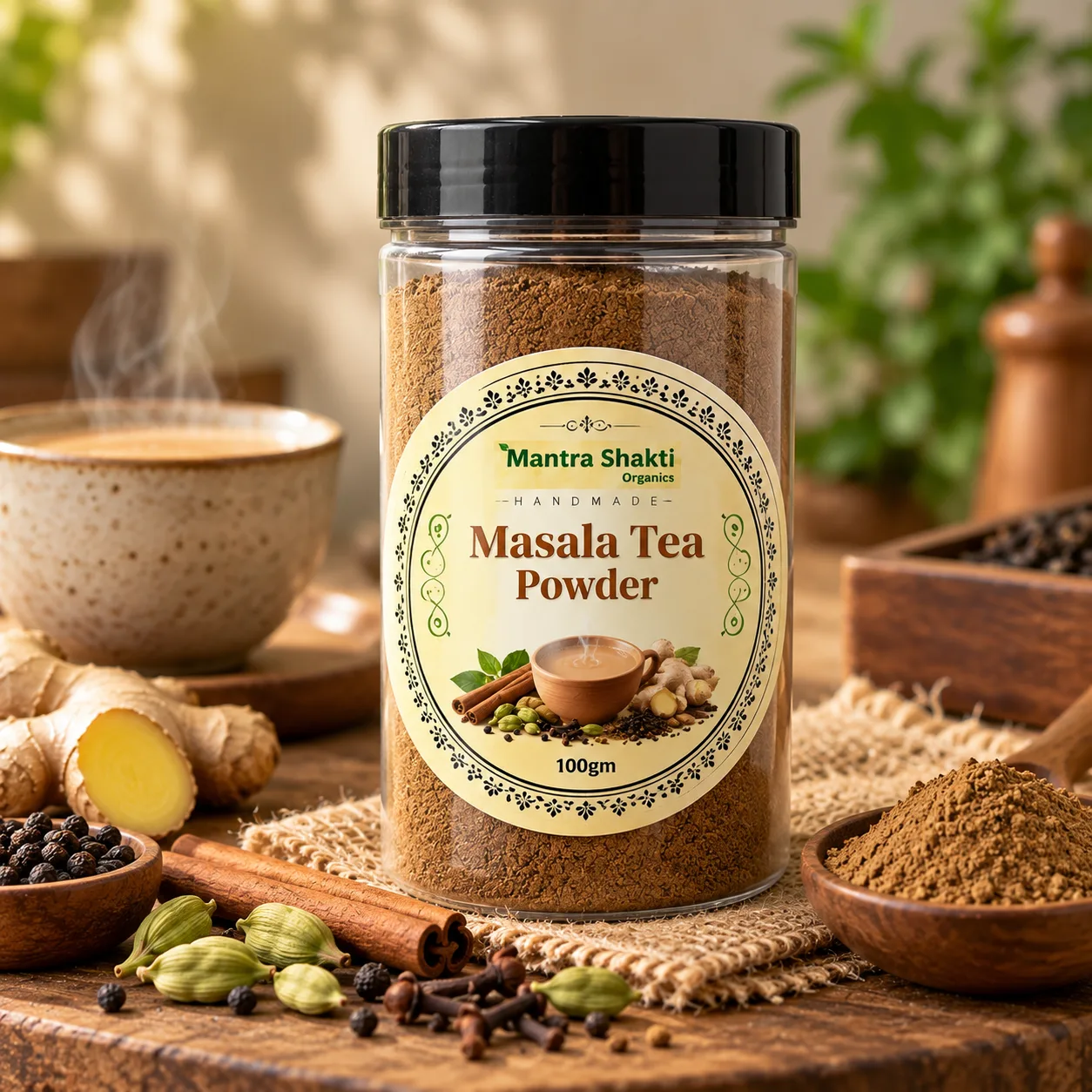
Our Masala Tea Powder is made from cardamom, cinnamon, cloves, ginger and black pepper, packed in small lots at our workshop in Chinhat, Lucknow, at ₹149 for 100 g. Each pack carries a batch code, and if the aroma seems faint when you open it, write to [email protected] and we will look at the batch. You can read more about the people behind the packs in who makes MantraShakti Organic.
Frequently asked questions
How much masala tea powder should I use per cup of chai?
Start with 1/4 teaspoon per cup of about 200 ml. Use 1/8 teaspoon for a light cup and 1/2 teaspoon for a strong one, and scale by volume: a small kulhad needs less, a large mug more. Published recipes from Hebbar's Kitchen and Swasthi's Recipes land near the same figure. It is a starting point, not a tested dose.
When do I add masala tea powder: with the water, the milk or the tea leaves?
The Indian recipes we checked add it with the water and the chai patti, boil for 3 to 4 minutes, then add milk. That gives the fullest spice. For a milder cup, add it after the milk goes in. For the gentlest result, stir it in off the heat, steep a minute or two and strain.
How do I make masala chai with ready masala powder?
For one cup, boil 150 ml water with 1 1/2 teaspoons of chai patti and 1/4 teaspoon of masala tea powder for 3 to 4 minutes. Add 100 ml milk and your sweetener, simmer for a minute or two, then strain through a fine mesh. Scale the quantities up in the same proportions for more cups.
Can you make masala tea without milk?
Yes. Boil water with chai patti and masala tea powder for about three minutes and strain. Without milk to round off the tea's bitterness, the same dose tastes sharper, so start at 1/8 teaspoon per cup. Lemon suits this version, because it is milk that lemon splits, not tea.
How long should masala chai boil?
The recipes we checked boil the water, tea and spices for about 3 to 4 minutes, then simmer for about 2 minutes after the milk goes in. Boiling much longer mainly risks bitter tea, because over-steeping releases tannins.
Why does my masala chai taste bitter or too sharp?
Bitterness usually comes from tea leaves boiled for too long or too much chai patti. Sharpness usually comes from too much masala for the size of the cup. Shorten the boil, cut the chai patti slightly, drop the powder to 1/8 teaspoon per cup, or add it after the milk.
How long does masala tea powder stay fresh after opening?
Ground spices fade faster than whole ones. Penn State Extension suggests checking ground spices after about six months and replacing them once the aroma has faded. Keep the pack sealed, dry and away from the stove, and take the date printed on the pack as the outer limit.
Is masala tea powder the same as a tea premix?
No. Masala tea powder is a ground spice blend. Ours is made from cardamom, cinnamon, cloves, ginger and black pepper, so you add your own chai patti, milk and sweetener. An instant premix usually has the tea and sugar already mixed in.
Sources and further reading
- chai masala powder recipe | masala tea powder | chai ka masala (Hebbar's Kitchen) Spice amount for a two-cup pan, a 4-minute decoction, and the milder option of adding it after the milk.
- Masala Chai Recipe (Indian Masala Tea) (Swasthi's Recipes) Masala powder per two servings, boil and simmer times, water-to-milk ratios, and the ginger and milk note.
- Masala Chai, by Nidhi Jalan (Food Network Kitchen) A whole-spice masala chai for comparison, with water, milk and CTC tea quantities.
- This Is Why Your Tongue Feels Like Sandpaper When You Drink Tea (Food Network) Over-steeping releases tannins, which taste bitter and leave a dry mouthfeel.
- Storing Staple Ingredients in the Kitchen (Penn State Extension) Airtight, dry storage away from sunlight and heat; ground spices fade sooner than whole ones.
Written by the MantraShakti Organic workshop team, Chinhat, Lucknow. This is general kitchen information, not medical advice.
Shop this guide
Made by hand in small batches in Lucknow.
More from the Journal
20 Oct 2026 · 18 min