
Handmade Soap Price in India: What You Should Really Pay
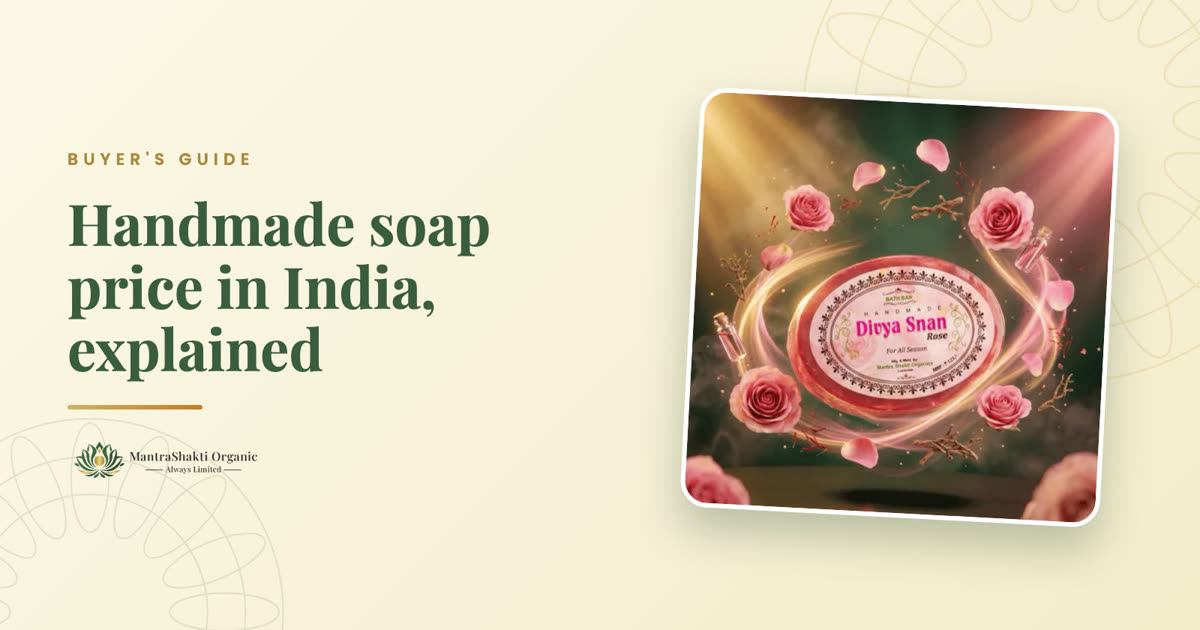
What is a fair handmade soap price in India?
Handmade soap in India is commonly sold between about ₹100 and ₹250 per 100 g at small-brand retail, against roughly ₹45 to ₹70 per 100 g for a branded factory bar sold in multipacks. Our Divya Snan bars are ₹125 for 100 g. Compare by price per 100 g and cost per wash, not by sticker price.
Key takeaways
- The only fair way to compare soaps is price per 100 g, then cost per wash. A ₹125 bar and a ₹40 bar are not the same size or the same product.
- Handmade prices rise because of small batches, hand labour, butters and oils, moulds and packaging, not because of a secret ingredient.
- GST on toilet soap bars was cut from 18% to 5% from 22 September 2025, according to the GST Council's announcement as reported. Liquid wash and other soap types can sit in other slabs.
- A softer handmade bar wears faster if it sits in water. A draining dish can add days or weeks to its life.
- One bar costs ₹125 plus ₹49 delivery; any four Divya Snan bars are ₹500 with free delivery and a free Herbal Dant Manjan.
Why does handmade soap cost more than a factory bar?
A factory bar is made in very large volumes on machines, then pressed, stamped and wrapped at speed. The cost per bar falls as the volume rises, which is why multipack bars can be cheap. A handmade bar is made in a small batch by people. Every step that a machine does for pennies, a person does by hand, and that shows up in the price. Here are the main cost drivers in plain words.
| Cost driver | What it means in practice |
|---|---|
| Batch size | Small batches cost more per bar because setup, cleaning and time are spread over fewer bars |
| Soap base, butters and oils | Shea and cocoa butter and oils such as olive, castor and coconut cost more than basic fillers |
| Botanicals and powders | Ground herbs, clays, dals and flower powders add cost, and quality powders cost more |
| Hand labour | Slicing, melting, stirring, pouring, unmoulding and trimming are all done by hand |
| Moulds and set time | Silicone moulds hold only so many bars; a batch sets for hours before the next one begins |
| Packaging and labels | Printed wraps and boxes cost more per bar at low volume |
| Licences, GST and compliance | Registered businesses collect and pay GST and meet labelling rules |
| Shipping and payment fees | Delivery, packing and payment gateway fees apply to every online order |
None of these makes a bar automatically "better". They explain why a small-batch bar sits higher on the price list. Whether you value that is up to you.
What are typical soap price bands in India per 100 g?
We looked at real Indian listings while writing this guide: a business-to-business directory, a large online marketplace and a pharmacy platform. This is a small sample, not a market survey, and listings change often. We describe categories only and name no brands.
| Category | Range per 100 g | What we saw |
|---|---|---|
| Trade and wholesale herbal or neem bars | ₹10 to ₹85 | A trade directory listed neem bars from about ₹10 to ₹85 per piece for weights of 55 g to 125 g. These are trade prices, usually for bulk buyers, not what a shopper pays. |
| Branded factory bar, multipack on a marketplace | About ₹45 to ₹70 | One pack of four 100 g bars was listed at ₹183 to ₹193 against a printed price of ₹280, which works out to about ₹46 to ₹48 per 100 g at the selling price. |
| Small-brand handmade bars, direct retail | Roughly ₹100 to ₹250 | Our bars are ₹125 per 100 g. A goat-milk handmade listing on a pharmacy platform showed a price of ₹2.48 per gram, about ₹248 per 100 g (that listing was out of stock when we looked). |
Two honest cautions. First, the trade prices on a business directory are not shop prices; a bar that costs a trader ₹15 will reach you at a higher price after packing, margins and shipping. Second, the handmade band is wide because the products differ widely. A bar made from a cheap base with a few drops of scent and a bar made with butters and ground botanicals are very different things, even if both are called handmade.
How do you compare soap prices by ₹ per 100 g and per wash?
This is the most useful skill in the whole guide. A price on its own tells you nothing unless you know the weight and how long the bar lasts.
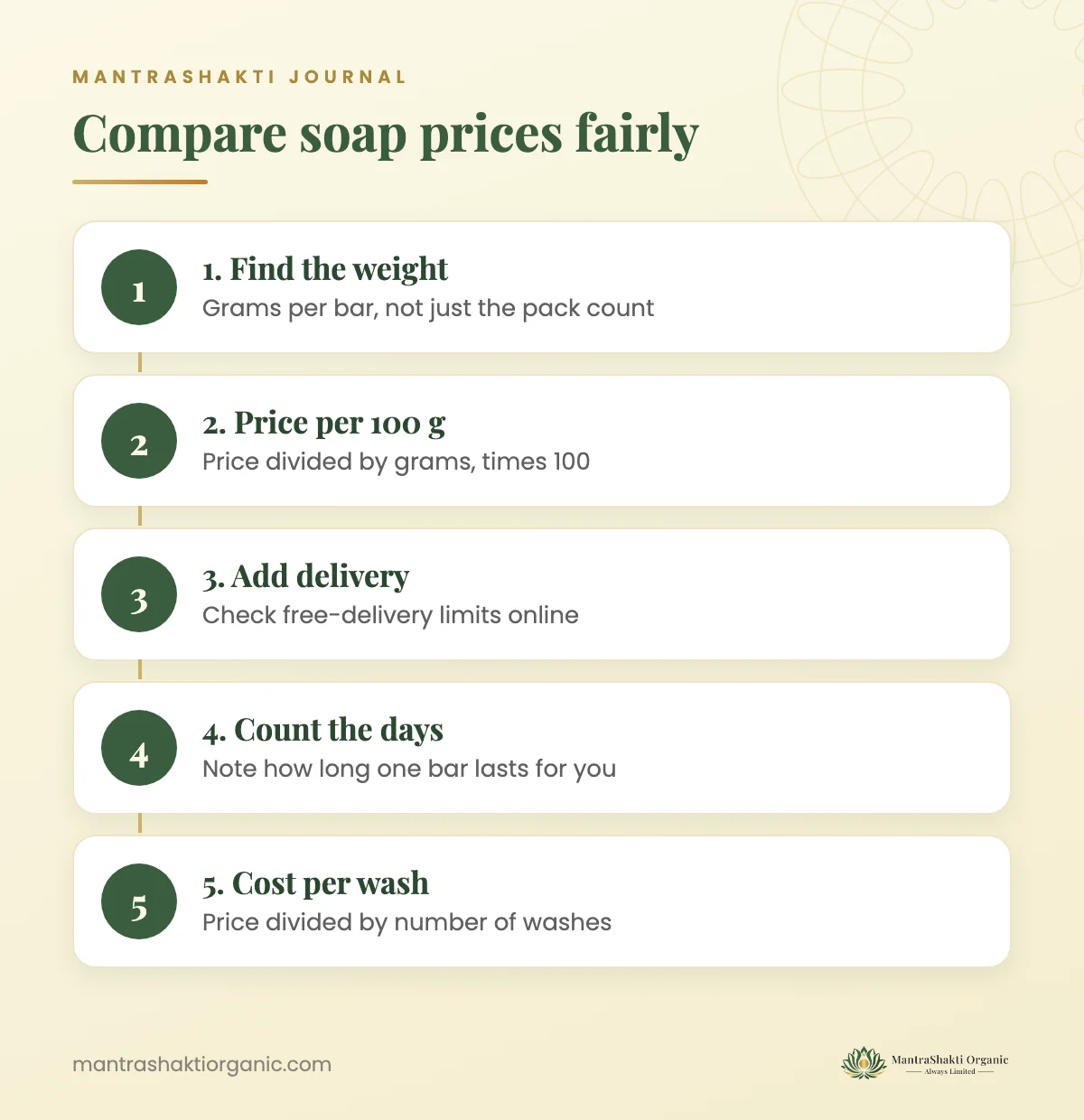
- Find the weight of the bar in grams on the pack or product page. If it only says "pack of 3", find the weight of each bar.
- Divide the price by the total weight and multiply by 100. That is the price per 100 g.
- Add delivery if you are buying online and the order is under the free-delivery limit.
- Note how many days one bar lasts for you. Use it for a few weeks and write the date you start and finish.
- Divide the price by the number of washes to get the cost per wash.
Use the calculator below to see where a bar's price sits against the bands in this guide.
Interactive · 30 seconds
Compare any soap fairly
Type the price and weight printed on any bar you are considering.
per 100 g
per day of use
Your bar
Price bands come from a small sample of Indian listings in November 2026 (see the article), not a market survey. How long a bar lasts depends on how you use and store it.
An example with our own numbers. A single Divya Snan bar is ₹125 for 100 g, so the price is ₹125 per 100 g. With ₹49 delivery on a single bar the total is ₹174, or ₹174 per 100 g. Buying four bars for ₹500 puts the price at ₹125 per 100 g with no delivery fee, which is why the Soap Box is the sensible way to buy more than one.
How many washes will one bar give?
It varies, and anyone who gives you a single number is guessing. How long a bar lasts depends on how often you use it, how long you lather, the size of your hands, how hard the water is and whether the bar sits in water. A handmade melt-and-pour bar is softer than a pressed factory bar and wears faster when wet. The table below shows the maths only. It does not predict your bar.
| Bar lasts | Cost per daily bath |
|---|---|
| 15 days | about ₹8.33 |
| 20 days | about ₹6.25 |
| 25 days | ₹5.00 |
| 30 days | about ₹4.17 |
For comparison, a factory bar at about ₹46 per 100 g that lasts 30 days costs roughly ₹1.50 per daily bath. So, in honest terms, a handmade bar costs more per wash even if it lasts a long time. What you get for the difference is a small-batch product, a different feel and a different ingredient story. If your priority is the lowest cost per wash, a factory bar wins. We would rather say that than pretend otherwise.
How much GST is charged on soap in India?
GST on toilet soap bars was reduced from 18% to 5% with effect from 22 September 2025, following the 56th GST Council meeting. Summaries of the Council's announcement list soap bars alongside items such as hair oil and shampoo among goods moved to 5% (some earlier slabs for certain items were 12%).
What this means for you as a buyer:
- Most shop and online prices are shown inclusive of GST. The price you see is the price you pay.
- Other soap-related goods may sit in other slabs. Advance rulings on laundry bars, for example, have placed them at 18%, and liquid body wash is often listed at 18% on tax guides. Rules differ by product, so we only comment on toilet soap bars here.
- If you are a business buying soap or need an exact classification, check the official notification or ask your tax adviser. We are a soap maker, not tax advisers, and the official notification text is the authority.
We could not open the official GST Council or notification page directly for this guide, so we cite two reputable tax-news summaries of the Council's announcement. Verify the current rate before you rely on it for tax filing.
How can you spot an over-priced handmade soap?
- No weight on the listing. If you cannot work out the price per 100 g, you cannot compare.
- Vague ingredients. A list that says only "natural ingredients" tells you little. Look for names you can recognise.
- Big claims. Promises about skin conditions, or absolute words like "totally pure" and "zero chemicals", are red flags. A soap is a cosmetic, and we avoid such claims ourselves.
- A very low price labelled "pure handmade". A ten-rupee bar cannot carry butters, botanicals, labour and packaging. Ask what it really is.
- A very high price with the same plain look. If a bar costs far above the band and is no different on the label, ask why.
- A fake "discount". A printed price that is never charged is not a discount. Look at the actual selling price.
Also see our explainer on TFM in soap and BIS grades, which is a standard measure of soap content, and which handmade makers rarely publish. We say openly that we have not published ours.
Why does a softer handmade bar wear faster, and how do you make it last?
A melt-and-pour bar is soft, easy to lather and can be snapped by hand, rather like a biscuit. That softness is part of the character, but it also means water takes it away faster than from a hard pressed bar. You can reduce waste with a few habits.
- Use a soap dish with slots or a wooden rack so water drains away.
- Keep the bar out of the shower stream.
- Rinse off the lather, then shake off water before putting it down.
- Let it dry fully between uses. Turn it over now and then.
- Use two bars alternately if you can, so each dries out for a day.
- In monsoon, store spare bars in a cool, dry place in paper, not in a sealed box.
Our guide on handmade soap in monsoon goes into this further, and the daily bar soap routine shows how to lather efficiently.
Is handmade soap actually better?
"Better" depends on what you value. We will not say handmade soap is better for everyone, and nobody can honestly say so. What handmade can offer is small-batch freshness, a clear ingredient story, choice of scents and botanicals, and a maker you can write to. What a factory bar offers is a low price per wash, a consistent product and easy availability.
If you want to try handmade, buy a single bar or a Soap Box of four and judge the feel, the fragrance and the cost per wash yourself. Do a patch test first on the inside of your forearm. If you have a skin condition, an allergy or you are pregnant, ask a doctor before trying a new product.
How do we price our own bars?
Our Divya Snan bars are handmade melt-and-pour bars made in small batches at our workshop in Chinhat, Lucknow. We melt a goat-milk soap base gently over a water bath, stir in butters and oils (shea, cocoa butter, olive, castor and coconut) and each bar's own botanicals, pour into moulds and let them set for several hours. One kilogram of base makes about 13 to 14 bars. Each bar is 100 g and costs ₹125. See all Divya Snan soaps, or pick one such as the Rose Bath Bar.
Delivery is ₹49 on orders under ₹499 and free from ₹499. The Soap Box gives any four bars for ₹500 with free delivery and a free Herbal Dant Manjan. If you do not love a bar's fragrance, WhatsApp us on +91 94516 65552 within 7 days and we will send a different scent free, one swap per bar. For large or wedding quantities, message us on WhatsApp.
What are the common mistakes when buying handmade soap?
- Comparing the sticker price instead of the price per 100 g.
- Ignoring delivery on a single low-priced bar.
- Judging by words like "pure" and "natural", which are not proof of anything.
- Keeping the bar wet, then complaining it wore away.
- Buying a big pack before trying one bar and a patch test.
Frequently asked questions about handmade soap prices
What is the price of handmade soap in India?
Small-brand handmade bars are commonly seen from about ₹100 to ₹250 per 100 g, though wider ranges exist. Our Divya Snan bars are ₹125 for 100 g.
Why is handmade soap expensive?
Small batches, hand labour, butters and oils, moulds, packaging, GST and shipping all add up. A factory bar spreads these costs over a huge volume.
Is handmade soap better than store-bought soap?
It depends on what you want. Handmade offers small batches and ingredient choice; factory bars cost less per wash. Try one and judge for yourself.
How much GST is charged on soap?
Toilet soap bars moved from 18% to 5% from 22 September 2025, as reported from the GST Council's announcement. Other products can differ, so check the official notification.
How do I calculate cost per wash?
Divide the price by the number of days the bar lasts if you use it once a day. A ₹125 bar that lasts 25 days costs ₹5 a day.
Homemade soap price per bar: what is normal?
Homemade and small-brand bars vary widely. Compare the price per 100 g, not the price per bar, since bar weights differ.
Does a handmade bar wear faster?
A softer melt-and-pour bar can wear faster than a hard pressed bar, mostly when it sits in water. A draining dish helps a lot.
Is there a handmade soap bulk or wedding price?
For large quantities, message us on WhatsApp at +91 94516 65552. We do not promise any bulk discount in advance.
Sources and further reading
- Recommendations of the 56th Meeting of the GST Council (summary of the Council's press release)
- TaxGuru: GST rate changes announced after the 56th Council meeting
- Taxscan: 56th GST Council meet, what gets costlier and what becomes cheaper
- IndiaMART: neem soap trade listings
- Flipkart: example pack of four 100 g soap bars
- PharmEasy: handmade goat milk soap listing
Shop this guide
Made by hand in small batches in Lucknow.

More from the Journal
18 Sep 2026 · 6 min
Cold-Process vs Melt-and-Pour Soap: How Our Divya Snan Bars Are Made
Read more →