Dant Manjan Ingredients: What It Is and How to Read the Label
What is dant manjan (dant manjan kya hai), and what is it called in English?
Dant manjan is the Hindi name for tooth powder, a dry powder used on a brush or fingertip. Dant manjan ingredients vary by maker, usually herb and bark powders, spices, salt, mint and sometimes charcoal, so the label is the only reliable guide. Check the ingredients, net quantity, batch, dates, address and licence number.
This guide explains the word, the ingredient types you will meet on Indian labels, and how to read a pack. It is about reading labels, not about what any powder does for the mouth: we make no such claim, and nothing here replaces a dentist.
Key takeaways
- Meaning: dant is tooth and manjan is a powder for cleaning, so dant manjan is tooth powder, also called a dentifrice powder.
- No single recipe: herb and bark powders, spices, salt, mint, charcoal, colour and flavour all appear. Read the list.
- The rules: India's Cosmetics Rules, 2020 list tooth powder as a cosmetic category and name IS 5383 as its BIS standard. Some herbal powders are licensed as Ayurvedic drugs instead.
- Tobacco: tobacco in tooth powder has been banned since a 1992 amendment.
- On the pack: name, ingredients, net quantity, batch number, expiry or manufacture date, manufacturer's address and a licence number, with small-pack exemptions.
- Storage: keep the lid on and the powder dry.
What are the dant manjan ingredients? The usual types
A dant manjan is built from a few families of dry ingredients: herb, fruit and bark powders, spices, salt, minerals or fillers, charcoal, and flavour and colour. There is no fixed recipe in the rules, so two powders with the same name can differ completely.
| Family | Examples you may see | What it adds to the powder |
|---|---|---|
| Herb, fruit and bark powders | Neem (nim), babool, triphala-type blends | Colour from green to brown, and a bitter or astringent taste |
| Spices and aromatics | Clove (laung), black pepper, camphor | Warm, spicy aroma and a pungent bite |
| Mint and menthol | Pudina, menthol | A fresh smell and a cool tingle on the tongue |
| Salts | Rock salt (sendha namak), sea salt | A salty taste and a dry, fine texture |
| Minerals and fillers | Chalk (calcium carbonate), baking soda | Bulk, a white or pale colour and a smooth, dry feel |
| Charcoal | Charcoal (koyla) | A black colour; the Cosmetics Rules recognise "black" tooth powders |
| Flavour and colour | Added flavours, permitted colourants | Sweet, fruity or mint taste; red, pink or green colour |
The table is a map of what to expect, not a recipe, and not every family is in every powder. An encyclopaedia entry on tooth powder describes tooth powder in India as long widespread, especially in rural areas, with charcoal and salt among the traditional materials, applied with a finger, as a cheaper alternative to toothpaste. A 2012 paper in the Journal of Toxicology uses the Hindi term "dant manjans" for these powders.
Why are some manjans red, brown, black or white?
Colour comes from the ingredients or from an added colourant. Brown and black powders often hold bark, spice or charcoal; white powders usually rest on a mineral or salt base; red or pink ones owe their shade to an ingredient or to an added colour.
The Cosmetics Rules, 2020 take colour seriously. Rule 39(3) says no cosmetic may contain colours other than those specified by the Bureau of Indian Standards (IS 4707, Part 1 or Part 2) and listed in the Tenth Schedule, and that permitted colours must stay within set limits for arsenic, lead and other heavy metals. The Rules also have separate premises requirements for "black" and "white" tooth powders, which tells you the black variety is a recognised category. If a powder is a striking red, look at the ingredient list for a colourant, and do not judge a powder by its colour alone.
What do neem, clove and mint bring to a tooth powder?
They bring taste, smell and feel, and nothing else we will claim. Neem is bitter, clove has a warm, spicy aroma with a pungent bite, and mint gives a fresh, cool tingle. Those are sensory facts you can check with your own tongue.
| Ingredient | Names you may see | Taste, smell and feel |
|---|---|---|
| Neem | Nim, nimb; Azadirachta indica; margosa in English | Bitter |
| Clove | Laung, lavanga; Syzygium aromaticum | Warm, spicy aroma; pungent bite |
| Mint | Pudina; Mentha (for example Mentha arvensis, corn mint); menthol | Fresh smell; cool tingle |
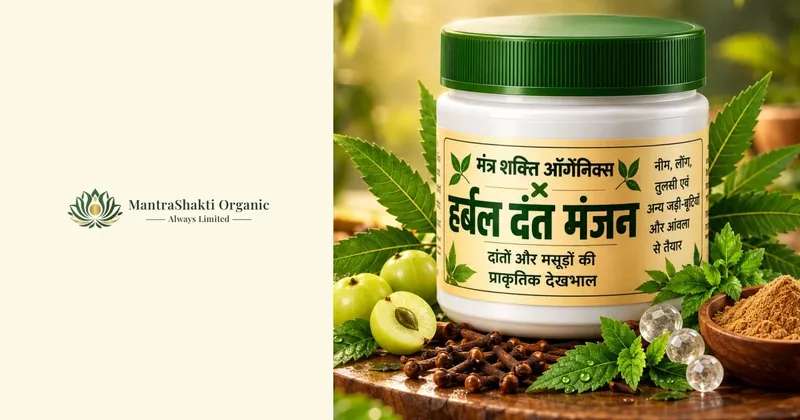
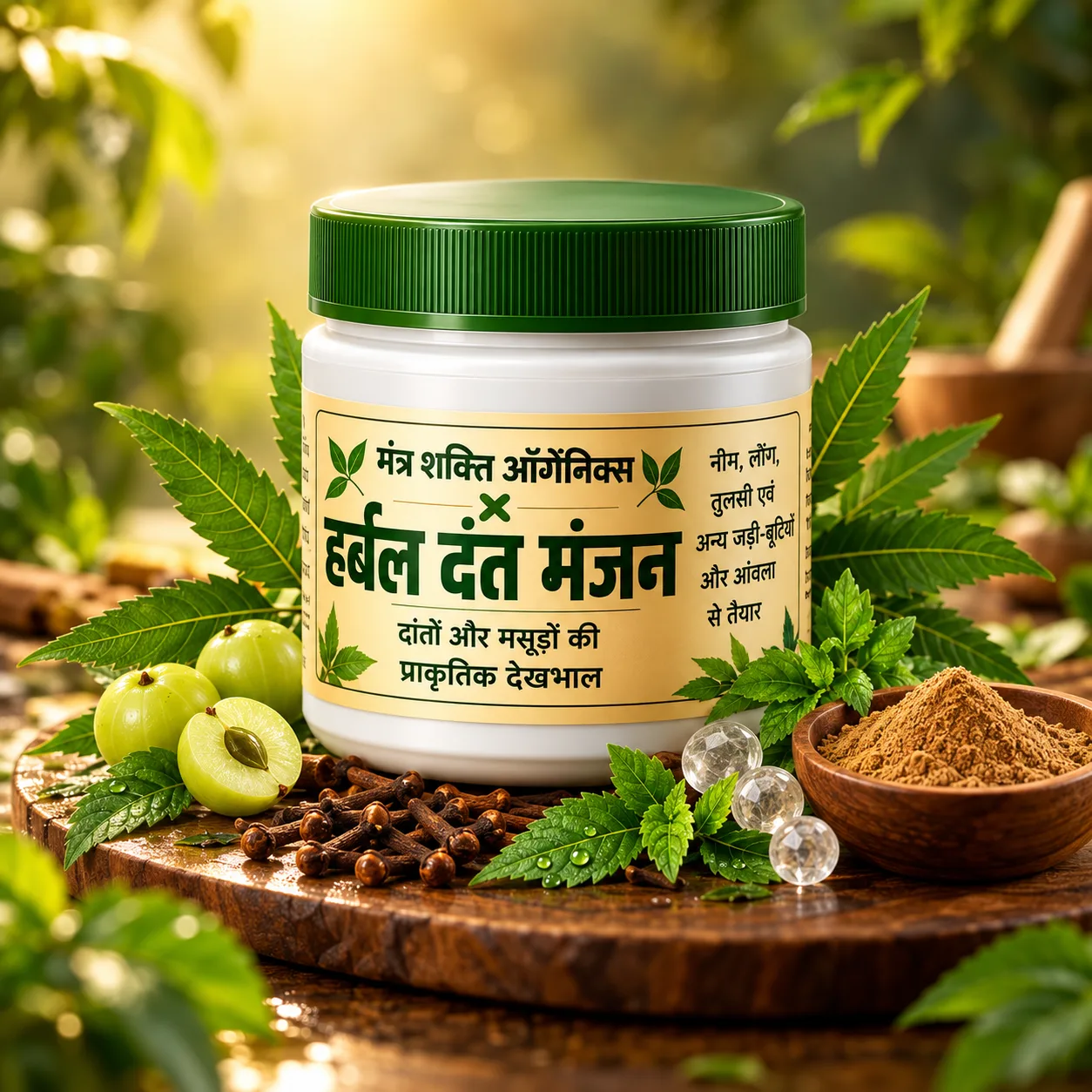
The names above come from the University of Melbourne's Multilingual Multiscript Plant Name Database, which lists Hindi, Sanskrit and English names against the botanical name. That is useful on a label: a pack may print "Azadirachta indica" where a shopper expects "nim". Our Herbal Dant Manjan is a traditional tooth powder with Neem, Clove and Mint.
How is dant manjan different from toothpaste?
A manjan is a dry powder and toothpaste is a paste, and the Indian rules keep them as separate products. Both are dentifrices, which the encyclopaedia entry defines as agents used along with a toothbrush.
| Point | Tooth powder (manjan) | Toothpaste |
|---|---|---|
| Form | Dry powder, used on a brush or finger | Paste in a tube |
| BIS standard in the Ninth Schedule | IS 5383 | IS 6356 |
| Fluoride statement rule | Not covered by Rule 38 | Rule 38: fluoride content in ppm printed on tube and carton, not above 1,000 ppm |
Dentists' advice on fluoride toothpaste is a separate matter, and the American Dental Association's MouthHealthy guidance is built around a toothbrush and fluoride toothpaste, twice a day for two minutes. A manjan is a traditional product, not a replacement for that advice or for a dentist.
Is tobacco allowed in tooth powder in India?
No. A 1992 amendment to the Drugs and Cosmetics Act, notified as G.S.R. 443(E) and 444(E) on 30 April 1992, prohibited the manufacture and sale of cosmetics and Ayurvedic drugs licensed as tooth powders or toothpastes that contain tobacco, as the 2012 Journal of Toxicology paper records. The same paper reports that tobacco tooth powders are still found in parts of India, often without tobacco in the ingredient list.
The practical lesson is plain. Avoid loose, unlabelled powder sold by weight from an open container, and avoid any pack with no maker's address or licence number. A legitimate pack tells you who made it, where, and under what licence.
How do you read a tooth powder label?
Read the label from the name down to the licence number: every line has a purpose, and Rule 34 of the Cosmetics Rules, 2020 lists what a cosmetic must carry. Small packs are partly exempt, so a missing line on a 25 g pack is not always a fault, but you can ask the maker.
| Label item | What to look for | Small-pack exemption |
|---|---|---|
| Name of the cosmetic | A clear product name on inner and outer labels | None |
| Ingredients | The heading INGREDIENTS; above 1 per cent in descending order of weight, then the rest in any order | Not required on solid packs of 30 g or less |
| Net contents | On the outer label, by weight for a solid | Not required on a solid pack of 30 g or less |
| Batch or lot number | Preceded by B, Batch No. or Lot No.; the number is traceable to the maker's records | Not required on solid packs of 10 g or less |
| Expiry or manufacture date | Use before, date of expiry or date of manufacture, with month and year | None |
| Manufacturer and address | Name and complete address of the premises where it was made | On packs of 30 g or less, name and principal place of manufacture with pin code |
| Licence number | Preceded by M, M.L. No. or Mfg. Lic. No. | None for Indian-made products |
| Directions and warnings | Present where a hazard exists | None |
Two other items sit outside that rule. The maximum retail price (MRP) is printed on packaged goods in India, so check it against what you are asked to pay. And the Cosmetics Rules, 2020 add that Indian-made cosmetics must come from a licensed manufacturer (Rule 33), that no cosmetic may carry a false or misleading claim (Rule 36), and that tooth powder must meet its BIS standard (Rule 39 and the Ninth Schedule).
One caution on licences. Not every herbal tooth powder is a cosmetic. The 1992 notification described above applies to cosmetics and to Ayurvedic drugs licensed as tooth powders, so both kinds exist, and the label should carry the licence number for whichever kind it is, with the maker's address. CDSCO's FAQ on cosmetics adds that a product with a drug claim cannot be registered as a cosmetic, so a cosmetic-licensed powder that promises a medical result is a mismatch worth questioning.
A six-step label check you can do in the shop
- Find the name and the maker. You should see a product name and the manufacturer's name and address, not only a brand or a phone number.
- Find the licence number. Look for "M", "M.L. No." or "Mfg. Lic. No." followed by digits, or an Ayurvedic drug licence number if the product is sold that way.
- Read the ingredients. The first names are the bulk of the powder. If a 25 g or 30 g pack has no list, ask the seller or maker, and check the website. Walk away if tobacco is named or if nobody can tell you what is in it.
- Check the dates and batch. Look for the batch or lot number and an expiry or manufacture date with month and year.
- Check the quantity and MRP. Compare the price per 10 g with other packs.
- Check the seal. The pack should be sealed and dry. A clumped, damp or musty powder is a reason to return it.
Should a tooth powder say whether it has fluoride?
Rule 38 of the Cosmetics Rules requires fluoride content, in ppm, to be printed on the tube and carton, but it is written for toothpaste, not powder. So a powder with no fluoride statement is not breaking that rule. If fluoride matters to you or your dentist, read the ingredient list, ask the maker, and ask your dentist how a powder fits with your toothpaste. If you would like to know more about our own powder, write to [email protected].
How should you store a tooth powder?
Keep it in a tightly closed container, in a cool, dry place away from bathroom steam, and use it only with dry hands or a dry spoon. Moisture is the usual enemy of a dry powder: it clumps, cakes and can turn musty.
- Close the lid firmly after each use.
- Keep the jar on a dry shelf, not beside the shower or tap.
- Tip a little into a dry palm or spoon rather than dipping a wet finger into the jar.
- Never return unused powder to the container.
- Note the expiry date; the Rules define it as the date up to which the product keeps its characteristics under the storage conditions on the label.
- Discard powder that smells off, has changed colour, or has gone damp and lumpy.
What are the common mistakes when buying a tooth powder?
- Buying by colour or brand name alone. The ingredient list and licence number tell you more.
- Buying loose powder with no label. You cannot check the maker, the date or the contents.
- Ignoring the date. A powder past its expiry is not worth the saving.
- Assuming "herbal" means one thing. It does not; the rules do not fix a recipe.
- Using a manjan in place of a dentist. It is a traditional product, and a tooth or gum problem needs a dentist.
- Storing it open or damp.
How we make our Herbal Dant Manjan
We make our Herbal Dant Manjan at our family workshop in Chinhat, Lucknow: a traditional tooth powder with Neem, Clove and Mint, in a 25 g pack for ₹105. We do not claim it does anything for teeth or gums, and it does not replace a dentist. If you have a tooth or gum problem, a mouth ulcer, or you are pregnant or take medication, please ask your dentist or doctor first. The full range is in the Oral Care category, and you can read more about us in who makes MantraShakti Organic.
Frequently asked questions
What is dant manjan called in English?
Dant manjan is called tooth powder in English. Dant means tooth, and manjan is the word for a powder used for cleaning. Tooth powder and toothpaste are both dentifrices, agents used along with a toothbrush, the powder in dry form and the paste in a tube. Indian rules list tooth powder as a cosmetic category with its own BIS standard, IS 5383.
What goes into a traditional dant manjan?
There is no single formula. Labels on Indian herbal powders commonly show herb or bark powders such as neem or babool, spices such as clove, salt, mint or menthol, sometimes charcoal, and colour or flavour. The ingredient list is the only reliable guide, and the Cosmetics Rules require one on larger packs.
Why are some manjans red and others brown or white?
Colour comes from the ingredients or from added colourants. Dark brown and black powders often contain bark, spice or charcoal; the Cosmetics Rules recognise black and white tooth powders. A red or pink powder is either coloured by an ingredient or by an added colourant, which must be one listed in IS 4707 Part 1. Check the ingredient list.
What do neem, clove and mint bring to a tooth powder?
Taste, smell and feel. Neem is bitter, clove has a warm, spicy aroma with a pungent bite, and mint gives a fresh, cool tingle. These are sensory facts, not effects. We make no claim about what any of them does for teeth or gums.
How do you read the ingredient list on a tooth powder?
Look for the heading INGREDIENTS. Under the Cosmetics Rules, ingredients above 1 per cent are listed in descending order of weight, followed by those at 1 per cent or less in any order, so the first names are the bulk of the powder. Solid packs of 30 g or less are exempt, so ask the seller if the list is missing.
Is tobacco allowed in tooth powder in India?
No. A 1992 amendment to the Drugs and Cosmetics Act, notified as G.S.R. 443(E) and 444(E) on 30 April 1992, prohibited the manufacture and sale of cosmetics and Ayurvedic drugs licensed as tooth powders or toothpastes that contain tobacco. A 2012 paper reports that tobacco tooth powders are still found, so avoid unlabelled loose powder.
How is a manjan different from toothpaste?
Form and rules. A manjan is a dry powder; toothpaste is a paste. The Cosmetics Rules give them separate BIS standards, IS 5383 for tooth powder and IS 6356 for toothpaste, and Rule 38 on stating fluoride content applies to toothpaste. Dentists' advice on fluoride toothpaste is separate, and a manjan does not replace it.
Should a tooth powder say whether it has fluoride?
The rule that requires fluoride content in ppm to be printed on the tube and carton, Rule 38 of the Cosmetics Rules, is written for toothpaste, not for powder. If fluoride matters to you or your dentist, read the ingredient list or ask the maker, and ask your dentist how a powder fits with your toothpaste.
Sources and further reading
- Central Drugs Standard Control Organisation: The Cosmetics Rules, 2020 (G.S.R. 763(E), 15 December 2020)
- CDSCO: Frequently asked questions on cosmetics under the Cosmetics Rules, 2020
- Agrawal SS, Ray RS. Nicotine contents in some commonly used toothpastes and toothpowders: a present scenario. Journal of Toxicology, 2012
- University of Melbourne: Multilingual Multiscript Plant Name Database
- Wikipedia: Tooth powder
- American Dental Association, MouthHealthy: Toothbrushes
Written by the MantraShakti Organic workshop team, Chinhat, Lucknow. This guide explains labels and is not dental or medical advice; please see a dentist for any tooth or gum problem.
Shop this guide
Made by hand in small batches in Lucknow.
More from the Journal