How to Use Neem Datun: Cut, Chew, Brush and Store the Stick

How to use neem datun: the short answer
How to use neem datun in short: pick a fresh, knot-free twig about as thick as your little finger, rinse it, chew one end into soft bristles, and brush with short, gentle strokes. Then trim the used end, rinse the stick and let it dry. A datun is a traditional practice, not a substitute for a dentist's advice.
This guide answers the questions people also type in Hinglish: neem datun kaise kare, neem ki datun kaise kare, datun se brush kaise kare. It follows how Ayurvedic reviews describe the tradition. We are describing a custom; we make no promise about teeth or gums, and nothing here replaces a dentist.
Key takeaways
- English name: a datun is a chew stick or teeth-cleaning twig. The word is related to the Sanskrit dantakashtha, "tooth-wood".
- Size: Ayurvedic reviews describe about 9 inches (12 finger-widths), as thick as your little finger, fresh and free of knots. Neem is a well-known choice, and it tastes bitter.
- Method: chew the tip into bristles, brush gently one section at a time, trim the used end, rinse, and let the stick dry.
- Lifespan: it is fresh green wood, so plan on days, not weeks. Replace it when it dries out, splinters or shows mould.
- Boundary: the American Dental Association's advice is a toothbrush and fluoride toothpaste, twice a day for two minutes. A datun is a separate tradition, not a replacement for that advice or for a dentist.
What is datun called in English?
In English a datun is a chew stick (or chewing stick), also called a teeth-cleaning twig. The Hindi word datun, also spelled datwan or dantwan, is related to the Sanskrit dantakashtha: danta means tooth and kashtha a piece of wood. A neem datun is simply a chew stick cut from a neem tree.
| Name | Where you hear it | What it means |
|---|---|---|
| Datun, datwan, dantwan | Hindi | A twig for cleaning the teeth |
| Dantakashtha | Sanskrit | Tooth (danta) plus a piece of wood (kashtha) |
| Chew stick, chewing stick, teeth-cleaning twig | English | The general term for the practice |
| Neem datun, neem ki datun | Hindi | A datun cut from the neem tree |
| Babool or kikar datun | Hindi | A datun cut from babool, Vachellia nilotica |
| Miswak, siwak, arak | Arabic | The chew stick made from Salvadora persica |
The practice is old. The encyclopaedia entry on teeth-cleaning twigs notes that ancient Indian texts, Ayurvedic and Buddhist, describe it, and it names neem and babool among the trees whose twigs are used in India.
Which twig should you choose, and how long and thick should a datun be?
Choose a fresh, straight, knot-free neem twig about as thick as your little finger and about 9 inches (23 cm) long. That is the specification in Ayurvedic reviews: a stem of 12 angula (finger-widths), the thickness of one's little finger, soft and healthy, without leaves or knots, and bitter, pungent or astringent in taste.
One review of the daily routine (Journal of Ayurveda and Integrated Medical Sciences, 2023) lists neem as the bitter (tikta) choice in Sushruta's list, alongside karanja (pungent), khadira (astringent) and madhuka (sweet). A 2011 Ayurvedic review (Singh and Purohit) calls neem, Azadirachta indica, a famous herbal chewing stick and asks for fresh stems "without leaves or knots". A finger-width is your own, so a smaller hand gets a slightly shorter stick. The 7th-century Chinese monk Yijing is quoted as giving twelve finger-widths for the length and eight as the shortest to use, which is about 6 inches (15 cm).
| Check | Look for | Walk away if |
|---|---|---|
| Freshness | Green-brown bark, slightly moist wood that bends before it snaps | Dry, grey, brittle or splintery |
| Knots and leaves | Straight, smooth, no knots | Knotty or bent, hard to chew into bristles |
| Thickness | About your little finger | Much thicker than a thumb, or wiry and thin |
| Length | About 9 inches; not shorter than about 6 | Short stubs |
| Taste | Clearly bitter when you chew the tip | No bitterness at all, which suggests it may not be neem |
| Condition | A clean, dry bundle kept off the ground | Mould, black spots, insect holes, a musty smell, or bundles lying in dust |
If you have a neem tree at home
If you have a neem tree in your courtyard or lane, cut a young, green, straight twig of the right thickness from a healthy tree, and take a few from different branches instead of stripping one. Tradition asks for stems taken from a healthy tree. Avoid trees beside busy roads and any tree you know has been sprayed, ask before you cut from a tree that is not yours, and rinse the twig well before use.
How to use neem datun step by step: make the brush end and brush (datun kaise kare)
Chew one end gently until the fibres separate into soft bristles, then brush one section at a time with short, light strokes. The classical instruction, as one review puts it, is to clean the teeth without injuring the gums, so press lightly and let the bristles do the work.
- Wash your hands and the twig. Rinse the twig under running water and wipe it with a clean cloth. Check it for dust, splinters, black spots or mould; if you see any, use a fresh one.
- Trim it to a comfortable length. About 9 inches is the classical measure. Cut or snap it to a length that sits comfortably in your hand and is not shorter than about 6 inches.
- Chew one end into a brush. A review of the tradition says the tip is chewed a little to make a brush. Use your back teeth, turn the stick as you go, and stop when the fibres have separated into soft bristles about a centimetre long. This usually takes a minute or two and tastes bitter; that is our rough guide, not a rule from a text.
- Spit out the juice and loose fibres. Do not swallow pieces of wood.
- Brush with short, gentle strokes. Hold the stick like a pencil and work one section at a time: upper outer, upper inner, lower outer, lower inner, then the chewing surfaces. If the bristles feel hard or your mouth feels sore, stop and trim to fresher wood.
- Rinse your mouth with plain water, then rinse the stick under the tap.
- Trim the used end. Cut off the frayed end, about a centimetre, with a clean knife so the next session starts on fresh wood.
- Dry and store the stick as described below.
How long should you brush, and how long does one datun last?
The classical texts give no stopwatch time, so use a few minutes, one section at a time, and stop if anything hurts. A fresh twig lasts days, not weeks: its length allows several trims, but its freshness runs out first. Reviews describe the practice as a morning habit, with some traditions adding a session after meals.
For comparison only, the American Dental Association's advice for a toothbrush with fluoride toothpaste is two minutes, twice a day. A datun is a different tool, but two minutes is a handy habit to borrow.
| Limit | What decides it | Rule of thumb |
|---|---|---|
| Length | Each trim removes the used end | Trim about a centimetre each time and a 23 cm stick allows roughly eight trims before it falls under 15 cm |
| Freshness | The texts ask for fresh, soft stems, and green wood dries and stiffens | A few days after cutting; replace it when it turns dry, hard or splintery |
| Condition | Mould, black spots or a sour smell | Replace it at once |
The figures in the last column are our own rule of thumb, not rules from any text.
What is the difference between neem datun and miswak?
Neem datun and miswak are different trees used in different traditions. Neem datun comes from Azadirachta indica and belongs to Indian tradition; miswak comes from Salvadora persica and is used by many populations worldwide, more often by Muslims. Both are chew sticks, and we describe both as tradition and material, with no claim about what either does for the mouth.
| Neem datun | Miswak | |
|---|---|---|
| Tree | Neem, Azadirachta indica | Salvadora persica |
| Other names | Datun, datwan, neem ki datun | Siwak, arak |
| Part used | The twig (stem) | Usually the root, with the bark cut back to expose the bristles |
| Taste described in the texts | Bitter (tikta) | Not covered in the sources we read |
| Tradition | Ayurvedic and Buddhist texts; a neem twig is a chew stick in parts of South India | Used by several populations worldwide, more often by Muslims, with a place in Islamic tradition |
The miswak details come from a 2022 narrative review of Salvadora persica. Which one you use is a matter of family habit, availability and taste. Whichever you choose, the buying checks above apply: fresh, clean, knot-free, about as thick as your little finger.
How do you store a datun and keep it clean?
Rinse it, shake off the water and let it dry in open air, away from the sink. The American Dental Association's advice for toothbrushes is to rinse with tap water, store upright to air-dry, and not to cover them routinely or keep them in closed containers; the same common sense suits a wooden stick, which also stays wet longer.
- After each use: rinse, shake dry and stand the stick upright or lay it on a dry shelf. Chew-stick references say not to keep it near a sink.
- Trim the used end every time, so you never reuse a chewed, damp tip.
- Do not share it. Handle it as you would a toothbrush.
- Spare sticks: keep the bundle in a dry, airy place, loosely wrapped in a dry cotton cloth or paper, not in a closed plastic box where moisture collects. Check it every few days.
- Buy small bundles, about a week's worth, so every stick is used while it is fresh.
- Discard any stick with mould, black spots or a sour smell.
Can you use a datun together with a tooth powder or toothpaste?
There is no rule against it, but they are separate traditions with different textures, and we have no research on how they combine. Keep each gentle, and ask your dentist how a datun or a powder fits with a fluoride toothpaste if you are unsure.
A datun is wood and toothpaste is a formulated product. The American Dental Association's advice is built around a toothbrush and fluoride toothpaste, twice a day for two minutes. We are not dentists, so we will not tell you to swap one for the other. If you have a tooth or gum problem, a mouth ulcer, a loose or painful tooth, braces, dentures or recent dental work, skip the datun and see a dentist. If you are pregnant or take medication, ask a doctor first. Even the traditional review we read lists a mouth ulcer among the cases where brushing is advised against.
What are the common mistakes with a datun?
- Using a dry, old stick. The texts ask for fresh, soft stems; a dry stick is hard and splintery.
- Choosing one that is too thick or knotty. It will not fray into a soft brush.
- Chewing the end to mush and carrying on. Trim it instead.
- Scrubbing hard. The classical instruction is to avoid hurting the gums.
- Storing it damp in a closed box or near the sink.
- Sharing a stick.
- Swallowing the chewed wood. Spit it out.
- Buying a twig whose tree the seller cannot name. Ask what it is, and check that it tastes as bitter as neem should.
How we make our Herbal Dant Manjan, and how it differs from a datun
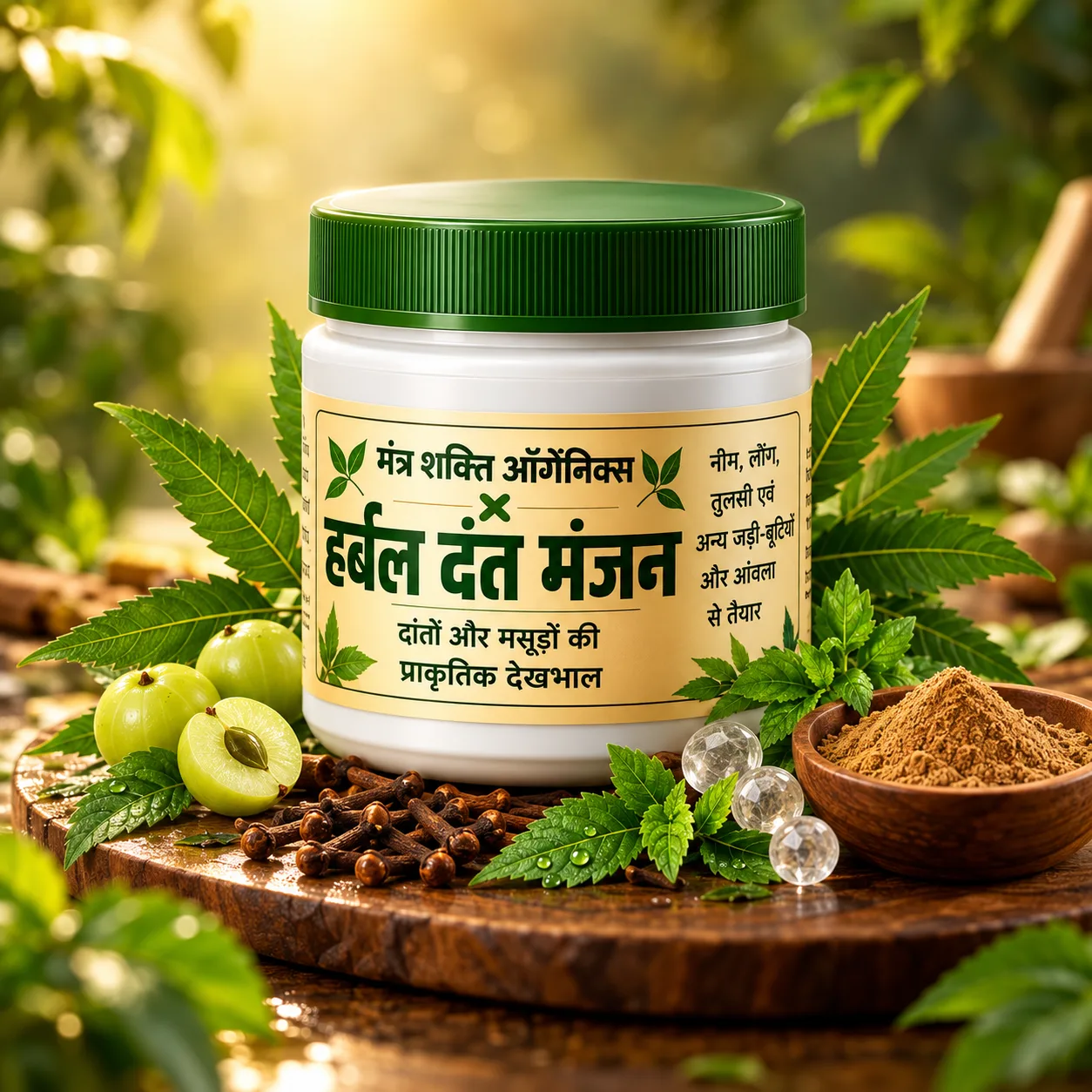
We make our Herbal Dant Manjan at our family workshop in Chinhat, Lucknow: a traditional tooth powder with Neem, Clove and Mint, in a 25 g pack for ₹105. It is a separate tradition from the datun stick, and we do not say it replaces a datun or dental care. You can read more about us in who makes MantraShakti Organic, and the whole range is in the Oral Care category.
Frequently asked questions
How do you use a neem datun to brush your teeth?
Rinse a fresh, knot-free neem twig, chew one end gently until it frays into soft bristles, and spit out the bitter juice and loose fibres. Brush one section at a time with short, light strokes, rinse your mouth, then trim the used end and rinse the stick. Do not swallow pieces of wood.
What is datun called in English?
In English a datun is a chew stick, or chewing stick, also called a teeth-cleaning twig. The word is related to the Sanskrit dantakashtha, from danta, tooth, and kashtha, a piece of wood. A neem datun is a chew stick cut from a neem tree, and the Arabic equivalent is the miswak.
How long and how thick should a datun be?
Ayurvedic reviews describe about 9 inches (12 finger-widths, roughly 23 cm) in length and the thickness of your little finger, from a fresh, soft stem without knots or leaves. A finger-width is your own, so a smaller hand gets a slightly shorter stick. Avoid anything dry, brittle or splintery.
How do you make the brush end of a datun?
Chew one end gently with your back teeth, turning the stick, until the fibres separate into soft bristles about a centimetre long. It usually takes a minute or two and tastes bitter. Spit out the juice and loose bits. If the stick is dry or very hard, use a fresher one.
How often should you cut the end or replace the stick?
Cut off the used, frayed end each time so the next session starts on fresh wood. Replace the whole stick when it dries out, turns hard or splintery, or shows mould or black spots. A fresh green twig lasts days, not weeks, so buy small bundles rather than a month's supply.
What is the difference between neem datun and miswak?
They are different trees and different traditions. Neem datun comes from Azadirachta indica and is part of Indian tradition; miswak comes from Salvadora persica, usually from the root, and is used by many populations worldwide, more often by Muslims. Both are chew sticks, and both are described here as tradition, with no claim about what either does for the mouth.
Can you use a datun together with a tooth powder?
There is no rule against it, but they are two separate traditions with different textures, and we have no research to say how they combine. Keep each gentle, avoid pressing hard, and ask your dentist how a datun or powder fits with a fluoride toothpaste if you are unsure.
Is a datun a substitute for a toothbrush and toothpaste?
No. A datun is a traditional practice, not a substitute for dental care. The American Dental Association's advice is brushing twice a day for two minutes with fluoride toothpaste, and any tooth or gum problem is a reason to see a dentist.
Sources and further reading
- Singh A, Purohit B. Tooth brushing, oil pulling and tissue regeneration: a review of holistic approaches to oral health. J Ayurveda Integr Med, 2011;2(2):64-68
- Kapse AR et al. Scientific approach towards Dincharya: a review. Journal of Ayurveda and Integrated Medical Sciences, 2023
- Aljarbou F et al. Salvadora persica biological properties and applications in different dental specialties: a narrative review. Evid Based Complement Alternat Med, 2022
- Wikipedia: Teeth-cleaning twig
- American Dental Association, MouthHealthy: Toothbrushes
Written by the MantraShakti Organic workshop team, Chinhat, Lucknow. This is a guide to a traditional practice, not dental or medical advice; please see a dentist for any tooth or gum problem.
Shop this guide
Made by hand in small batches in Lucknow.
More from the Journal