
Tooth Powder and Enamel: What Abrasivity Means and What to Check
Does dant manjan wear down tooth enamel?
Whether any dentifrice wears enamel depends on the hardness, size and shape of the abrasive particles it is made from — not on whether it comes as a powder or a paste. A coarsely ground tooth powder can be more abrasive than a toothpaste; a finely ground one need not be. The single number that captures this is called RDA, and most tooth powders sold in India, ours included, do not publish it.
If you already have gum recession, exposed dentine (the softer layer under enamel), sensitivity, pain or bleeding, talk to a dentist before switching to any dentifrice. This article explains how abrasivity works and what to check. It is general information and does not replace advice from a dentist who has looked at your teeth.
What "abrasivity" actually means: RDA
Every dentifrice has to be mildly abrasive — that is how it lifts plaque and stains that water and a brush alone leave behind. The question is never "abrasive or not", it is "how abrasive, and is that appropriate for my teeth".
Dentistry measures this with a standardised laboratory scale called Relative Dentin Abrasivity (RDA), defined under ISO standard 11609 and used by the American Dental Association (ADA). A reference abrasive is fixed at 100, and every product is scored against it. The ADA and ISO treat an RDA of 250 as the upper limit below which a dentifrice is considered acceptable for daily use over a lifetime of normal brushing.
Here are the reference points the tooth-powder category almost never gives you. Treat them as commonly published approximations — the exact figure for any single product depends on its formulation and how finely it is milled.
| Cleaning method / dentifrice | Approximate RDA | Notes |
|---|---|---|
| Brushing with water only | ~4 | Baseline; effectively negligible wear |
| Plain baking soda (sodium bicarbonate) | ~7 | One of the softest common abrasives |
| Most everyday toothpastes | ~50–150 | Wide range; the same brand's variants differ |
| Many whitening toothpastes | Often higher, can exceed 150 | Extra abrasives or chemistry for stain removal |
| ISO / ADA upper acceptable limit | 250 | Above this, considered unsuitable for daily use |
| A typical tooth powder (dant manjan) | Usually unpublished | Depends entirely on grind and ingredients |
The reassuring part, per the ADA, is that a lifetime of correct brushing with a dentifrice at or below RDA 250 produces limited wear to dentine and very little to enamel. The unreassuring part is that a dentifrice with no published RDA gives you no way to know where on this scale it sits. That is the real gap in the tooth-powder market — not "powder versus paste", but "measured versus unmeasured".
Is a tooth powder more abrasive than a toothpaste?
Not automatically. It depends on the grind. This is worth being precise about, because "powder" and "paste" describe the form, and abrasivity is about the particles inside.
An in-vitro study published in the Indian Journal of Dental Research (2016; 27(6):630–636, doi 10.4103/0970-9290.199601) tested this on Indian dentifrices directly. Researchers brushed freshly extracted human premolars in a laboratory brushing machine for the mechanical equivalent of about six months of normal use, then weighed how much tooth substance each dentifrice had removed.
The maximum tooth substance loss occurred in a group brushed with a red-coloured tooth powder. The researchers traced the difference to the abrasive particles themselves — their size, hardness and shape — not to the powder form on its own, and not to a label reading "herbal" or "natural". As a rule of materials, coarse, hard, irregular grit removes more tooth substance than fine, soft, rounded particles. That mechanism, rather than any single product result, is the thing to reason from.
A few honest caveats, because how you read evidence matters as much as citing it. This was a laboratory test on extracted teeth, not a study of people brushing over years. It examined specific commercial samples, so it cannot be read as a verdict on every tooth powder, or on any product it did not test. What it establishes well is the mechanism above.
The plain-language boundary: whether a dentifrice suits the current state of your enamel is a question for a dentist, not a blog. We are describing how abrasivity works, not diagnosing your teeth.
The fluoride question, stated plainly
Most traditional tooth powders, including ours, contain no fluoride. This is a factual point about composition, and it is a genuine trade-off rather than a feature to celebrate.
The evidence that fluoride reduces tooth decay is strong and well established. A Cochrane systematic review (Walsh and colleagues, 2019) concluded that fluoride toothpaste prevents caries in children, adolescents and adults compared with non-fluoride toothpaste, with more decay prevented at higher concentrations. The World Health Organization recommends brushing twice a day with a fluoride toothpaste in the 1000–1500 ppm range.
So a non-fluoride dentifrice does the mechanical job of cleaning, but it does not deliver fluoride's anti-caries effect. If you use a fluoride-free powder as your only dentifrice, it is worth asking your dentist how you are getting fluoride otherwise — for example from your local drinking water, which varies enormously across India, or from a separate fluoride toothpaste or rinse. This is a conversation to have with a professional, not a decision a product page should make for you.
What is in our Herbal Dant Manjan — and what we have not tested
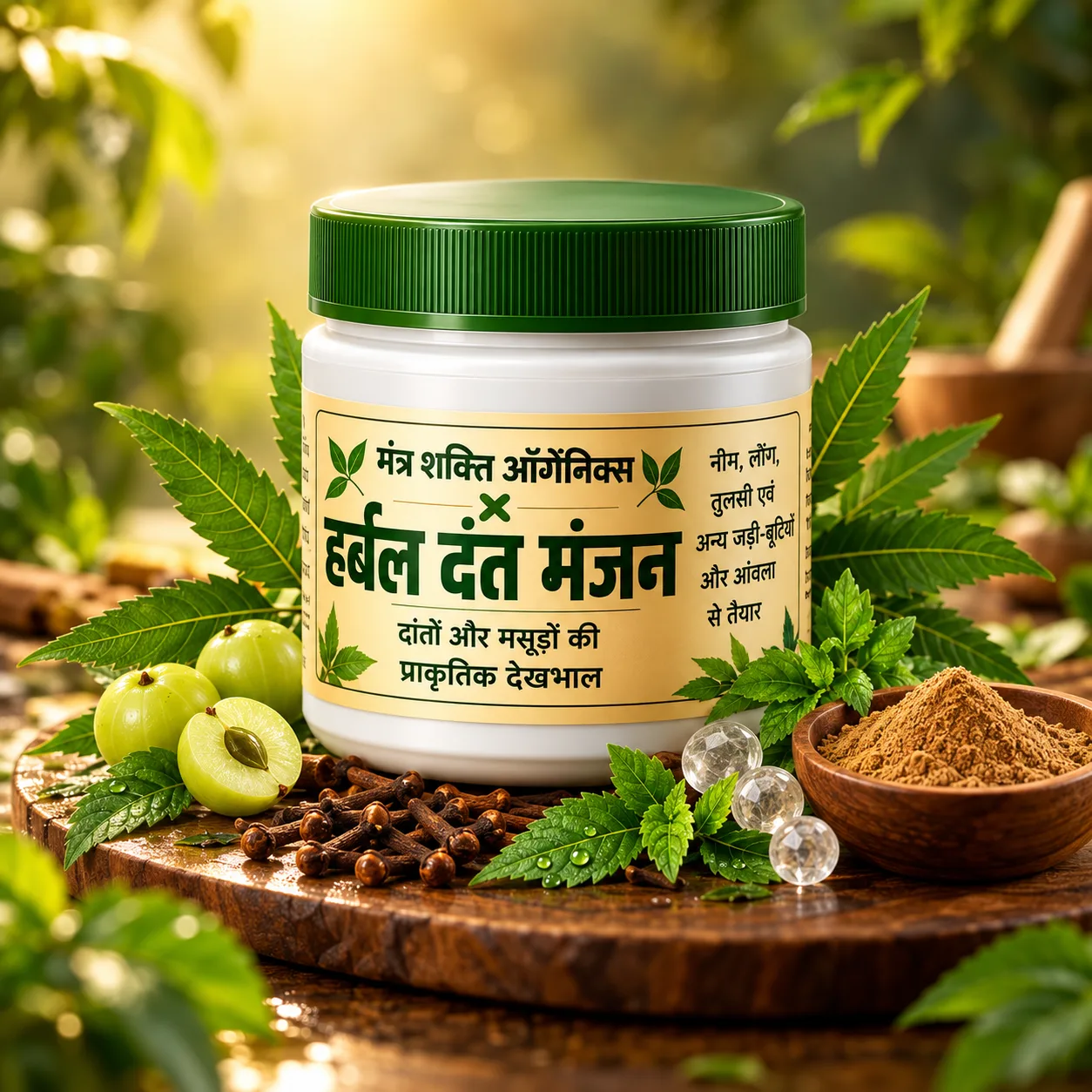
We would rather state our composition plainly than hide behind a wall of "free-from" claims. Our Herbal Dant Manjan is made from neem, clove and mint, hand-ground in small batches in our home workshop in Chinhat, Lucknow.
Now the unflattering part, which almost nobody in this category will say out loud: "herbal" does not mean "gentle". A plant-based powder can still be gritty if it is coarsely ground. Grind fineness is what governs abrasivity, and it is a manufacturing choice, not a marketing one.
We will be equally direct about our own gap: we have not yet had a laboratory RDA abrasivity test done on our dant manjan. We describe our grind because that is the honest, checkable fact we have; we do not have an RDA number, and we are not going to imply ours is the safe exception when we cannot show you the figure. When we commission that test, we will publish the result on this page, good or bad.
The one thing we would ask you to do is put the same question to every maker, us included: what is your grind, and have you measured its abrasivity? A category that answered that honestly would be a better category.
How to check any tooth powder before you switch
These steps apply to any brand, not only ours. They are ordered from most to least informative.
- Ask for the RDA figure. If a maker has tested it, they can tell you. If they have not, at least you now know that. An unmeasured "gentle" is an opinion, not data.
- Ask how fine the grind is. Mesh or sieve size, or particle size in microns, is the property that most affects wear. A specific answer is a good sign; a vague one is a flag.
- Rub a pinch between your fingers. This is crude, not a lab test, but a powder that feels noticeably gritty rather than fine is telling you something about its particles.
- Read the full ingredient list and look up anything you do not recognise. Coloured powders in particular owe their colour to something — find out what.
- Match it to your own mouth. If you have sensitivity, receding gums or exposed roots, take the powder and its ingredient list to your dentist and ask before you switch.
Who should be careful, and where technique comes in
Abrasivity interacts with how you brush. Even a low-RDA dentifrice can wear teeth if you scrub hard with a stiff brush, and much of the enamel and dentine loss attributed to "abrasive toothpaste" is really abrasion driven by heavy pressure and a horizontal sawing motion. A soft-bristled brush, light pressure and gentle, angled strokes matter at least as much as the number on the tube.
Be especially cautious, and get professional advice first, if you have gum recession, exposed root surfaces (dentine is far softer than enamel), tooth sensitivity, active gum bleeding, or any pain. None of those is a situation in which a dentifrice choice should be made blind. For a first-hand account of what changing dentifrice actually feels like day to day, see our companion piece on switching from toothpaste to tooth powder.
Frequently asked questions
What is RDA and why is it the number to ask about?
RDA stands for Relative Dentin Abrasivity, a laboratory measure of how much a dentifrice wears tooth substance, scored against a reference abrasive set at 100. It matters because it turns a vague word like "gentle" into a figure you can compare. The ISO and ADA treat 250 as the upper acceptable limit for daily use.
Is a tooth powder more abrasive than a toothpaste?
Not necessarily. Abrasivity comes from the size, hardness and shape of the particles inside a dentifrice, not from whether it is a powder or a paste. A coarsely ground powder can be more abrasive than toothpaste, while a finely ground one may sit in the same range. The form alone does not tell you.
What should I check before switching to any tooth powder?
Ask the maker for the RDA figure and how fine the grind is, rub a pinch between your fingers to feel for grit, read the full ingredient list, and if you have any gum or sensitivity issues, show the product to your dentist first. A specific answer about grind and testing is a good sign.
Does this powder contain fluoride?
No. Our Herbal Dant Manjan contains neem, clove and mint and no fluoride. This is a real trade-off, because fluoride has strong evidence for preventing tooth decay. If a fluoride-free powder is your only dentifrice, ask your dentist how you are getting fluoride from other sources, such as your drinking water.
Who should talk to a dentist before switching?
Anyone with gum recession, exposed root surfaces or dentine, tooth sensitivity, gum bleeding, or any dental pain should get professional advice before changing dentifrice. So should parents choosing products for young children. A dentist can look at the actual condition of your enamel and gums, which no product description or article can do.
How does brushing technique affect enamel wear?
A lot. Hard scrubbing with a stiff brush and a horizontal sawing motion can wear teeth even with a low-abrasivity dentifrice. A soft-bristled brush, light pressure and gentle angled strokes reduce wear regardless of what you brush with. Technique often matters as much as the abrasivity number itself.
Written by the MantraShakti Organic workshop team, Chinhat, Lucknow. This article is general information about dentifrice abrasivity and is not a diagnosis or a substitute for advice from your own dentist. Explore our oral care range, or read about who makes MantraShakti Organic.
Shop this guide
Made by hand in small batches in Lucknow.
More from the Journal